

Your supplier says the goods qualify for a trade agreement, and your customs broker asks for proof. Which of the UAE CEPA agreements applies, and does it really cut your duty? Many importers only find out after the cargo has landed.
This guide lists the UAE CEPA agreements by status, shows which partners to check first, and explains how a certificate of origin turns a signed treaty into a lower duty bill. Figures are dated, because the number of agreements keeps changing.
It is written for UAE importers and B2B buyers. It is general information: always confirm the rate, the origin rule and the paperwork for your own product with Dubai Customs or your clearing agent.
In this article
What UAE CEPA agreements are
CEPA stands for Comprehensive Economic Partnership Agreement. It is a bilateral trade deal between the UAE and one partner country. The UAE launched its CEPA programme in September 2021, according to the Emirates News Agency (WAM).
Each agreement covers trade in goods, and usually services and investment too. For an importer, the goods chapter matters most. It sets lower or zero duty on products that originate in the partner country.
Importers care because duty is a direct cost. On a large order, even a small percentage cut changes the landed cost and the price you can offer your own customers. That is why the UAE CEPA agreements are worth a place in your sourcing checklist.
Two points are easy to miss. First, every agreement has its own tariff schedule and its own rules of origin. Second, the preference is not automatic. You claim it with proof.
How many UAE CEPA agreements are there
The total changes every few months, so treat any number as a snapshot. The WAM report of 30 June 2026 states that the UAE had concluded 37 CEPAs, 17 of them in force. That report announced the Ukraine agreement, which took effect on 1 July 2026.
Talks continue. WAM reported on 8 October 2026 that the UAE and Thailand had concluded CEPA negotiations. The agreement still has to be signed, ratified and brought into force, so it gives importers no preference yet.
This is the key distinction for buyers:
- Concluded or signed: the text is agreed. Do not claim a preference yet.
- In force: the tariff cuts apply from the entry-into-force date. This is the only status that lowers your duty.
- Under negotiation: nothing applies. Watch the news, but do not price orders on it.
Dated 26 October 2026. Check the latest WAM announcements before you quote a figure to a customer.
UAE CEPA partners in force
The table shows UAE CEPA agreements whose entry into force was reported by WAM or another published source. It is a selection, not the full list: other agreements, such as Serbia, are also in force.
| Partner | Entered into force |
|---|---|
| India | May 2022 |
| Israel | 1 April 2023 |
| Türkiye | 1 September 2023 |
| Indonesia | September 2023 |
| Cambodia | 31 January 2024 |
| Georgia | 26 June 2024 |
| Costa Rica | 2 April 2025 |
| Mauritius | 2 April 2025 |
| Jordan | May 2025 |
| Malaysia | 1 October 2025 |
| Australia | 1 October 2025 |
| Azerbaijan | April 2026 |
| Ukraine | 1 July 2026 |
Check the official list of the UAE Ministry of Foreign Trade for the complete and current status, and the text of each agreement for its tariff schedule.
Which CEPA partners matter to importers
There is no single best partner among the UAE CEPA agreements. The agreements that matter are the ones that match what you actually buy and where you buy it. Use four questions to rank them, in this order.
1. Where do your suppliers sit?
List your suppliers by country of origin. If you buy from India, Türkiye, Indonesia, Malaysia or Australia, those agreements are in force and deserve a check first.
2. Is the agreement in force for your shipment date?
The goods must ship and clear after the entry-into-force date. A signed treaty is not enough.
3. Does your product pay duty today?
Most general goods pay 5% of CIF value, as the Dubai Customs FAQ explains. A preference only helps where there is duty to remove. Our UAE import duty guide shows how the calculation works.
4. Can the supplier prove origin?
A partner country is not the same as a qualifying product. The goods must meet the rule of origin for their tariff line. Many suppliers have never issued a preferential certificate, so ask early.
For a worked example of the first partner, read our India UAE CEPA guide. If you are comparing several countries for one product, our import and export coordination service can help line up suppliers, documents and customs steps.
How much a CEPA can save on duty
For a standard product, the ceiling is the normal duty rate. At 5% of CIF value, an order with a CIF value of AED 100,000 would carry AED 5,000 of customs duty. A full preference would bring that to zero. This is an illustration, not a quote.
Three limits apply:
- Not every tariff line is zero. Some goods get a phased cut or no cut. Check the schedule for your HS code.
- VAT still applies. A CEPA reduces customs duty. It does not remove import VAT.
- Savings must cover the effort. On small orders, the cost of obtaining origin proof can outweigh the duty saved.
To show the scale of a typical deal, the WAM report on Ukraine says 97 percent of Ukrainian exports to the UAE are exempt from customs duties with immediate effect. The share differs for every partner.
Rules of origin and the certificate
The rules of origin decide whether a product counts as coming from the partner country. Under the UAE CEPA agreements they differ by product and by agreement. Some goods qualify because they were wholly obtained there. Others qualify after enough processing or value added.
The proof is a preferential certificate of origin. It is not the same as an ordinary certificate. Our certificate of origin guide explains the difference, and the types you may be asked for.
- Issuer: the body named by the agreement, usually in the exporting country.
- Shipping: most agreements expect direct shipment, or documented transit.
- Documents: invoice, packing list, transport document and the certificate must tell the same story.
- Validity: each agreement sets its own period and form. Confirm both before shipping.
Ask the supplier to show how the product meets the rule before you pay a deposit. A missing certificate is hard to fix once the goods are at the port.
5 steps to claim a CEPA preference
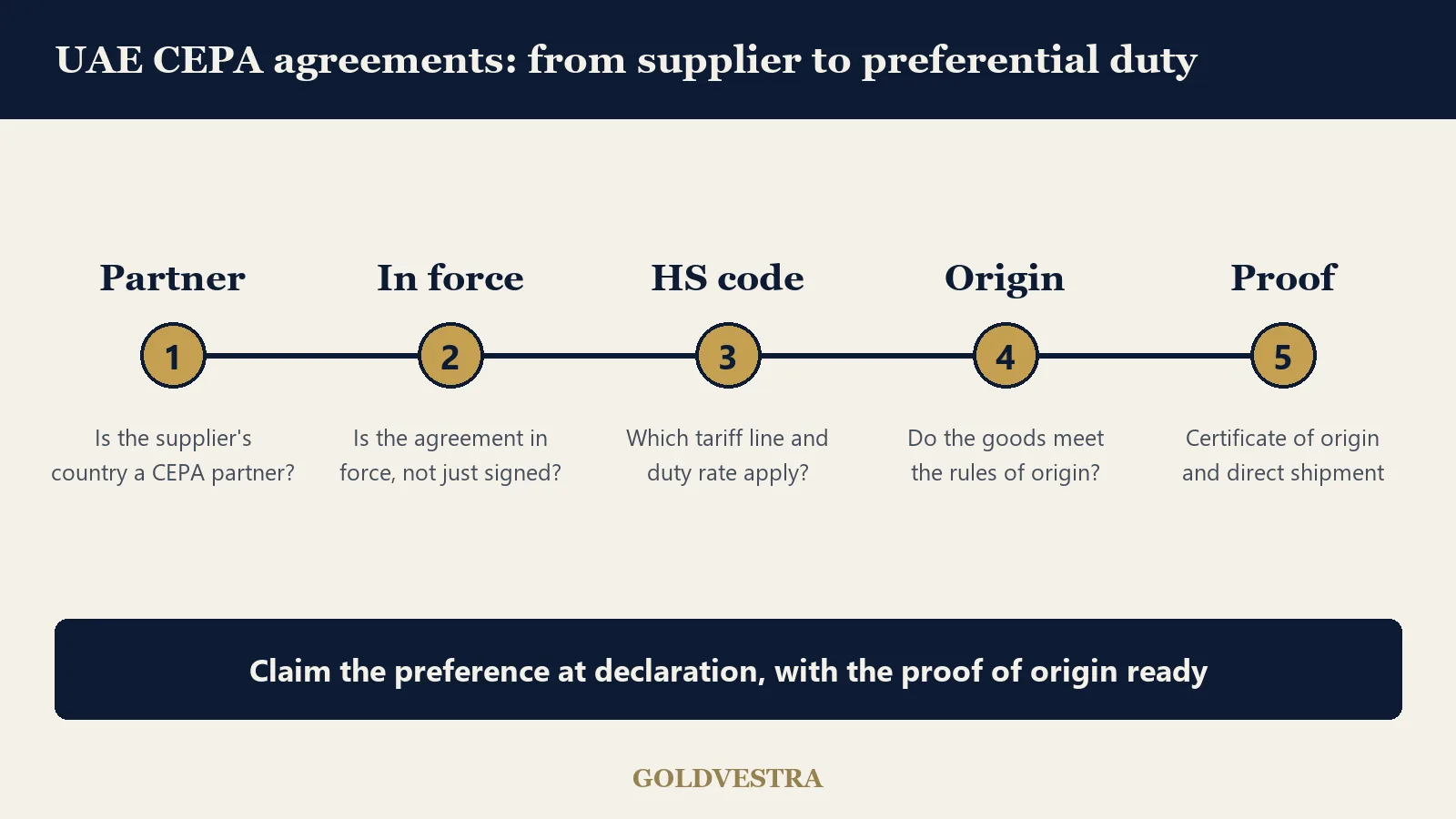
- Check the partner. Confirm the country of origin of the goods, not only the country you ship from.
- Confirm the status. The agreement must be in force on the shipment date.
- Find the HS code and rate. Read the tariff schedule for that line and compare it with the standard rate.
- Test the origin rule. Ask the supplier for the basis on which the product qualifies.
- Get the proof and declare it. Hold the certificate, keep documents consistent and give them to your clearing agent for the customs declaration.
If you would rather not manage this alone, you can request a quote and tell us the product, origin country and quantity. We will help you map the documents before the goods ship.
Common mistakes
- Assuming a signed agreement is already in force.
- Treating the country of shipment as the country of origin.
- Applying for the certificate after the goods have sailed.
- Using one agreement’s rules for a different partner.
- Ignoring tariff lines where the UAE CEPA agreements give only a partial cut.
- Forgetting that import VAT is separate from customs duty.
- Quoting a customer a duty saving before the HS code is confirmed.
Each of these can be avoided with a short check before the purchase order, not after the shipment. Build that check into your buying routine for every new supplier under the UAE CEPA agreements, and keep the answers in the order file.
Frequently asked questions
What are UAE CEPA agreements?
UAE CEPA agreements are bilateral Comprehensive Economic Partnership Agreements between the UAE and partner countries. They reduce or remove tariffs on qualifying goods and cover services and investment. For importers, the benefit is lower customs duty on products that meet the rules of origin and carry proof.
How many CEPAs has the UAE signed?
A WAM report of 30 June 2026 stated that the UAE had concluded 37 CEPAs, 17 of them in force. Ukraine’s took effect on 1 July 2026, and Thailand concluded negotiations on 8 October 2026. The number changes often, so check the latest official announcement.
Do UAE CEPA agreements remove import duty automatically?
No. You must show that the goods originate in the partner country and meet the rule for their tariff line, normally with a preferential certificate of origin. Without proof, customs applies the standard rate. VAT is separate and still applies to the imported goods.
Which UAE CEPA partners matter most to importers?
The ones that match your supplier countries and products. Start with UAE CEPA agreements that are in force with the countries you buy from, then check whether your product pays duty and can meet the origin rule. A partner that is signed but not in force gives no preference.
What is a CEPA certificate of origin?
It is a preferential proof of origin issued under a specific agreement, usually by a body designated in the exporting country. It states that the goods qualify under that agreement’s rules. Its form, issuer and validity vary, so confirm them for each partner before shipment.
How do I check if my product gets a CEPA preference?
Find the HS code, then read the tariff schedule of the agreement for that line. Compare the preferential rate with the standard rate, usually 5% of CIF value, and check the rule of origin. Your customs broker or Dubai Customs can confirm the result.
Related reading
India UAE CEPA
How importers claim tariff preference.
Certificate of Origin in the UAE
Types, issuers and how it is used.
UAE Import Duty Guide
How duty is calculated on declared value.
Importing under a UAE CEPA?
Send us your product, origin country and quantity. We will help you check the documents and customs steps before the goods ship.