You have a supplier quote, a shipping estimate and a target selling price. Then the clearing agent sends a duty figure that does not match your spreadsheet. Most of the time the gap comes from the customs value, not the rate.
UAE import duty is a percentage of the CIF value of your goods, and the percentage depends on the HS code. This guide shows how the two fit together, walks through a numbers example, and lists the mistakes that change a landed cost. It is general information, not customs or tax advice.
In this article
- The short answer: what UAE import duty is
- UAE customs duty rates
- CIF value: the base of the calculation
- Why the HS code drives the rate
- Worked example: import duty calculator UAE style
- What sits outside the duty calculation
- 7 common mistakes importers make
- Checklist before you ship
- Frequently asked questions
The short answer: what UAE import duty is
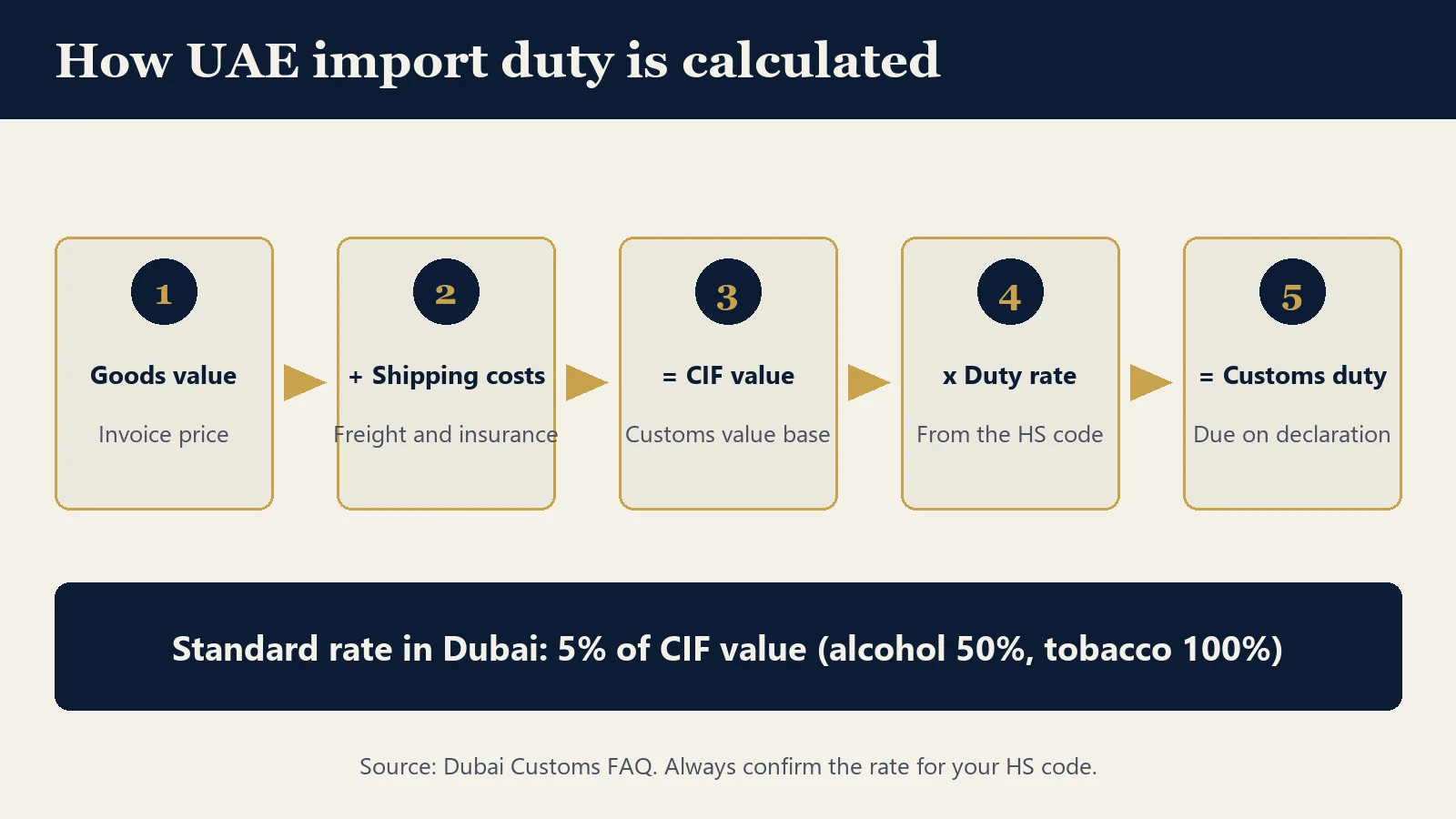
Customs duty is a tax charged when goods enter the country. In Dubai, the Dubai Customs FAQ gives the standard rate as 5% of the CIF value, with higher rates for alcohol (50%) and cigarettes (100%).
Three inputs decide the amount:
- The CIF value of the shipment: goods, freight and insurance.
- The HS code that classifies the product.
- The duty rate attached to that code, plus any exemption that applies.
That is the whole formula: CIF value × duty rate. The rest of this guide is about getting each input right.
UAE customs duty rates
The UAE follows the GCC common external tariff, so the same system applies at the main entry points. According to the official UAE government portal, government tariffs in the UAE range from 0 to 5 per cent, and Dubai applies 5% of CIF value except for alcohol and cigarettes.
In practice, that gives you three groups of UAE customs duty rates:
| Group | Typical treatment | What to do |
|---|---|---|
| Most general goods | 5% of CIF value (Dubai Customs) | Use 5% as your planning figure, then confirm by HS code. |
| Alcohol and cigarettes | 50% and 100% (Dubai Customs) | Check licences and restrictions as well as the rate. |
| Goods with a lower or zero rate, or an exemption | Set by the tariff line or a specific rule | Ask your broker to confirm the line and any document you must show. |
Rates and exemptions can change. Treat any figure in a blog, including this one, as a starting point and check the current tariff with Dubai Customs or your clearing agent.
CIF value: the base of the calculation
CIF stands for cost, insurance and freight. For customs, the value of your shipment is the price you pay for the goods plus the cost of transport and insurance up to the point of entry.
This is where many importers lose accuracy. A supplier invoice usually shows the goods value only. Freight and insurance sit on other documents. If the invoice is on an FOB or EXW basis, you have to add the shipping cost before you calculate UAE import duty.
Your Incoterms decide which costs are already in the price. Under CIF or CFR terms the supplier arranges the main carriage, so freight is part of the invoice. Under FOB or EXW terms it is not.
- Goods value: the price on the commercial invoice.
- Freight: sea, air or road cost to the UAE entry point.
- Insurance: cargo cover for the same leg.
- Currency: values are converted to dirhams for the declaration. Ask your agent which exchange rate applies.
Keep the invoice, the freight invoice and the insurance certificate together. They support the value you declare.
Why the HS code drives the rate
The Harmonized System is a global classification for traded goods, developed by the World Customs Organization. The UAE portal explains that the HS code has six digits, and that national or GCC extensions can add more.
The tariff line behind your code decides the duty rate. Two products that look similar can sit under different lines. One wrong digit can change the rate, trigger a query or delay clearance.
Read our guide to HS code classification for a step-by-step method. In short:
- Describe the product by material, use and composition, not by marketing name.
- Ask the supplier which code they use, then verify it yourself.
- Keep the same code on the invoice, packing list and declaration.
- Ask your broker to confirm doubtful lines before you ship.
Worked example: import duty calculator UAE style
Here is a simple import duty calculator UAE importers can copy into a spreadsheet. The numbers are illustrative only. They are not a customs quote, and the exchange rate on a real declaration may differ.
Assumptions: goods bought FOB for USD 20,000, freight USD 1,500, insurance USD 100, a 5% duty rate, and the AED 3.6725 per USD peg for conversion.
| Step | Calculation | Result |
|---|---|---|
| Goods value (FOB) | USD 20,000 | USD 20,000 |
| Freight + insurance | USD 1,500 + USD 100 | USD 1,600 |
| CIF value | USD 20,000 + USD 1,600 | USD 21,600 |
| CIF value in AED | USD 21,600 × 3.6725 | AED 79,326.00 |
| Customs duty at 5% | AED 79,326.00 × 5% | AED 3,966.30 |
| VAT base (separate tax) | AED 79,326.00 + AED 3,966.30 | AED 83,292.30 |
| VAT at 5% | AED 83,292.30 × 5% | AED 4,164.62 |
Now see what happens if the duty is calculated on the FOB value only. USD 20,000 × 3.6725 is AED 73,450. Five per cent of that is AED 3,672.50. The duty is understated by AED 293.80 on one small shipment. On larger orders, the gap grows with the order.
The VAT lines are shown so you can see the full cost picture. Confirm the VAT treatment for your own registration with the Federal Tax Authority or an adviser.
What sits outside the duty calculation
Customs duty is only one line of your landed cost. Other charges are separate and vary by shipment, port and provider:
- Import VAT, generally calculated on the CIF value plus duty.
- Terminal, handling and delivery order charges.
- Customs clearing agent fees and inspection or storage charges.
- Inland transport to your warehouse.
Our guide to import cost factors shows how these items add up. If you plan to buy through a free zone, read free zone vs mainland first, because duty usually becomes payable when goods move to the mainland.
If your supplier is inside the country, see importing from the UAE for the route and the documents that apply.
7 common mistakes importers make
- Using the FOB price as the customs value. Add freight and insurance.
- Trusting the supplier HS code without checking it. The importer is responsible for the declaration.
- Forgetting insurance. It is part of CIF, even when it is a small amount.
- Mixing currencies. Convert every cost to the same currency before you add them.
- Assuming a free zone means duty-free forever. Duty can arise when goods enter the mainland.
- Using one rate for a whole mixed shipment. Each product line may have its own code and rate.
- Leaving documents incomplete. Invoice, packing list and freight documents should agree on value, quantity and description.
Checklist before you ship
Run through this list before you confirm a purchase order:
- Confirm the HS code for every product line.
- Check the duty rate and any exemption with Dubai Customs or your broker.
- Write the Incoterm into the contract and note who pays freight and insurance.
- Build a landed cost sheet with CIF value, duty, VAT and local charges.
- Make sure the invoice, packing list and bill of lading agree.
- Keep copies of every document for your records.
A trade documentation service can help you prepare the documents that support the declared value and the classification.
Frequently asked questions
How much is UAE import duty?
Dubai Customs states that duty is 5% of the CIF value for most goods. Alcohol is charged at 50% and cigarettes at 100%. The UAE government portal notes that tariffs generally range from 0 to 5 per cent, so check the rate for your HS code.
What is CIF value in customs?
CIF means cost, insurance and freight. The customs value is the price of the goods plus the cost of insurance and freight to the point of entry. It is the base on which UAE import duty is calculated, not the ex-works or FOB price alone.
How do I calculate import duty in the UAE?
Add the goods value, freight and insurance to get the CIF value. Convert it to dirhams. Multiply it by the duty rate for your HS code, usually 5%. The result is the customs duty. VAT and other fees are charged separately.
Do I pay UAE import duty on goods in a free zone?
Duty is generally not charged while goods stay inside a free zone. It becomes payable when goods move to the mainland. Rules differ by free zone and activity, so confirm with the free zone authority and your clearing agent before you ship.
Is VAT included in the customs duty?
No. VAT is a separate tax. Import VAT is generally calculated on the CIF value plus the customs duty. Treat the two as separate lines in your landed cost and confirm your VAT position with the Federal Tax Authority or an adviser.
Does the HS code change the duty rate?
Yes. The HS code decides which tariff line applies, and the tariff line decides the rate. A wrong code can mean the wrong duty, delays or penalties. Confirm the classification before shipment, using the tariff and your customs broker.
Where can I check the official duty rate?
Start with Dubai Customs and the UAE government portal. For a specific product, ask your customs clearing agent to confirm the tariff line and rate for your HS code before you finalise the price with the supplier.
Related pages and articles
Import Cost Factors
Every cost that builds up your landed price.
HS Code Classification
How to classify your product before you ship.
Import from UAE
Routes and documents for sourcing from the UAE.
Trade Documentation
Documents that support the customs declaration.
Need a clear landed cost before you order?
Send us the product, quantity and destination. We will review the commercial terms and follow with a proposal.