

You found a supplier with the right product. Then the quote arrives with a line that stops the deal: the supplier will only sell in large batches, far above what you planned to buy.
That line is the minimum order quantity (MOQ). This guide explains what it means, why suppliers set it and how a first-time B2B buyer can negotiate it without promising volume they cannot deliver. It is general guidance, not a guarantee that any supplier will agree.
In this article
Minimum order quantity meaning
The minimum order quantity is the smallest amount a supplier is willing to sell in one order. It can be counted in units, cartons, pallets, metres or even a total order value.
You will see it written as MOQ in quotes, catalogues and supplier chats. Some suppliers apply it per product, others per colour or size, and others to the whole order. Always ask which one it is.
An MOQ is also not the same as a price break. A supplier may sell above the MOQ at one price and quote a lower unit price at higher volumes. Keep the two numbers apart when you compare offers.
Why suppliers set an MOQ
Suppliers do not set an MOQ to make life hard for buyers. It protects their costs. Understanding the reason helps you find what is negotiable.
- Production set-up. Starting a run takes time, labour and machine changeovers. Tiny orders do not cover that effort.
- Raw materials. Materials are often bought in fixed lots, so a small order can leave the supplier with unused stock.
- Packaging and handling. Cartons, labels and export paperwork cost about the same for a small order as for a large one.
- Risk. A custom product cannot easily be sold to someone else if the buyer walks away.
This is why the answer often depends on who you buy from. A factory and a reseller treat the MOQ differently, so see our guide on choosing a trading company or a manufacturer.
What to do before you negotiate
Negotiation starts before the first message. A supplier takes a buyer with a clear request more seriously than one who only asks for a lower MOQ.
- Fix your specification. Know the size, material, finish, packaging and any standards the product must meet.
- Estimate real demand. Work out how much you can sell or use over a sensible period, not only in the first order.
- Set your limits. Decide the largest order and total budget you can accept, plus the storage you have.
- Send a structured request. A clear brief gets comparable answers. Our guide shows how to write an RFQ so suppliers quote the same thing.
A written plan also helps. Good procurement planning tells you how much stock you need and when, which is exactly what a supplier asks about when you raise the MOQ.
7 ways to negotiate MOQ
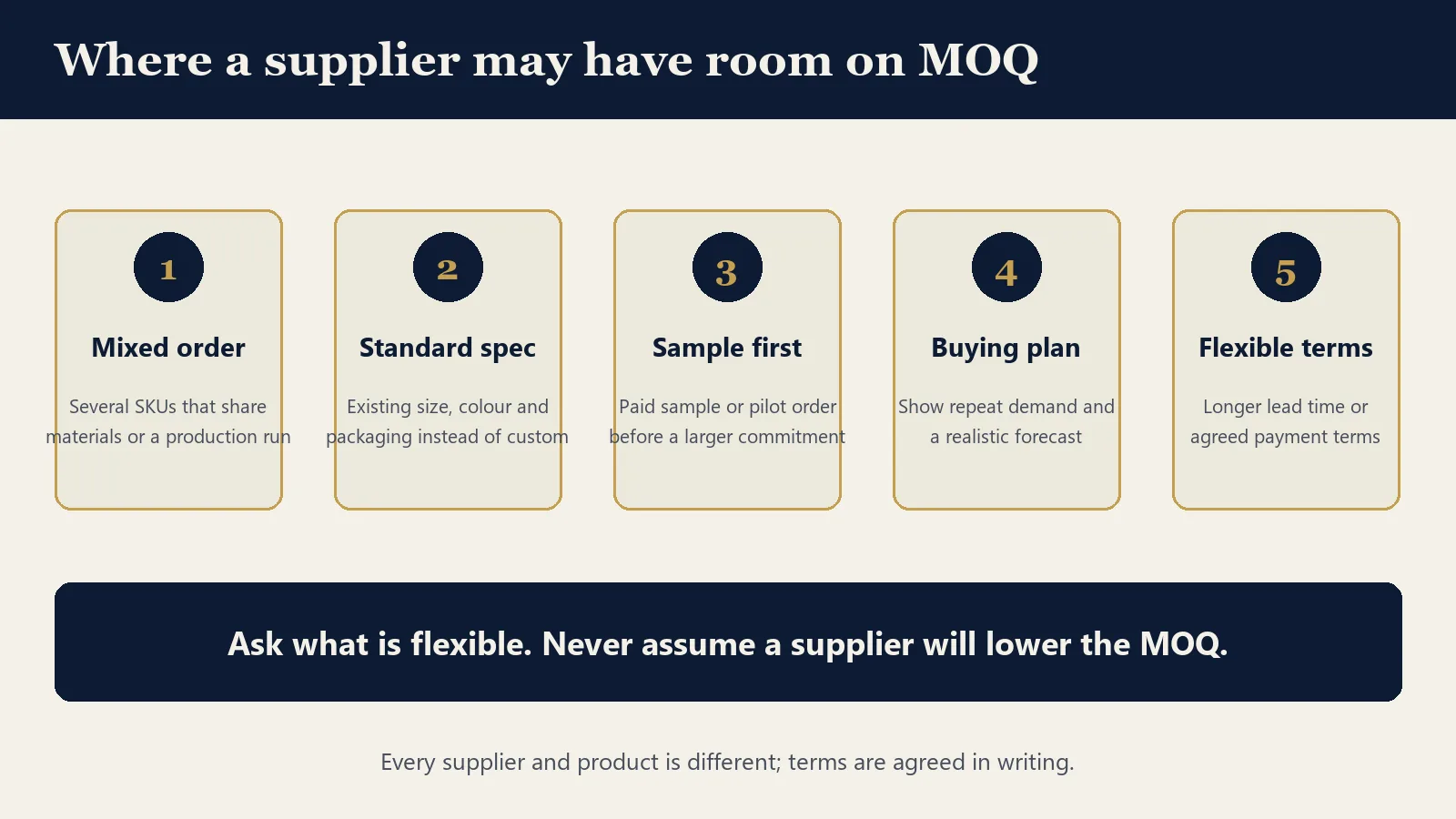
There is no formula that works on every supplier. These are the levers buyers commonly use. Treat each as a question to ask, not a demand.
1. Combine products in a mixed order
If a supplier has an MOQ per item, ask whether the minimum can be met across several items. This works best when the products share materials or a production run.
2. Choose standard specifications
Custom sizes, colours and packaging usually push the MOQ up. Standard stock items often have more room. Ask which options are standard and which are made to order.
3. Start with a sample or pilot order
A paid sample or small trial lets both sides test quality and communication. It is a way to build trust, and some suppliers then discuss a first order below the stated MOQ. Do not expect it.
4. Share a realistic buying plan
Suppliers like repeat business. If you can show a believable schedule of future orders, say so. Only share numbers you can stand behind, because a plan you do not meet can end the relationship.
5. Offer flexibility on timing
A supplier may accept a smaller batch if it can be produced when the line has spare capacity. A longer lead time can be worth more to a factory than a faster one.
6. Discuss price and terms openly
A lower MOQ may come with a higher unit price. Ask for both quotes and compare the total cost. Delivery terms matter here, so check the ICC Incoterms rules and agree the methods of payment before you commit.
7. Ask who else can supply the item
If a factory will not lower its MOQ, ask whether it sells through a distributor or trading partner that holds stock. A reseller may carry a smaller pack at a higher price.
Finding low MOQ suppliers
Sometimes the better move is to look for a supplier whose normal MOQ already fits your first order. Low MOQ suppliers exist, but the low number should not be the only thing you check.
- Ask for the MOQ in your first message so you do not waste time.
- Compare at least three quotes for the same specification.
- Check what the low MOQ includes: standard stock only, or custom work too.
- Verify the company before paying anything. See our notes on vetting international suppliers.
- Ask about quality control for small orders, because small batches can get less attention.
If you do not have a shortlist yet, a sourcing partner can approach several suppliers for you. Our international procurement service covers supplier search, quotations and coordination for first orders.
Risks of pushing MOQ too hard
A lower MOQ is not always a better deal. Watch for these trade-offs.
- Higher unit cost. The saving on stock can be lost in the price per piece.
- Lower priority. Small orders may be produced after larger ones.
- Quality drift. Rushed or mixed small batches can vary more.
- Broken promises. Agreeing a low MOQ against a forecast you cannot meet damages trust.
- Weaker checks. Do not skip inspection because the order is small. See pre-shipment inspection.
MOQ negotiation checklist
- I know the exact specification, packaging and certifications needed.
- I know my realistic first-order quantity and my maximum budget.
- I asked whether the MOQ is per item, per colour or per order.
- I compared the unit price at the MOQ and at higher volumes.
- I asked about mixed orders and standard options.
- I asked about samples before the main order.
- I compared at least three suppliers on the same request.
- Delivery terms, payment terms and lead time are agreed in writing.
- I did not promise future volume I cannot deliver.
Use the list at the quote stage and again before you pay. Anything you cannot tick is a question for the supplier.
Frequently asked questions
What is minimum order quantity (MOQ)?
The minimum order quantity (MOQ) is the smallest amount a supplier will sell in a single order. It can be set in units, cartons, weight or order value. Suppliers use it to cover production set-up, materials, packaging and handling costs, and it is usually stated in the quotation.
Is MOQ negotiable?
Sometimes. Many suppliers have some room, especially on standard products, mixed orders or repeat business, but there is no guarantee. Ask politely, explain your plan and be ready for a higher unit price in return. Some suppliers will not move at all.
How do I negotiate a lower MOQ with a supplier?
Send a clear specification, ask whether a mixed order or standard options can meet the minimum, and offer a sample or pilot order first. Share a realistic buying plan, accept flexible lead times and compare total cost, not only the quantity.
What is a MOQ for a first order?
A first-order MOQ is the minimum a supplier will accept from a new buyer. It is often the same as the standard MOQ, though some suppliers allow a smaller trial order at a higher unit price. Confirm it in writing before you pay a deposit.
Where can I find low MOQ suppliers?
Ask for the MOQ in your first message, shortlist suppliers that stock standard items and compare at least three quotes. Distributors and trading companies may sell smaller quantities than factories. Always verify the company before paying anything.
Does a lower MOQ mean a higher price?
Often, yes. A smaller batch spreads set-up and handling costs over fewer units, so the price per piece can be higher. Ask for quotes at the MOQ and at larger volumes, then compare the total cost including freight, duties and storage.
Related reading
How to Write an RFQ
Get comparable quotes from suppliers.
Procurement Planning
Plan quantities and timing.
Trading Company vs Manufacturer
Who you buy from changes the MOQ.
International Procurement
Supplier search and coordination.
Need a supplier for your first order?
Send us the product, target quantity and destination. We will review the request and follow with a proposal.


