

A pre-shipment inspection is the last chance to check what you are buying before it is on a ship. Once the goods leave the factory, every problem becomes slower and more expensive to fix, and your leverage with the supplier shrinks.
This guide explains when buyers order an inspection, what an inspector actually checks, how AQL sampling works and how to write the result into your purchase terms. It is the step that follows vetting your suppliers.
In this guide
What is pre-shipment inspection?
Pre-shipment inspection is an independent check of finished goods at the supplier’s premises, carried out before shipping. The inspector works from your purchase order, specification and approved sample. The output is a written report, usually with photos and a pass or fail result.
Most buyers hire a third-party inspection company or an independent inspector, because the supplier should not mark its own work. The inspector has no stake in the sale, which is the point.
Do not confuse this with the government programmes covered by the WTO Agreement on Preshipment Inspection. That agreement governs inspection that importing governments require, for example for customs purposes. The commercial inspection in this guide is something you choose to order, and you decide the scope.
When pre-shipment inspection is worth ordering
You do not need an inspection for every order. Weigh the cost of the check against the cost of receiving the wrong goods. An inspection is usually worth it when:
- the supplier is new to you, or you are placing a first order;
- the order value is high, or the product is hard to resell or return;
- the product must meet safety, labelling or regulatory requirements in your market;
- quality has been inconsistent on earlier shipments;
- you cannot visit the factory yourself.
For small repeat orders from a proven supplier, a lighter check may be enough. The deciding factor is risk, not habit. The global sourcing process places inspection after supplier selection and before shipment for exactly this reason.
What inspectors check in a pre-shipment inspection
Scope depends on your product, but a standard inspection covers four areas. Put them in writing so the inspector checks what matters to you.
Quantity, packing and marking
The inspector counts cartons, confirms that quantities match the order and checks packing against your instructions. Shipping marks, barcodes and labels are verified. Carton drop tests may be added for fragile goods.
Appearance and workmanship
Units are compared with the approved sample and your specification. Typical findings include scratches, stains, wrong colours, loose stitching and poor finishing.
Function, measurement and on-site tests
The inspector measures dimensions and weight and runs simple functional tests. For electrical or other regulated products, ask which tests can be done on site and which need a laboratory.
Documents and compliance marks
Required markings, certificates and test reports are checked for presence and consistency. An inspector can confirm a mark is on the product. Only the issuing body can confirm that a certificate is genuine.
How AQL sampling works
Inspectors rarely open every carton. They draw a random sample from the lot, inspect it and compare the defects found with an AQL (Acceptable Quality Limit). Sampling plans commonly follow the ISO 2859-1 standard, which sets sample size by lot size and inspection level.
Defects are normally split into three classes:
- Critical: unsafe or illegal for the user. Most buyers allow none.
- Major: likely to make the product unusable or unsellable.
- Minor: a departure from the specification that most buyers would still accept.
Many buyers use 0 for critical, 2.5 for major and 4.0 for minor defects. That is a common convention, not a rule. Set the limits that suit your product and market, and write them into the order.
If the number of defects in the sample is at or below the accept number, the lot passes. If it is above, the lot fails. A pass does not mean the whole lot is perfect. It means the lot is acceptable at the agreed risk level.
Factory audit and other inspection stages
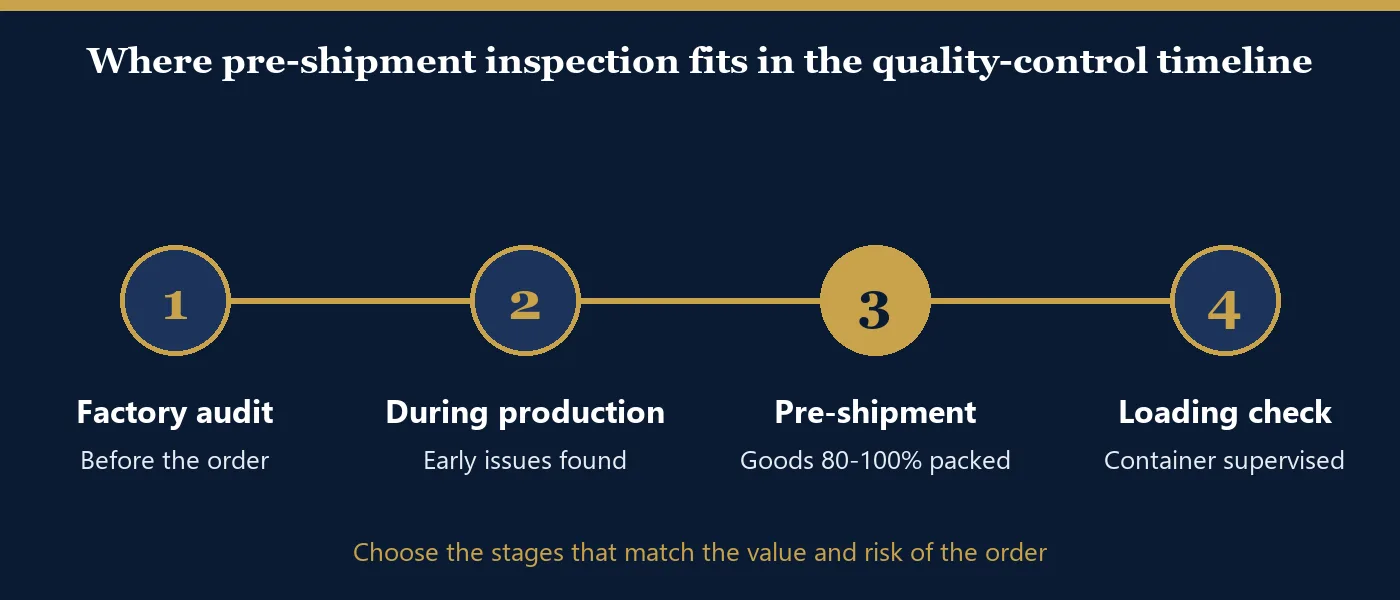
Quality control before shipping is a chain of checks, not a single event.
- Factory audit: reviews the supplier’s facilities, processes and management before you place an order. It tells you about the supplier, not about your batch.
- During production inspection: done when roughly 20-50% of the goods are finished. Problems found here can still be corrected in time.
- Pre-shipment inspection: done when the goods are finished and mostly packed. It decides whether the shipment is released.
- Loading supervision: an inspector watches the container being loaded, to check the right goods, quantity and condition go in.
The audit belongs to supplier selection. See supplier identification for how suppliers are found and compared. Inspection belongs to order execution.
The 7 steps of a pre-shipment inspection
- Write the specification. Include dimensions, materials, colours, packing, labels and the approved sample.
- Choose the inspection company. Check that it can inspect your product type in the supplier’s region.
- Set the AQL and the checklist. Define defect classes, sample plan and on-site tests.
- Book the date. Aim for when production is complete and at least 80% is packed, so the sample is representative.
- Notify the supplier. Share the checklist and the inspection date. Make clear that the result affects payment and shipment.
- Review the report. Read the findings and photos, not only the pass or fail line. Ask for clarification where the report is vague.
- Decide and document. Accept, require rework and re-inspection, negotiate a remedy or reject the lot. Confirm the decision in writing before releasing any balance payment.
Keep the inspector’s report with your purchase order file. It is evidence if a dispute follows.
Tying the inspection report to your purchase terms
An inspection only protects you if the contract says what happens next. Without that, a failed report is just a negative opinion. Add these points to the purchase agreement:
- The standard: the specification, approved sample and AQL the goods must meet.
- The right to inspect: the supplier agrees to give the inspector access and to prepare the goods on the agreed date.
- Who pays: the buyer for the first inspection, and the party at fault for any re-inspection.
- The remedy: rework, replacement, price adjustment or rejection, with a deadline.
- Payment link: release the balance only after a passing report or an agreed remedy.
Timing matters under your shipping terms. Under most Incoterms rules, risk passes to the buyer at an agreed point during delivery. Inspect before that point, while the supplier still carries the risk.
If the order is paid by letter of credit, the inspection certificate can be named as a required document. This must be agreed with your bank and written into the credit terms. Our guide to trade documentation lists the other documents to expect.
What a pre-shipment inspection cannot do
An inspection reduces risk. It does not remove it. Keep these limits in mind:
- It checks a sample, so a pass does not guarantee that every unit is perfect.
- It cannot see hidden defects such as material fatigue or long-term durability. Those need laboratory testing.
- It does not replace supplier checks. A weak supplier should be caught earlier, in the supplier vetting stage.
- It cannot fix a vague specification. If the contract is unclear, the report cannot settle the dispute.
Treat the report as one input to your decision, alongside samples, documents and the supplier’s record. A pre-shipment inspection works best as part of a wider international procurement plan, where supplier checks, contract terms and logistics are handled together.
Want background on government-mandated inspection programmes? The US International Trade Administration publishes a trade guide to the WTO preshipment inspection agreement.
Frequently asked questions
What is a pre-shipment inspection?
A pre-shipment inspection is a quality check carried out on finished goods before they leave the factory. An inspector compares quantity, appearance, function, packing and marking against your purchase order, then issues a report you can use to accept, reject or renegotiate the shipment.
When should I order a pre-shipment inspection?
Order it when production is complete, or nearly so, and the goods are mostly packed. At that point defects are visible but the shipment has not left. It is most useful for first orders with a new supplier, high-value orders and products with safety or compliance requirements.
What does AQL mean in an inspection?
AQL stands for Acceptable Quality Limit. It sets the maximum number of defective units allowed in a random sample before a lot fails. Inspectors usually take the sampling plan from ISO 2859-1 and classify defects as critical, major or minor.
Who pays for a third-party inspection?
The buyer usually orders and pays for a third-party inspection, because the report protects the buyer. Some contracts split the cost or make the supplier pay for a re-inspection after a failed result. Agree this in writing before the order is confirmed.
Is a factory audit the same as a pre-shipment inspection?
No. A factory audit assesses the supplier’s facilities, processes and management before you order. A pre-shipment inspection checks one specific batch of finished goods before shipping. Many buyers use both: the audit to select a supplier, the inspection to approve each shipment.
What happens if the goods fail inspection?
You decide, using the terms in your contract. Typical options are rework and re-inspection, sorting out the defective units, a price adjustment, or rejection of the lot. Do not release the balance payment or accept shipment until the problem is resolved in writing.
Related guides and pages
Supplier Identification
How suppliers are found, shortlisted and compared.
International Procurement
How purchases from overseas suppliers are arranged.
How to Vet International Suppliers
Checks to run before you commit.
The Global Sourcing Process Explained
Where inspection fits in the process.
Planning a purchase from overseas suppliers?
Tell us what you need to buy and where it needs to go. We will start with a sourcing assessment and follow with a commercial proposal.


