What Incoterms® rules do, and what they do not
Incoterms® rules are standard three-letter trade terms published by the International Chamber of Commerce (ICC). They describe what a seller and a buyer must each do when goods move between them. The current edition is Incoterms® 2020, with eleven rules. A contract that says “FCA Istanbul Airport, Incoterms® 2020” tells both sides who arranges transport, who pays which costs, who handles export and import clearance and, above all, where the risk of loss or damage passes from seller to buyer.
That last point is the one that matters most in a dispute. Costs and risk do not always change hands in the same place, and neither is the same as the transfer of ownership. Incoterms rules say nothing about when title passes, how you pay, which law governs the contract or what happens when goods arrive late or damaged. They also apply only if you incorporate them, so write the rule, the named place and the edition into the purchase order and the proforma invoice.
This article is general information, not legal, customs or tax advice. The ICC updates the rules periodically, so check its current edition before relying on a rule.
The eleven rules at a glance
Seven rules work for any mode of transport, including multimodal: EXW (Ex Works), FCA (Free Carrier), CPT (Carriage Paid To), CIP (Carriage and Insurance Paid To), DAP (Delivered at Place), DPU (Delivered at Place Unloaded) and DDP (Delivered Duty Paid). DPU replaced the older DAT rule in the 2020 edition. Four are for sea and inland waterway transport only: FAS (Free Alongside Ship), FOB (Free on Board), CFR (Cost and Freight) and CIF (Cost, Insurance and Freight).
Think of them as a staircase of seller responsibility. Under EXW the seller does the least; under DDP it does the most. Each step in between moves one job across: loading, export clearance, main carriage, insurance, unloading, import clearance.
What each rule means for you as the buyer
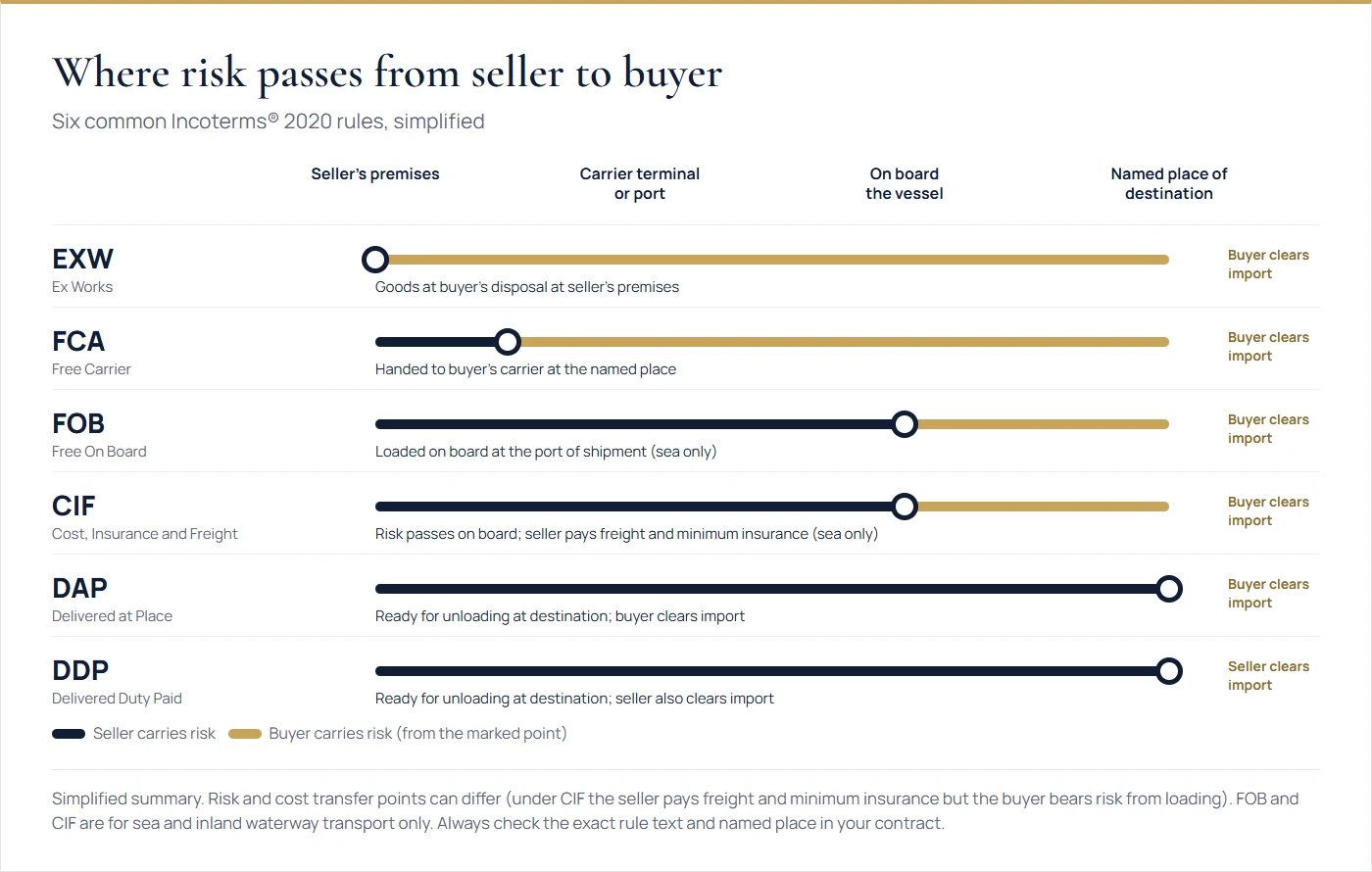
Delivery is the point where the seller’s duties end and risk passes to you. The named place decides both, so read it as carefully as the three letters.
EXW (Ex Works)
The seller makes the goods available at its premises or another named place and need not load them. From there you carry cost and risk, including export clearance in the seller’s country. This works only if you or your forwarder can handle export formalities abroad.
FCA (Free Carrier)
The seller clears export and delivers the goods to the carrier you nominate at a named place, where risk passes. Main freight, insurance and import clearance are yours. FCA suits containers and multimodal cargo, and the 2020 edition lets you have your carrier issue an on-board bill of lading to the seller.
CPT and CIP
The seller contracts and pays for carriage to a named destination and clears export, but risk passes to you at handover to the first carrier, not at destination. Under CIP the seller also insures for your benefit, with ICC (A) cover as the 2020 minimum. Import clearance is yours.
FAS and FOB
Sea and inland waterway only. The seller clears export and delivers the goods alongside the vessel (FAS) or on board it (FOB) at the named port of shipment, where risk passes. You arrange main freight, insurance and import clearance.
CFR and CIF
Sea and inland waterway only. The seller pays sea freight to the named destination port and clears export, but risk passes to you once the goods are on board at the port of shipment. CIF adds insurance, with ICC (C) cover as the minimum. Agree destination port charges in writing.
DAP, DPU and DDP
The seller delivers to a named place in your country and bears risk until then. Under DAP the goods are ready for unloading on the arriving vehicle and you unload. DPU is the only rule that makes the seller unload. DDP is DAP plus import clearance, with the seller paying duties and taxes.
Who clears customs and who pays what
Customs is where Incoterms rules cause the most misunderstanding. Even when the seller “pays the freight,” the buyer usually remains responsible for import clearance, duty, VAT and any import permits. Goldvestra’s trade documentation service covers checking that the declared rule and the paperwork match. The pattern across the eleven rules is simple:
At a glance
- Export clearance: the buyer under EXW, the seller under every other rule.
- Import clearance, duties and taxes: the buyer under every rule except DDP.
- Main carriage paid by the seller: CPT, CIP, CFR, CIF, DAP, DPU and DDP. Paid by the buyer: EXW, FCA, FAS and FOB.
- Insurance is compulsory for the seller only under CIP (ICC (A)) and CIF (ICC (C) minimum).
- Unloading at destination falls on the seller only under DPU.
- Risk passes at origin under EXW, FCA, FAS, FOB, CPT, CIP, CFR and CIF, and at destination only under DAP, DPU and DDP.
How to choose the right rule
There is no best rule, only the one that fits your capabilities and appetite for risk. Work through these questions with your forwarder before you sign.
Fix the transport mode first
If the cargo flies, only the any-mode rules apply. FAS, FOB, CFR and CIF are for sea or inland waterway, and containerized cargo is usually better served by FCA, CPT or CIP.
Decide who should control the freight
With a forwarder and negotiated rates, FCA or FOB lets you choose carrier, route and timing. If you want one all-in price, the C and D rules move booking to the seller, though under the C rules risk still passes early.
Check who can really clear customs
EXW works only if someone can handle export formalities in the supplier’s country. DDP works only if the seller can lawfully act as importer in yours. If either answer is no, pick another rule.
Match payment and insurance
If you pay by letter of credit, the bank’s document and insurance requirements must fit the rule. Under CIP and CIF, check the cover level, insured value and beneficiary.
Compare total landed cost
Get quotes under two or three rules and compare them like for like. Our guide to import cost factors lists the charges such quotes often leave out.
Name the place and the edition
Write the rule, a precise place (a terminal, port or address, not just a city) and “Incoterms® 2020.”
An illustrative example
Imagine a Dubai distributor buying packaged components from a manufacturer in an inland city abroad. The scenario is hypothetical. On EXW the unit price is lowest, but the distributor must find an agent in the origin country to collect the goods, file the export declaration and ship them. If the declaration is rejected, the goods wait at the supplier’s gate at the distributor’s cost and risk.
On FCA, with a forwarder’s warehouse at the origin port as the named place, the supplier clears export and hands over to the distributor’s forwarder. The distributor keeps control of freight while the biggest origin-side uncertainty disappears. On DAP, with the distributor’s warehouse as the named place, one price covers transport to the door and the supplier carries transit risk, but the distributor still clears import and cannot compare the supplier’s freight margin with its forwarder’s rates. Our logistics coordination service can help line up carriers and timing under whichever rule you choose, where legally permissible.
Why FOB is often the wrong rule for containers
Under FOB, delivery and risk transfer happen when the goods are on board the vessel. With containers, the seller usually hands the box to a carrier or terminal before loading, sometimes days earlier. In between, the seller still carries the risk although it no longer has control, and that gap breeds disputes over terminal damage, delays and extra handling.
The ICC’s own guidance points to FCA when goods are handed over before they are on board, as containers typically are. FCA moves risk to the buyer at the handover, where control actually changes, and since the 2020 edition it works with letters of credit that call for an on-board bill of lading. The same reasoning applies to CFR and CIF, whose container-friendly equivalents are CPT and CIP.
DDP: the rule that looks simple
DDP appeals because the seller delivers “cleared and paid,” but in many countries only a locally registered entity can act as importer of record or register for import VAT. A foreign seller that cannot do so will pad the price or subcontract to an agent you have never met, and you lose sight of classification, customs value and the duty actually paid. You may also be unable to reclaim import VAT if the seller is the importer.
A valuation dispute after arrival can leave unanswered who pays the extra duty unless the contract says so, and unloading remains yours because DDP delivery is ready for unloading on the arriving vehicle. If you use DDP, put the importer of record, the VAT treatment and any additional duties in writing, and compare it with DAP before accepting the higher price.
Other mistakes to avoid
These also slip into contracts.
- Writing only the three letters and leaving out the named place.
- Omitting the edition. DPU replaced DAT in 2020, and rules differ between editions.
- Using a sea-only rule for air, road or multimodal cargo.
- Assuming Incoterms transfer ownership or settle payment terms. They do neither.
- Accepting CIF or CIP without checking cover level, insured value and beneficiary.
- Forgetting charges the rule does not settle, such as terminal handling, demurrage and storage.
General information only
Incoterms rules allocate duties between buyer and seller. They do not replace customs law, sanctions or export-control rules or tax obligations. Confirm specifics with a licensed customs broker, your forwarder or a legal adviser, and see our trade documentation checklist.
Incoterms questions importers ask
Which Incoterms rule is best for a first-time importer?
There is no universal answer. FCA or DAP is often easier than EXW, because the seller handles export clearance (FCA) or delivery to your door (DAP). The choice depends on your forwarder access, your ability to clear imports and the freight control you want.
Do Incoterms apply automatically to my purchase?
No. They apply only when the parties incorporate them. State the rule, the named place and “Incoterms® 2020” in the purchase order and keep the same wording on the invoice.
What is the difference between CIF and CIP?
CIF is for sea and inland waterway only, risk passes when the goods are on board and the minimum insurance is ICC (C). CIP works for any mode, risk passes at handover to the first carrier and the minimum insurance is ICC (A).
Who pays import duty and VAT?
Under every rule except DDP, import clearance, duties and taxes are the buyer’s responsibility. Under DDP the seller must pay them. Local rules on who may act as importer of record still apply.
Is DAT still a valid Incoterms rule?
DAT was replaced by DPU in Incoterms® 2020. If your contract expressly refers to the 2010 edition, DAT still applies to that contract, but using the current edition avoids confusion.
Related reading and services
Logistics Coordination
Shipment planning and carrier coordination where legally permissible.
Trade Documentation
Help preparing and checking the paperwork behind each shipment.
Air Freight vs Sea Freight
Choosing a mode that fits your cargo, budget and timeline.
Import Cost Factors
The charges that sit on top of the supplier’s price.
International Trade Documentation Checklist
The documents that must agree with your chosen rule.
Not sure which trade term fits your next order?
Tell us what you are buying, where from and how you plan to ship it. Submit your requirements and we will take the delivery terms into the sourcing assessment and the commercial proposal.