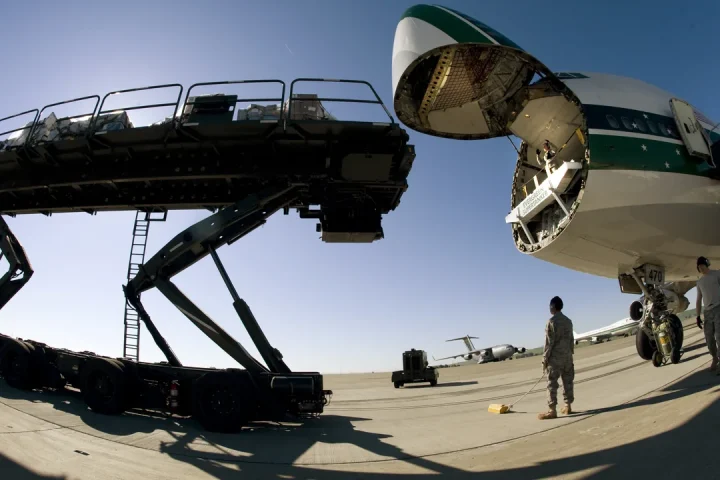

The cargo has landed, the invoice is paid, and the buyer is waiting. Then the shipment stops at the border and nobody can say when it will move. In most cases the reason is on paper, not on the quay.
Customs clearance Dubai is the process of declaring imported goods, paying duty and VAT, and getting them released for delivery. This guide walks through the steps, the documents, the usual causes of delay and what to do when cargo is held. It is general information, not customs or legal advice.
In this article
- Customs clearance Dubai: the steps in order
- Who can file a customs declaration
- Customs clearance documents UAE importers need
- The Dubai customs declaration and value
- Duty, VAT and other charges
- 7 common reasons cargo is held at customs
- What to do if cargo is held
- Using a customs broker in Dubai
- Checklist before the cargo arrives
- Frequently asked questions
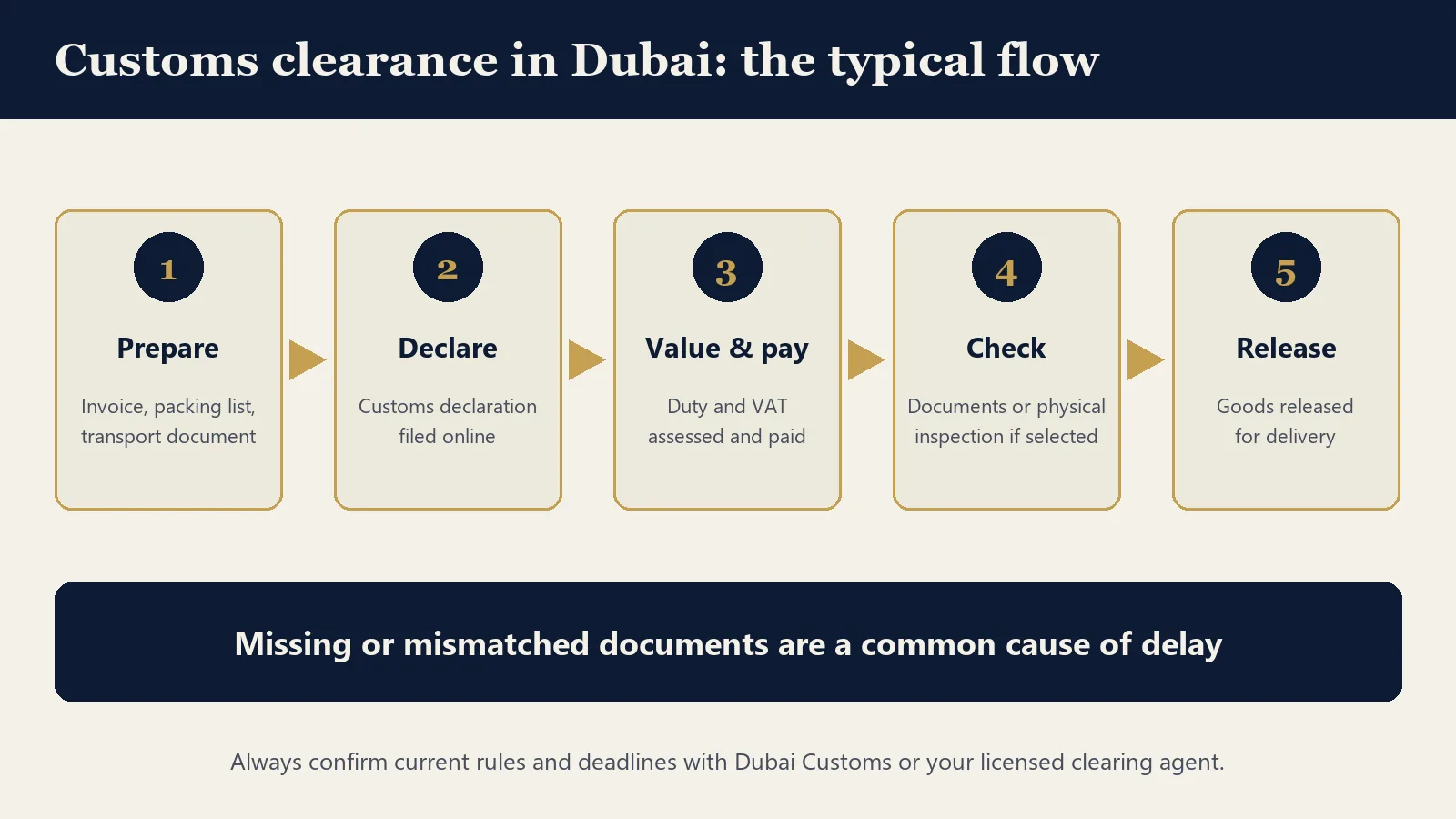
Customs clearance Dubai: the steps in order
Every shipment is different, but customs clearance Dubai follows a similar flow. Goods arrive by sea, air or road, a declaration is filed, the value and duty are assessed, and the goods are released once the customs file is accepted.
- Prepare the documents. The commercial invoice, packing list and transport document must agree with each other and with the cargo.
- Register and appoint who files. The importer files directly with a customs business code, or authorises a licensed clearing agent.
- Submit the declaration. The declaration states the goods, the HS code, the origin and the value, and goes in with the supporting invoice.
- Customs assesses the file. Customs checks the value and classification. It may ask for more evidence or select the cargo for inspection.
- Pay duty and VAT. Charges are paid against the assessed declaration.
- Release and deliver. Once cleared, the goods are released and can be collected or trucked to the consignee.
The Dubai Customs FAQ describes the declaration and the supporting invoice as the core of the file. Register for online services on the Dubai Trade portal before the first shipment, because registration is done online and takes no office visit.
Who can file a customs declaration
According to the Dubai Customs FAQ, any company with a customs business code can submit a customs declaration. Clearing and forwarding agents with the right licence can also clear cargo for a consignee. They need a business code, and the goods owner must authorise them to submit the declaration.
That leaves two practical options for an importer:
- File yourself. You hold the business code, prepare the file and answer customs queries directly.
- Appoint an agent. A licensed clearing agent files on your behalf. You still supply accurate documents and remain responsible for what the declaration says.
Check the agent’s licence and written authority before cargo arrives. Do not hand over the original documents without knowing who is acting for you.
Customs clearance documents UAE importers need
The exact set depends on the goods, the origin and the transport mode. A standard commercial shipment normally starts with the same core file for customs clearance Dubai. Our international trade documentation checklist covers each paper in detail; this is the short version.
| Document | What it does | Common problem |
|---|---|---|
| Commercial invoice | States seller, buyer, goods, quantity and price. Basis for the declared value. | Description too vague, or value different from the payment. |
| Packing list | Lists packages, weights and contents. | Quantities or weights do not match the invoice. |
| Bill of lading or air waybill | Transport document that proves who can take delivery. | Consignee name differs from the invoice. |
| Certificate of origin | Shows where the goods were made, when needed. | Wrong country or missing legalisation. |
| Approvals or permits | Needed for restricted or regulated goods. | Requested after the cargo has already arrived. |
| Price evidence | Bank transfers or buyer-seller correspondence, if customs asks. | Not kept, so the value cannot be proven. |
For restricted goods, the Dubai Customs FAQ says approvals from the relevant authorities go in with the other documents, and goods are released only after those approvals are submitted. Plan for that before you order, not after the container is on the water.
Documents also feed the classification. A wrong code changes the duty and can raise questions at the counter, so read our HS code classification for importers before the declaration is drafted.
The Dubai customs declaration and value
The Dubai customs declaration is the formal statement of what you are importing. Customs reads it against your invoice and transport document, so it sits at the centre of customs clearance Dubai. Every field should be traceable to a document in the file.
What a clean declaration shows
- A clear description of the goods, not just a trade name.
- The HS code that matches that description.
- The country of origin.
- The quantity and weight, matching the packing list.
- The customs value, with freight and insurance shown where they apply.
How customs values the goods
The Dubai Customs FAQ says customs value is based on CIF, meaning cost, insurance and freight up to the place of importation. The exchange rate on the date the declaration is submitted is used. If customs doubts the declared value, it may ask for further evidence and may reject the value.
This is why price evidence matters. Keep the contract, the payment record and the supplier correspondence together. They are the first things customs asks for when a price looks low.
Importers who disagree with a valuation decision have an appeal route, and the same source notes that an importer may ask for release of goods before valuation is completed. Confirm the conditions with Dubai Customs before relying on either.
Duty, VAT and other charges
For most goods, the Dubai Customs FAQ gives the Dubai duty rate as 5% of the CIF value. It lists 50% for alcohol and 100% for cigarettes. The official UAE government portal says tariffs in the UAE range from 0 to 5 per cent. Our UAE import duty guide shows the calculation with a worked example.
VAT is separate from duty. The standard UAE VAT rate is 5%, as shown by the Federal Tax Authority. Ask your clearing agent exactly how import VAT is assessed and paid on your shipment, because the treatment can differ by case.
Beyond duty and VAT, budget for the charges that sit around clearance:
- Agent or broker fees.
- Terminal handling and port or airport charges.
- Storage if cargo waits for documents or approvals.
- Inspection or testing, where required.
- Local transport to the delivery address.
None of these are a surprise if customs clearance Dubai is in the landed cost before you order. For a full view of what builds a landed price, read our guide to import costs.
7 common reasons cargo is held at customs
Delays in customs clearance Dubai rarely come from one dramatic error. They come from small mismatches that make an officer stop and ask. These are the causes importers meet most often.
- Documents that disagree. The invoice, packing list and transport document show different quantities, weights or names.
- A vague goods description. “Spare parts” or “accessories” gives customs nothing to classify.
- The wrong HS code. The code does not match the product, so duty or controls differ from what you declared.
- An undervalued or unsupported price. The declared value looks low and there is no payment or contract evidence.
- Missing approvals for restricted goods. The permit was not requested, or does not cover the exact product.
- Missing origin papers. A certificate of origin is required or expected and is not in the file.
- Nobody authorised to file. The consignee, agent and business code do not line up, so the declaration cannot go in.
Each one is preventable. Most are fixed before shipment by checking the documents against each other, which is exactly what the checklist below is for.
What to do if cargo is held
Cargo held at customs is stressful but usually solvable. Work through it in a fixed order instead of chasing everyone at once.
- Find out why. Get the reason in writing from customs or from your agent. Do not guess.
- Check the file against the cargo. Compare invoice, packing list, transport document and declaration line by line.
- Supply what is missing. Send the requested document, certificate, permit or price evidence through your agent or the customs channel.
- Correct errors properly. If the declaration is wrong, correct it through the official process rather than informally.
- Watch storage. Ask what storage charges apply while the cargo waits, and what the time limits are.
Confirm the deadline. After a declaration is filed, customs may ask for supporting documents within a set time. We do not state a number here. Confirm the current deadline for supporting documents with Dubai Customs or your licensed agent, because the rule can change.
Using a customs broker in Dubai
A customs broker Dubai importers hire, also called a clearing agent, files the declaration and deals with customs on your behalf. For occasional importers, that customs clearance Dubai experience is often worth the fee. For regular importers, it keeps classification and filing consistent.
Questions to ask before you appoint one:
- Do they hold the licence needed to clear cargo for a consignee?
- Which fees are fixed and which are charged at cost?
- Who pays duty and VAT up front, and how is it recovered from you?
- How do they handle a query or an inspection?
- What documents do they need from you, and by when?
If you want one team to line up the paperwork, carrier and customs hand-offs, our import and export coordination service is built for B2B buyers. The trade documentation service covers the document set that supports the declaration. We coordinate the process; the declaration itself is filed by the importer or a licensed clearing agent.
Checklist before the cargo arrives
- Importer business code and online registration are active.
- A licensed agent is named, with written authority if you use one.
- Invoice, packing list and transport document agree on quantities, weights and names.
- Goods description is specific and the HS code is confirmed.
- Origin papers and any permits are in hand.
- Payment and contract records are saved as price evidence.
- Duty, VAT and storage are in the landed cost.
- You know who to call at your agent, and the current customs deadlines.
Run the list for customs clearance Dubai once at order stage and again before the cargo leaves the origin port. Fixing a document is cheap before shipment and expensive after arrival.
Frequently asked questions
What is customs clearance in Dubai?
Customs clearance in Dubai is the process of declaring imported goods to Dubai Customs, paying duty and VAT, and getting the goods released for delivery. It needs a customs declaration, a supporting invoice and the transport documents, filed by the importer or a licensed clearing agent.
What documents are needed for customs clearance in Dubai?
A standard shipment normally needs a commercial invoice, a packing list and a bill of lading or air waybill. A certificate of origin, permits for restricted goods and price evidence may also be required. Customs can ask for more, so confirm the set for your goods.
How long does customs clearance take in Dubai?
There is no fixed time that applies to every shipment. Clearance is quicker when documents match and the declaration is accurate. It slows when customs asks for more evidence, inspects the cargo or waits for approvals. Ask your clearing agent for a realistic estimate.
Who can submit a customs declaration in Dubai?
According to Dubai Customs, any company with a customs business code can submit a declaration. A licensed clearing and forwarding agent can also clear cargo for a consignee if it holds a business code and the goods owner has authorised it to file.
Why is my cargo held at customs?
Cargo is usually held because of a document mismatch, a vague description, a wrong HS code, an unsupported value, missing approvals for restricted goods or missing origin papers. Ask for the reason in writing, then supply the missing item through your agent.
Do I need a customs broker in Dubai?
A company with a customs business code can file its own declarations, so a broker is not always required. Many importers still use a licensed clearing agent for classification, filing and dealing with queries, especially on their first shipments.
Related reading
UAE Import Duty
How duty is calculated on the CIF value.
Trade Documentation Checklist
The papers behind every shipment.
HS Code Classification
Classify the product before you declare.
Import & Export Coordination
One team for paperwork and hand-offs.
Trade Documentation
Documents that support the declaration.
Planning an import into the UAE?
Tell us the product, quantity and route. We will review the documents and coordination needed and follow with a proposal.