
Your supplier says the goods will ship by air, or by sea. Either way, a transport document will follow. Importers often treat the two main ones as the same paper with a different name. They are not, and the gap can affect when you get your cargo and when your bank pays.
This guide explains air waybill vs bill of lading in plain words: what each document does, why one is a document of title and the other is not, how MAWB and HAWB fit in, and what changes for clearance and payment.
It is a general guide, not legal advice. Rules depend on the carrier, the contract and the law that applies, so confirm details in writing. For the sea side in depth, see our bill of lading explained guide.
In this article
- Air waybill vs bill of lading: the short answer
- What an air waybill is
- What a bill of lading is
- Document of title and negotiability
- Air waybill vs bill of lading: side-by-side table
- MAWB vs HAWB (and MBL vs HBL)
- Effect on customs clearance and cargo release
- Effect on payment and bank control
- Practical checklist for importers
- Frequently asked questions
Air waybill vs bill of lading: the short answer
Both documents are issued by or for the carrier. Both prove that the carrier received the goods, and both record the contract of carriage. The big difference is control.
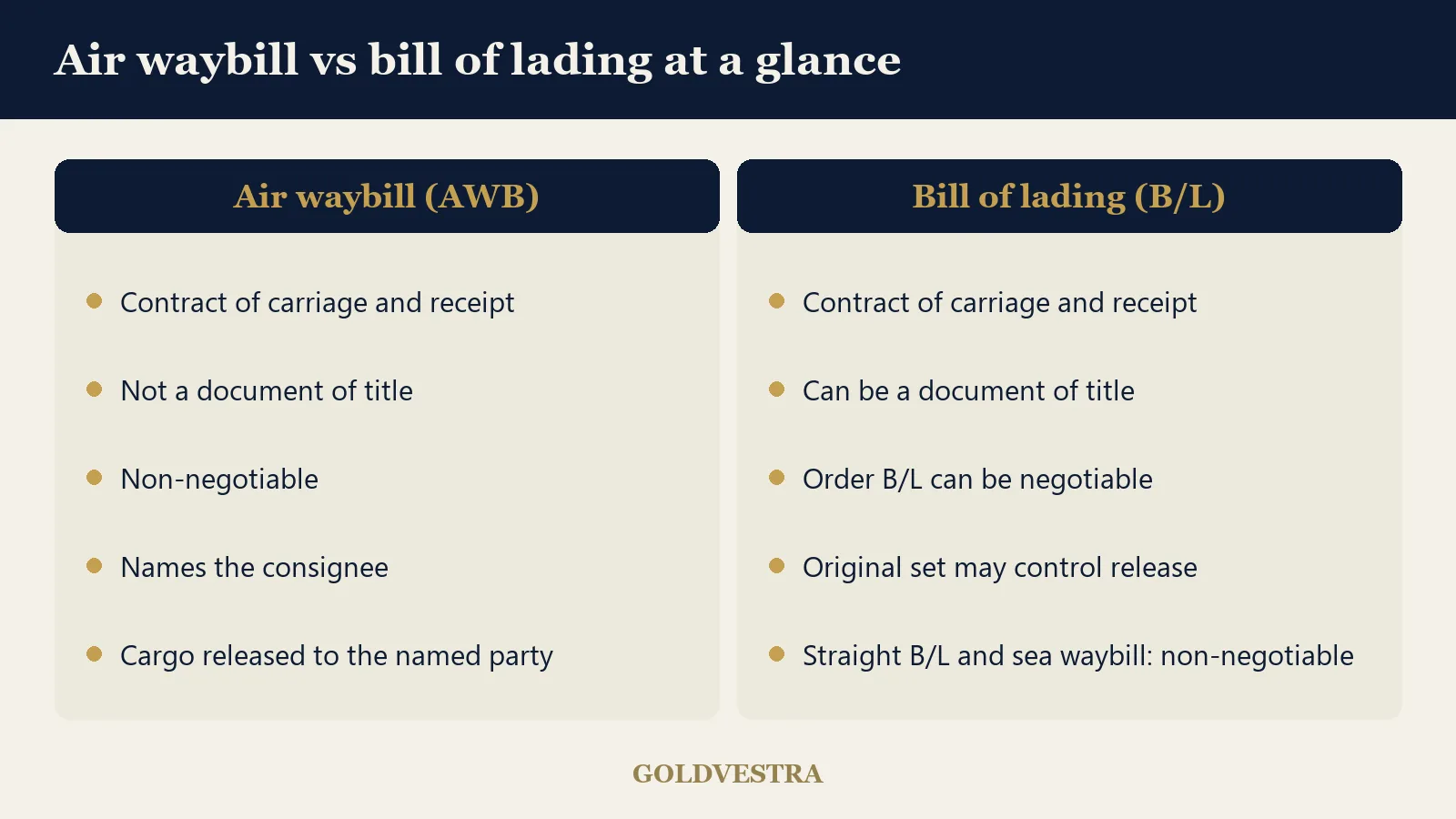
- An air waybill (AWB) is a non-negotiable document. It is not a document of title. The carrier delivers to the consignee named on it.
- A bill of lading (B/L) can be a document of title. An order B/L can be endorsed and transferred, and the carrier may release the cargo only against an original.
- A sea waybill is a sea document that behaves more like an AWB: non-negotiable, no original needed at discharge.
In practice, whoever holds the original order B/L can control the sea cargo. Whoever is named consignee on an AWB receives the air cargo. That one difference drives most of the rest.
What an air waybill is
An AWB is the transport document for air cargo. According to IATA, it is the contract of carriage between the shipper and the carrier, the airline. See the IATA e-freight and e-AWB programme for the industry view.
It also works as a receipt for the goods and a record of the shipment details. Typical content:
- shipper, consignee and notify party
- airport of departure and destination
- description, pieces and weight of the cargo
- freight charges and who pays them (prepaid or collect)
- handling information and any special instructions
Each AWB carries an 11-digit number. The first three digits are the airline prefix. Agents and airlines use this number to track the shipment and to reference it on customs declarations.
An AWB is not a document of title. Possession of the paper does not give you ownership of the goods. The airline delivers to the consignee named on the face of the document.
Many airlines and forwarders now use the electronic AWB (e-AWB), which replaces the paper original. It follows the same logic. For how air compares with sea on speed and cost, read air freight vs sea freight.
What a bill of lading is
A B/L is the transport document for ocean cargo. It does three jobs: it is a receipt for the goods, it is evidence of the contract of carriage, and, in some forms, it is a document of title.
The form decides the control. These are the common types:
- Order (negotiable) B/L: issued “to order” of the shipper or a bank. It can be endorsed and transferred. The carrier releases cargo against an original.
- Straight B/L: names a specific consignee. It is generally treated as non-negotiable, although many carriers still ask for an original at release.
- Sea waybill: non-negotiable and not a document of title. Cargo goes to the named consignee, usually with no original to present.
- Telex or express release: the original is surrendered at origin and the carrier releases the cargo at destination without a paper original.
An order B/L is often issued as a set of originals, commonly three. The carrier needs only one to release the cargo, and the other originals then lose value. That is why importers keep track of who holds each original.
For fields, types and common errors, see our bill of lading explained article.
Document of title and negotiability
These two terms cause most of the confusion, so keep them apart.
Document of title
A document of title lets its holder claim the goods and, where the law allows, transfer that right by handing over the document. A negotiable B/L is the classic example. The goods follow the paper.
Non-negotiable
A non-negotiable document cannot be transferred this way. The AWB is non-negotiable by design. The carrier hands the cargo to the consignee on the face of the document, not to whoever holds the paper.
This is why air cargo can move so fast. No one has to wait for an original to travel by courier ahead of the aircraft.
Electronic documents are changing the picture. The UNCITRAL Model Law on Electronic Transferable Records shows how a legal system can treat an electronic record like a transferable paper one. It only helps where a country has adopted it, so check before you rely on an electronic B/L for title.
Air waybill vs bill of lading: side-by-side table
Use this air waybill vs bill of lading table as a quick reference. It describes the general position, and individual carriers may apply their own conditions.
| Point | Air waybill (AWB) | Bill of lading (B/L) |
|---|---|---|
| Issued by | Airline or its agent | Shipping line, NVOCC or their agent |
| Contract of carriage | Yes | Yes (or evidence of it) |
| Receipt for goods | Yes | Yes |
| Document of title | No | Yes for order B/L; no for sea waybill |
| Negotiable | No | Order B/L yes; straight B/L and sea waybill no |
| Who gets the cargo | Named consignee | Holder of the original (order B/L) or named consignee |
| Original needed at destination | No | Usually for B/L; not for sea waybill |
| Electronic version | e-AWB | e-B/L (depends on carrier and law) |
| Master / house level | MAWB / HAWB | MBL / HBL |
MAWB vs HAWB (and MBL vs HBL)
Forwarders often consolidate several shippers’ cargo under one booking. That creates two layers of documents.
- MAWB (master air waybill): issued by the airline to the forwarder or consolidator. It covers the whole consolidated shipment.
- HAWB (house air waybill): issued by the forwarder to each of its customers. It covers one customer’s cargo.
Sea freight works the same way. The shipping line issues the master bill of lading (MBL). The forwarder or NVOCC issues house bills of lading (HBL) to each shipper.
What matters to you as an importer:
- The HAWB or HBL is the document that names you as consignee, in most consolidated shipments.
- The MAWB or MBL usually names the forwarder’s agent at destination as consignee.
- Customs entries and release instructions can refer to both numbers. A mismatch causes delays.
- Your claim for loss or damage is against whoever issued your house document. Ask who that is before you book.
If you are unsure who issues what, our freight forwarder vs customs broker guide explains the roles.
Effect on customs clearance and cargo release
Both documents feed the customs declaration. The declaration usually quotes the AWB or B/L number, the consignee, the description and the weight. These must match the commercial invoice and packing list.
The release step is where the difference shows:
- Air: the carrier or ground handler releases to the named consignee or its authorised agent. No paper original travels, so cargo can be ready within hours of landing.
- Sea with an order B/L: the line issues a delivery order only against an original B/L or a confirmed release. A missing original can hold your container and add storage cost.
- Sea waybill or telex release: release follows the carrier’s confirmation, so there is no courier wait.
Check the exact local steps and fees with your agent. Our customs clearance in Dubai guide covers the process in the UAE, and the trade documentation checklist lists the papers to prepare.
Effect on payment and bank control
Payment terms decide how much the air waybill vs bill of lading choice matters to you and your supplier.
- Advance payment or open account: the supplier trusts you. The document type matters less, and a sea waybill or AWB is simple.
- Letter of credit: the credit lists the documents the bank will accept. An order B/L consigned to the bank’s order lets the bank control the cargo until you pay or accept. The credit may also allow an AWB, but then control rests on the consignee named.
- Documentary collection: the bank hands over the documents against payment or acceptance. With a non-negotiable document, the seller has less leverage.
Because an AWB does not control the goods, a seller shipping by air on a bank-controlled deal may ask for the bank to be named consignee. That sets up a different release process, so agree it early.
Whatever the document, the wording of the credit and the document must match exactly. Our trade documentation service can review them before you present them, or you can send us the shipment details for a quick check.
Practical checklist for importers
- Ask the supplier which document will be issued and who the consignee is, before the goods ship.
- Confirm whether the B/L is an order B/L, a straight B/L or a sea waybill.
- For consolidated cargo, get both the master and the house numbers.
- Check names, addresses, weights and descriptions against the invoice.
- Agree how originals travel, or whether release will be telex or electronic.
- Match the document to your payment terms and your bank’s requirements.
- Keep copies of every document for customs, insurance and claims.
Small errors cost time on both modes. A wrong consignee on an AWB or a missing original on an order B/L is enough to delay delivery.
Frequently asked questions
What is the main difference between an air waybill and a bill of lading?
An air waybill is non-negotiable and is not a document of title, so the carrier delivers to the named consignee. A bill of lading can be a document of title, and an order B/L can be transferred. The holder of the original may control release of the sea cargo.
Is an air waybill a document of title?
No. An air waybill is a contract of carriage and a receipt, but it is not a document of title and cannot be negotiated. The airline releases the cargo to the consignee named on it. This is why banks and sellers pay close attention to who is named consignee.
Is a bill of lading always negotiable?
No. An order bill of lading can be negotiable and works as a document of title. A straight bill of lading names one consignee and is generally non-negotiable. A sea waybill is also non-negotiable. Check the wording on the face of your document.
What is the difference between MAWB and HAWB?
A MAWB is the master air waybill issued by the airline to a forwarder or consolidator for the whole shipment. A HAWB is the house air waybill the forwarder issues to each customer for its own cargo. The importer is normally named on the HAWB.
Do I need the original document to collect air cargo?
Usually not. Air cargo is released to the named consignee or its authorised agent, normally on proof of identity and customs documents, not on an original paper. Procedures differ by airline and handler, so confirm the exact steps with your forwarder before arrival.
Which document is better for letters of credit?
It depends on what the credit allows. An order bill of lading gives a bank stronger control over sea cargo. Credits can also allow an air waybill, but then control depends on the named consignee. Follow the exact wording of the credit and ask your bank.
Related reading
Bill of Lading Explained
Types, key fields and common errors.
Air Freight vs Sea Freight
How to choose the right mode for your cargo.
Trade Documentation Checklist
The papers importers and exporters prepare.
Freight Forwarder vs Customs Broker
Who does what in the UAE.
Unsure which transport document your shipment needs?
Send us the route, the payment terms and the draft documents. We will help you check the consignee, the document type and the paperwork before you ship.