
A supplier you have never met sends a pro forma invoice. The price is right, but the payment line says “100% in advance.” Another supplier offers 60 days open account. A third asks you to open a letter of credit. Which one is safe?
International trade payment terms decide who carries the risk between order and delivery. This guide compares the four main methods, shows where the risk sits for the buyer and the supplier, and explains which ones tend to suit a first order. It is general information, not financial or legal advice.
In this article
The short answer: how international trade payment terms shift risk
Every one of the international trade payment terms answers one question: who trusts whom, and for how long? The buyer wants to receive the goods before paying. The supplier wants to be paid before shipping. Real deals sit somewhere between those two positions.
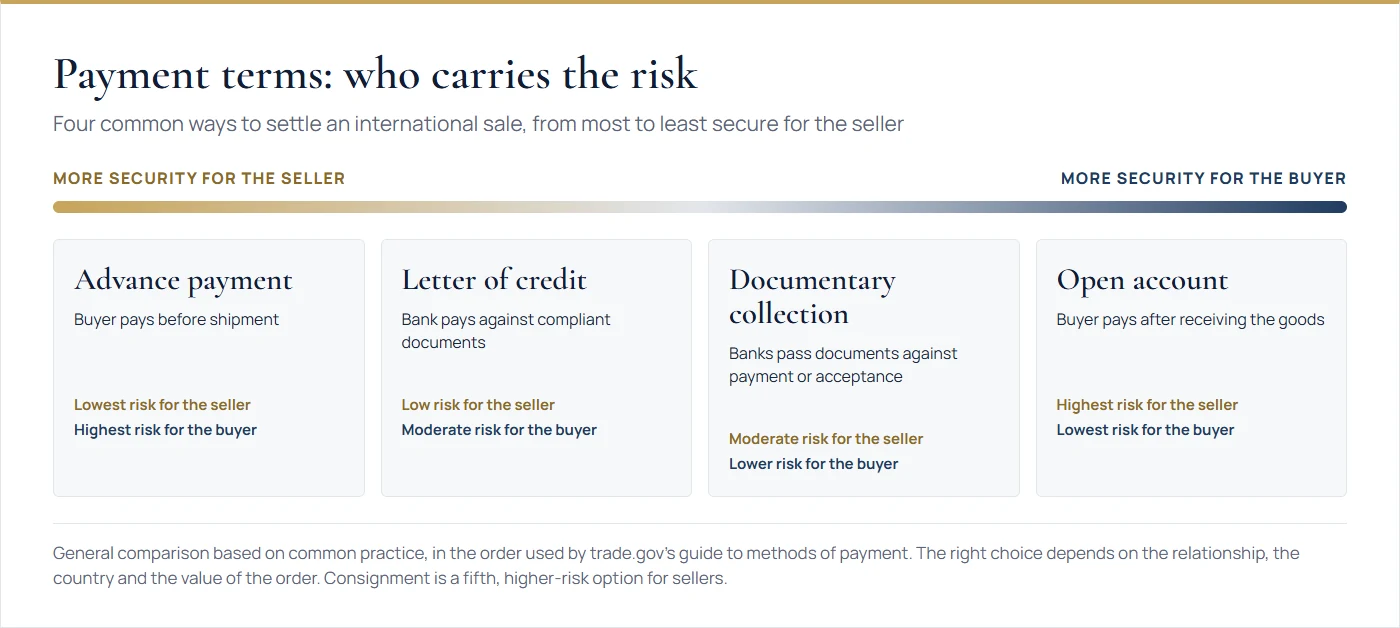
The U.S. International Trade Administration describes the same spectrum in its guide to methods of payment in international trade: from cash in advance, which is least risky for the exporter, to open account, which is most favourable to the importer. Letters of credit and documentary collections sit in the middle.
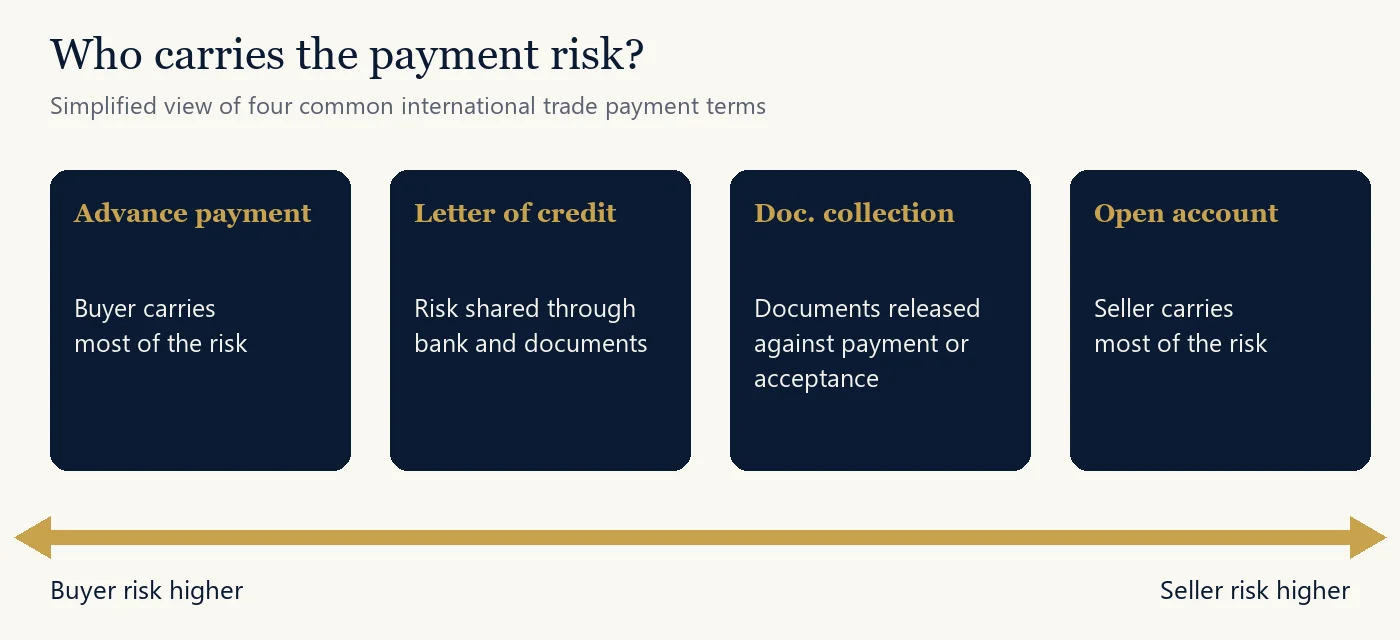
In short, advance payment protects the supplier, open account protects the buyer, and the other two methods use banks and documents to share the risk. Your choice usually depends on how well you know the other party, how large the order is and how much cash you can tie up.
Advance payment
Of all international trade payment terms, advance payment is the simplest. The buyer pays all or part of the price before the goods ship. It is usually made by bank transfer. The supplier carries almost no payment risk. The buyer carries the risk that the goods are late, wrong or never sent.
Where it is common
Suppliers often ask for advance payment on a first order, on custom-made products or when they cannot assess the buyer’s credit. A split is also common: a deposit to start production and the balance before or against shipping documents.
Risks for the buyer
- The money has left your account before you have seen the goods.
- If the supplier is not genuine, recovery can be slow and uncertain.
- Fraud attempts often involve changed bank details or a fake invoice, so every payment instruction should be verified.
How buyers reduce the risk
Verify the supplier first. Our guide on how to vet international suppliers covers company checks, samples and red flags. Pay only to an account in the registered company name, and prefer a smaller deposit with the balance tied to documents or inspection.
Letter of credit (L/C)
A letter of credit is a bank’s written commitment, issued on the buyer’s request, to pay the supplier if the supplier presents documents that match the credit’s terms. The trade.gov guide calls letters of credit one of the most secure instruments available to international traders.
How an L/C works
- Buyer and supplier agree the L/C terms in the sales contract.
- The buyer asks its bank (the issuing bank) to open the credit in the supplier’s favour.
- The supplier ships the goods and collects the documents the credit asks for, such as the invoice, packing list and transport document.
- The supplier presents the documents to the bank. The bank checks them against the credit.
- If the documents comply, the bank pays or commits to pay. If not, payment can be refused until the supplier fixes the discrepancy.
Most documentary credits are issued under the ICC’s Uniform Customs and Practice for Documentary Credits, known as UCP 600. The International Chamber of Commerce publishes these rules along with other trade finance resources.
Why use a letter of credit
For the supplier, the bank’s undertaking replaces reliance on the buyer alone. For the buyer, no payment is due until the supplier presents documents showing the shipment was made as agreed. That is why an L/C is often discussed for large or first-time deals.
What to watch
- Strict document checks. A misspelt name or a late shipment date can cause a discrepancy. Banks examine documents, not the goods themselves.
- Cost and time. Banks charge fees and the paperwork takes effort. Ask your bank for its fee schedule.
- Document quality. Clean, consistent paperwork matters. Our international trade documentation checklist lists the documents most shipments need.
Documentary collection
In a documentary collection, the supplier ships the goods and sends the shipping documents through its bank to the buyer’s bank. The buyer’s bank releases the documents only on the agreed condition. The ICC’s Uniform Rules for Collections (URC 522) generally govern the process.
There are two common forms:
- Documents against payment (D/P): the buyer pays at sight to get the documents.
- Documents against acceptance (D/A): the buyer accepts a draft to pay on a set future date and receives the documents now.
As payment terms go, a collection is usually cheaper than an L/C. The trade-off is that banks act as intermediaries only. According to trade.gov, collections offer no verification process and limited recourse if the buyer does not pay. The supplier stays exposed if the buyer refuses the documents, and the buyer still relies on the supplier’s word that the goods match the order.
Open account
Under open account, the supplier ships and delivers the goods first, and the buyer pays later, commonly after 30, 60 or 90 days. For the importer, this is the best option for cash flow. For the supplier, it carries the highest payment risk, because there is no bank undertaking and the goods may already be with the buyer.
Among international trade payment terms, open account is usually offered between parties with a track record, or when the supplier uses credit insurance or other trade finance tools. A new supplier rarely offers it on a first order. If one does, ask yourself why, and check the quoted price and the company carefully.
Consignment is a variation in which payment is made only after the goods have been sold on. It moves even more risk to the supplier.
Side-by-side comparison
This table summarises how the main international trade payment terms compare in general terms. Real contracts can combine them.
| Method | Main risk for the buyer | Main supplier payment risk | Bank involvement | Typical cost |
|---|---|---|---|---|
| Advance payment | Paying before receiving goods | Very low | Transfer only | Low |
| Letter of credit | Fees and strict document rules | Low if documents comply | High: issues and examines | Higher |
| Documentary collection | Goods may differ from the documents | Medium to high: buyer may not pay | Medium: passes documents | Moderate |
| Open account | Low; payment follows delivery | High: payment depends on the buyer | None | Lowest; credit insurance is optional |
Cost and risk vary by bank, country and counterparty. Ask your bank for current fees before you commit.
Which international trade payment terms suit a new supplier?
There is no single right answer among international trade payment terms, and what suits you depends on the deal. Still, a few patterns hold for a first order with an unfamiliar supplier:
- Full advance payment concentrates the risk on you. It is hard to justify without strong verification.
- A letter of credit spreads the risk through bank-checked documents. It works best when the order is large enough to justify the fees.
- A split payment (a deposit, then the balance against documents or after inspection) is a common middle ground for smaller orders.
- Open account usually comes later, once a supplier has delivered reliably over several orders.
Your international trade payment terms should also match your delivery terms. Who pays for freight and when risk passes to you are set by the Incoterms rule, so read our Incoterms 2020 guide for importers alongside your payment clause. If you want a second pair of eyes on a quote, our trade consultation service can review the commercial terms with you.
Checklist before you agree to terms
- Confirm the supplier’s legal name, address and registration through independent sources.
- Ask for the beneficiary bank details in writing and verify any change by calling a number you already trust.
- Put the payment schedule, currency and due dates in the contract or pro forma invoice.
- Agree the exact document list and who prepares each document. See trade documentation support if you need help with it.
- Match payment milestones to something you can verify: inspection, a bill of lading or delivery.
- Check which bank fees each side pays.
- Confirm the Incoterms rule so that risk, cost and payment line up with the payment terms you chose.
- Keep every invoice, transfer record and email in one file.
Frequently asked questions
What are the main international trade payment terms?
The four main international trade payment terms are advance payment, letter of credit, documentary collection and open account. They run from least risk for the supplier (advance payment) to least risk for the buyer (open account), with banks and documents sharing risk in the middle.
What is the difference between a letter of credit and advance payment?
With advance payment, the buyer pays the supplier directly before shipment. With a letter of credit, a bank promises to pay once the supplier presents compliant documents. The L/C adds bank checks and fees, but the buyer does not pay until shipping documents are presented.
Which payment term is safest for a buyer?
Open account is the safest for the buyer because payment follows delivery. A letter of credit is often the next safest, since payment depends on documents showing shipment. Advance payment carries the most risk for the buyer, especially with a supplier you have not verified.
What is a documentary collection?
A documentary collection is a method in which the supplier’s bank sends shipping documents to the buyer’s bank. The buyer receives them by paying (D/P) or by accepting a draft (D/A). Banks handle the paperwork but do not guarantee payment.
Why do suppliers ask for advance payment in international trade?
Suppliers want to avoid the risk of non-payment, particularly with a new buyer, a custom product or a high-risk market. A deposit also covers production costs. A negotiated split between deposit and balance often reassures both sides.
Can I combine payment methods in one deal?
Yes. A common mix is a deposit by bank transfer with the balance against shipping documents, or part of the order under a letter of credit. Write the schedule into the contract so both sides know what triggers each payment.
Related pages and articles
Trade Consultation
Review commercial and payment terms before you commit.
Trade Documentation
Documents that support L/C and open-account shipments.
Incoterms 2020 for Importers
Who pays, and who bears risk, at each stage.
How to Vet International Suppliers
Checks to run before you pay anyone.
Unsure which payment terms fit your next order?
Send us the product, quantity and destination. We will review the commercial terms and follow with a proposal.