
A supplier ships goods into a UAE free zone, and the invoice question starts at once. Is there import VAT on arrival? Who pays it later? Does the answer change when the goods move on?
The answer depends on one status: whether the zone is a designated zone UAE VAT. This guide explains what that means, how it differs from an ordinary free zone, and how the rules touch goods you import, store and re-export.
It is general information, not tax advice. Rules and zone lists change, so confirm your own case with the Federal Tax Authority (FTA), the free zone authority or a licensed tax adviser.
In this article
What a designated zone means for UAE VAT
Under the VAT law, a Designated Zone is an area that the Cabinet has specified for VAT purposes. The FTA’s Public Clarification TAXP010 from the Federal Tax Authority (FTA) says a VAT Designated Zone is a free zone listed in Cabinet Decision No. 59 of 2017 and its amendments, and that it meets the conditions in Article 51(1) of the VAT Executive Regulation.
A zone that meets those conditions is treated as being outside the UAE for VAT. That is the core of the designated zone UAE VAT rules. Goods inside the zone are, for VAT, in a different place from the UAE mainland.
The three conditions in Article 51(1)
According to the FTA clarification, the zone must meet all of these conditions:
- It is a specific fenced geographic area, with security measures and customs controls that monitor the entry and exit of people and the movement of goods.
- It has internal procedures for keeping, storing and processing the goods inside it.
- Its operator complies with the procedures set by the FTA.
The FTA also advises businesses to confirm with the free zone authority that the specific area where they are based meets these conditions. Listing alone is not the whole check.
Free zone vs designated zone
Many traders say “free zone” and mean “no VAT”. That shortcut is wrong. A free zone is a defined area in the UAE created by a Cabinet decision. It gives benefits such as different ownership rules and simpler licensing. Our guide to Dubai free zone vs mainland covers that business side.
The designated zone UAE VAT status is a narrower idea. It is a VAT status, and only the zones on the Cabinet list have it.
| Point | Ordinary free zone | VAT designated zone |
|---|---|---|
| What it is | A defined area with its own licensing and business rules | A free zone listed by Cabinet decision that meets the Article 51(1) conditions |
| VAT location | Treated as part of the UAE unless it is also designated | Treated as outside the UAE for VAT |
| Where to check | The free zone authority | The FTA list of Designated Zones, plus the free zone authority |
| Effect on goods | Normal UAE VAT rules apply | Special rules for goods held in the zone |
The FTA also stresses that the definitions differ by tax. A zone can be a designated zone for VAT and not be treated the same way for Corporate Tax or Excise Tax. The FTA says a VAT Designated Zone is not automatically a Corporate Tax Designated Zone, and Excise Tax has its own approval of designated areas.
So check each tax separately. A designated zone UAE VAT finding does not carry over to another tax.
How designated zone UAE VAT rules treat goods
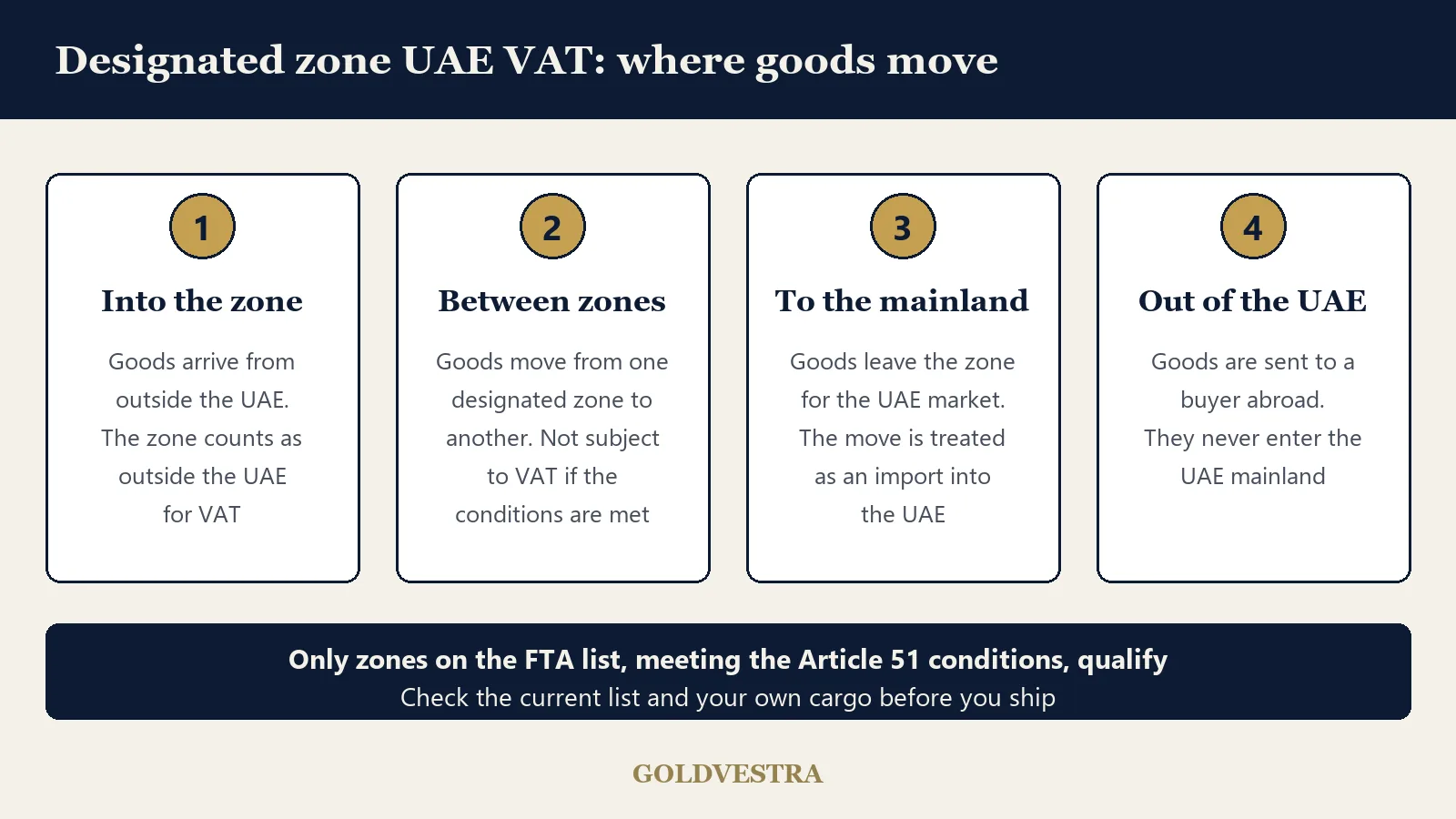
Under designated zone UAE VAT rules, goods movements are described by where they start and where they end. The summary below follows Article 51 as described in the FTA material and in a 2018 Grant Thornton VAT alert. Always confirm the current text for your case.
Goods arriving from outside the UAE
Under designated zone UAE VAT treatment, goods that arrive from abroad into the zone are not entering the UAE for VAT. So the import VAT that applies at the mainland border does not arise on arrival in the zone, as long as the goods stay there and the conditions are met.
Customs duty and permits are a separate question. They follow customs rules, not VAT rules, so ask the customs authority or your broker.
Goods moving between designated zones
Article 51 says that the transfer of goods between designated zones is not subject to VAT, subject to prescribed conditions. Keep the paperwork that proves the goods moved from one listed zone to another.
Goods leaving the zone for the mainland
This is the step in designated zone UAE VAT planning that surprises buyers. When goods move from a designated zone into the UAE mainland, the move is treated as an import into the UAE. VAT then has to be accounted for under the import rules. How that works for your case is in our guide to VAT on imports in the UAE.
The 2018 summary also notes that a registered mainland recipient may account for the VAT through the reverse charge. Treat that as a point to confirm with your adviser, because procedures can change.
Goods leaving for a buyer abroad
Goods that go from the zone to a customer outside the UAE do not enter the mainland, so there is no mainland import step. Export and re-export still need correct documents. See our guide to re-export from Dubai for the process, and ask your adviser how the evidence should be kept for VAT.
If you plan a mixed flow, with some goods sold abroad and some sold in the UAE, our team can help with import and export coordination. We coordinate the documents and the supplier side, not the tax filing.
Services are not treated like goods
The zone status mainly changes the treatment of goods. Article 51 treats the place of supply of services as inside the UAE if the place of supply is in the designated zone. A person established or resident in a designated zone is also deemed to have a place of residence in the UAE.
The designated zone UAE VAT treatment of goods does not cover services. In plain terms, a service supplied in the zone is not outside VAT just because the zone counts as outside the UAE for goods. A trader who handles both goods and services should look at each one on its own.
A business in a designated zone may still have to register and charge VAT on its services. Registration rules depend on the facts, so take advice.
How to check a designated zone for UAE VAT
For designated zone UAE VAT status, do not rely on a list copied into a blog post, including ours. The Cabinet list has been amended since it was first issued, and zones can be added. For that reason we do not reproduce it here.
Use the FTA’s own pages. The VAT guides and references page carries the TAXP010 clarification, and the FTA publishes the List of Designated Zones on its website. Then take these steps:
- Find the exact zone and area name in the FTA list of Designated Zones.
- Ask the free zone authority to confirm that your specific area meets the Article 51(1) conditions.
- Check where your supplier’s goods will be stored. A warehouse outside the fenced area does not share the status.
- Write the result down and keep it with the shipment file.
Designated zone UAE VAT status is a fact you verify, not a label you assume.
Checklist for importers and traders
- Confirm the designated zone UAE VAT status: the zone must be on the FTA list today, not only on a past list.
- Confirm the status for VAT. Do not assume it for Corporate Tax or Excise Tax.
- Keep records of every entry, transfer and exit of goods.
- Plan the VAT step before goods leave the zone for the mainland.
- Ask your broker how customs documents match the VAT treatment.
- Treat services separately from goods in your contracts and invoices.
Common mistakes
- Assuming every free zone has designated zone UAE VAT status. Only listed zones that meet the conditions qualify.
- Forgetting the mainland step. A sale from the zone to a UAE buyer is an import for VAT.
- Mixing up goods and services. The zone status does not take services out of UAE VAT.
- Using an outdated list. Always check the current FTA list.
- Weak records. Without documents, a zone movement is hard to prove.
Frequently asked questions
What is a designated zone for UAE VAT?
A designated zone is a free zone listed by Cabinet decision that meets the conditions in Article 51(1) of the VAT Executive Regulation. It must be fenced, have customs controls and storage procedures, and be run by an operator that follows FTA procedures. Such a zone is treated as outside the UAE for VAT.
Is every UAE free zone a designated zone?
No. Only free zones that appear on the Cabinet list, and that meet the Article 51(1) conditions, have designated zone UAE VAT status. A free zone that is not listed is treated like the rest of the UAE for VAT. Check the current FTA list and confirm the specific area with the free zone authority.
Is import VAT due when goods arrive in a designated zone?
Not on arrival, because the zone counts as outside the UAE for VAT and the goods have not entered the mainland. Conditions apply, and customs duty follows separate rules. Confirm the treatment of your cargo with your broker and the customs authority before you ship.
What happens when goods leave a designated zone for the mainland?
The movement is treated as an import into the UAE, so VAT has to be accounted for under the import rules. Plan this step in your pricing and cash flow. A tax adviser can confirm who accounts for the VAT and how, based on your registration and contracts.
Are services in a designated zone outside UAE VAT?
No. Article 51 treats the place of supply of services as inside the UAE when it is in the designated zone. The outside-the-UAE treatment is aimed at goods. A business in the zone should check separately whether it must register and charge VAT on its services.
Related reading
VAT on Imports in the UAE
How importers account for 5% VAT.
Dubai Free Zone vs Mainland
What importers need to know before choosing.
Re-Export from Dubai
How the process works for traders.
Import and Export Coordination
Support with documents and supplier handoffs.
Moving goods through a free zone?
Tell us the product, origin and where the goods will be stored and sold. We will help you plan the import documents and supplier handoffs before you ship.