The goods are bought, the pallets are ready and the freight is booked. Then a food shipment reaches the UAE with the wrong label, or a product nobody registered, and it waits at the port.
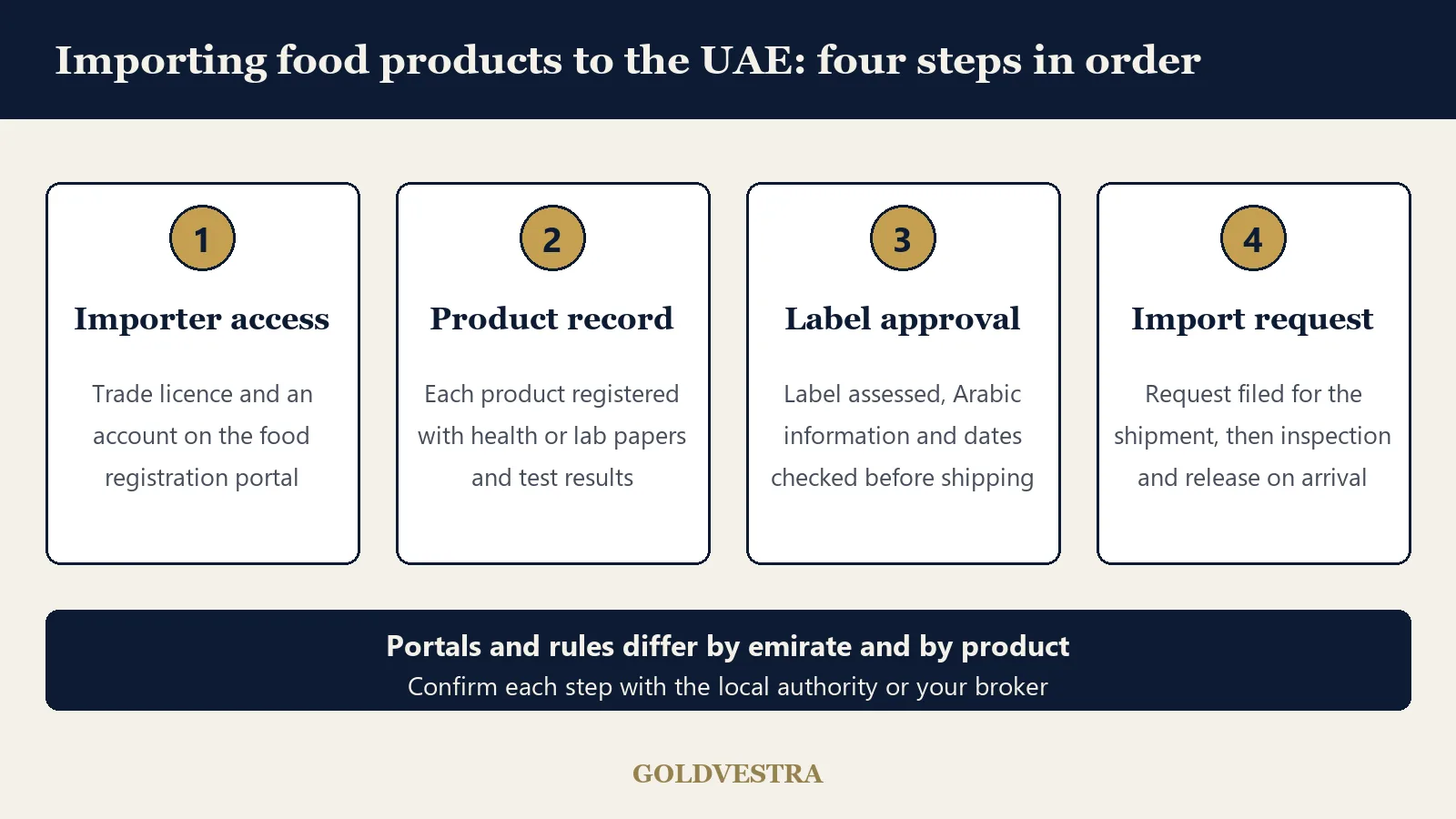
For food, importing food products to the UAE is a sequence: importer access, product registration, label approval, health papers and an import request. Each step depends on the one before it. This guide puts them in order for a trading company planning a first food or beverage import.
It is general information, not legal advice. Systems and rules differ by emirate and by product, so confirm every point for your own cargo with the authority or a licensed broker.
In this article
- Who controls importing food products to the UAE
- Step 1: importer access
- Step 2: product registration for importing food products to the UAE
- Step 3: labels for importing food products to the UAE
- Step 4: health and origin papers for importing food products to the UAE
- Step 5: import request and inspection
- Checklist for importing food products to the UAE
- Common mistakes
- Frequently asked questions
Who controls importing food products to the UAE
The main source for this guide is the USDA FAIRS Country Report for the UAE (November 2025). It was written for U.S. suppliers, but it describes how the UAE side works. We also checked the U.S. International Trade Administration labelling summary.
Responsibility is shared. At federal level, the Ministry of Climate Change and Environment (MOCCAE) and the Ministry of Industry and Advanced Technology (MOIAT) set the laws and standards for food. MOCCAE also covers plant and animal quarantine.
Municipalities in each emirate then enforce those rules at the port. They handle inspection, testing, label approval and the release of shipments. That is why the same product can meet different procedures in Dubai and in another emirate.
Some foods also need a permit before import. Our guide to UAE restricted and prohibited imports shows how to find the right authority for a regulated product.
Step 1: importer access for importing food products to the UAE
Before importing food products to the UAE, the importer, not the foreign supplier, needs access to a registration portal. The report names three: ZAD, a federal system for products destined for any emirate; FIRS, the Dubai Municipality Food Import and Re-export System; and ZADI, a Dubai platform that brings the import services together.
For FIRS, the report describes an online application with company details and the trade licence. The importer then visits Dubai Municipality to pay, and receives a username and password.
For the other six emirates, label assessment comes from the food control department of each municipality. If your goods will land outside Dubai, ask that department how it works before you plan the shipment.
A trade licence for the right activity is the base.
Step 2: product registration for importing food products to the UAE
When importing food products to the UAE, every food item must be registered before it is imported. The portal asks for the product’s label, packaging and an official certificate from a competent authority in the country of origin. The importer applies online.
Pack size matters. The report states that a 100 g pack and a 200 g pack of the same food count as different items and must be registered separately. A change to the packaging, weight, label or barcode needs a fresh label assessment.
Laboratory testing in Dubai
A food item registered for the first time for import into Dubai goes through laboratory testing by Dubai Municipality. The test depends on product safety risks and how often the item is imported. The report says results can take up to five working days, depending on the test.
One rule deserves attention. If the lab finds an ingredient or additive that is not on the label, the product is rejected.
Once a product is registered in ZAD, the report says the importer may apply for an import permit and bring shipments through any UAE port.
Step 3: labels for importing food products to the UAE
Labels are where many cases of importing food products to the UAE go wrong. The report cites the standard UAE.S GSO 9:2019, “Labeling of Prepackaged Food Stuffs”, and the standards it refers to.
| Label item | What to check |
|---|---|
| Language | Arabic is required. If you add another language, the information must be identical to the Arabic. The trade.gov summary says labels may be Arabic only or Arabic and English. |
| Product name and ingredients | Name in a prominent position. Ingredients in descending order of proportion, with additives named by class. |
| Nutrition and net quantity | A nutritional declaration and the net weight or volume. |
| Manufacturer and origin | Name and address of the manufacturer or packer, and the country of origin. |
| Dates and storage | Production and expiry dates where shelf life is mandatory, plus storage conditions that affect the date. |
| Batch and use | A production lot number, coded or marked indelibly, and instructions for use. |
Arabic stickers
Stickers can translate a label into Arabic. According to the report, they must be approved during the label assessment, applied once before export, and cannot be added on arrival. They must not hide required information or contradict the original label.
Dates and barcodes
Production and expiry dates must be printed on the original label or primary packaging in indelible ink. Dates only on a sticker are not accepted. Only one set of dates is allowed.
Barcodes must be unique. The report says a barcode cannot be re-registered with a different item description, such as another weight, brand or ingredient list.
Step 4: health and origin papers for importing food products to the UAE
The papers for importing food products to the UAE depend on the product category. For regulated categories such as meat, fish, eggs, grains, animal feed and planting seeds, the report says an original health certificate from the exporting country’s competent agency is required.
The report adds that the certificate must carry shipment details, such as quantity, weight, description, invoice number, container or airway bill number, exporter, importer and a statement that the goods are fit for human consumption.
Other processed foods
For processed or shelf-stable foods, the report lists a certificate of free sale issued by the exporting country’s authority. Its examples are U.S. documents, so ask your importer or broker what applies to your origin.
Meat and halal
Meat and meat products need an original halal slaughter certificate. The trade.gov summary says halal-logo products need a certificate from an approved certifier.
Phytosanitary certificate and origin
A phytosanitary certificate is the plant-health document that the exporting country’s plant authority issues for plant products. MOCCAE handles plant quarantine in the UAE. We could not find an official list saying which plant foods need one, so confirm it per product.
A certificate of origin is a separate proof of where the goods were made, not a health certificate. Keep names and quantities consistent across all papers; our HS code classification guide covers the customs side.
Step 5: import request and inspection
In importing food products to the UAE, after registration and label approval, the importer files an import request in the portal. For FIRS, the report lists the port of entry, airway bill number, arrival date and country of origin among the details.
When the goods arrive, they may be inspected. The inspector checks that the cargo meets the standards and matches what you declared. If the cargo clears quarantine, the importer pays customs duty and releases the shipment.
If a shipment is detained or rejected, FIRS notifies the importer, who can appeal through the same portal.
Duty, the customs declaration and port release follow their own rules. See our guide to customs clearance in Dubai for the clearance side.
Checklist for importing food products to the UAE
- Confirm the product category. Check whether it needs a prior permit or a special certificate.
- Open portal access. Get ZAD, FIRS or the local municipality account working before the order.
- Register each item. One entry per pack size, barcode and label version.
- Match label and formula. No ingredient or additive may be missing from the label.
- Approve Arabic stickers early. Include them in the label assessment and apply them before export.
- Collect certificates. Health, free sale, halal or phytosanitary papers, as your category needs.
- Check the dates. Production and expiry dates must be on the original packaging.
- Plan an inspection. A pre-shipment inspection at the factory catches label and packing errors before sailing.
If you want a second pair of eyes on the file, request a quote and tell us the product, origin and destination emirate.
Common mistakes
- Shipping first and registering the product afterwards.
- Registering one pack size and shipping another.
- Printing dates on a sticker instead of the original packaging.
- Using an English-only label for retail sale.
- Changing the label after approval without a new assessment.
- Assuming Dubai rules apply unchanged in every other emirate.
Each is cheap to fix before the cargo leaves. Treat importing food products to the UAE as a project with a start date well before the sailing date.
Frequently asked questions
What do I need before importing food products to the UAE?
A registered importer and registered products. The report says every food item must be registered by the importer before import, through ZAD, ZADI or, in Dubai, FIRS. Registration needs the label, packaging and an official certificate from the country of origin. Different pack sizes of the same food are registered separately.
Which authority handles food import permits?
It is shared. MOCCAE and MOIAT set federal rules, and each emirate’s municipality enforces them at the port, including inspection, testing and label approval. In Dubai that is Dubai Municipality. Check with the authority in the emirate where your goods will land.
Do food labels have to be in Arabic?
Yes. Labels must carry Arabic, and any other language must match the Arabic information. Arabic stickers are accepted if approved in the label assessment and applied before export, not on arrival. Production and expiry dates must be on the original packaging.
What certificates do imported food products need?
It depends on the category. Meat, fish, eggs, grains and similar products need a health certificate from the exporting country. Processed foods may need a certificate of free sale. Meat needs a halal slaughter certificate. Confirm the list for your product with the authority.
Does Dubai test imported food?
Food items imported into Dubai for the first time are tested by Dubai Municipality. The report says the test depends on product safety risks and import frequency, and results can take up to five working days. A product is rejected if an ingredient is missing from its label.
What happens if a food shipment is rejected?
The portal notifies the importer that the shipment is detained or rejected. In FIRS, the importer can appeal through the same system. Exact outcomes depend on the reason, so ask your broker for the written finding before you decide on re-export or other action.
Related reading
UAE Restricted Imports
Which goods need a permit and who issues it.
Customs Clearance in Dubai
How the clearance side of an import works.
Certificate of Origin
What it proves and when buyers ask for it.
Trade Documentation
Support with the papers behind a shipment.
Planning a first food import?
Tell us the product, origin and destination emirate. We will help you plan the import documents and supplier checks before you place the order.