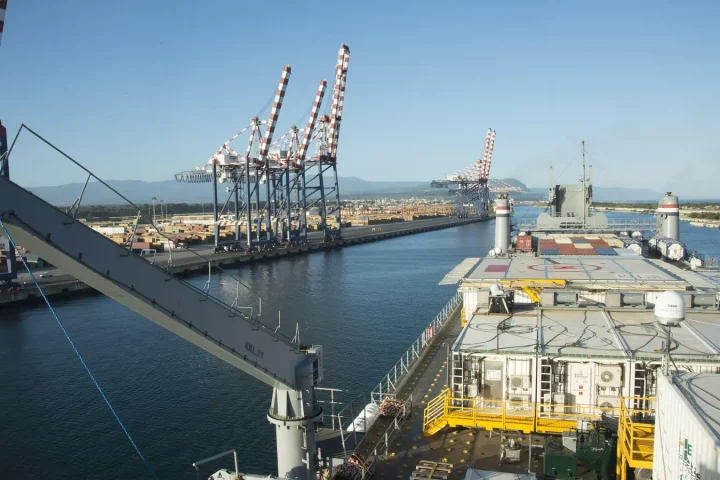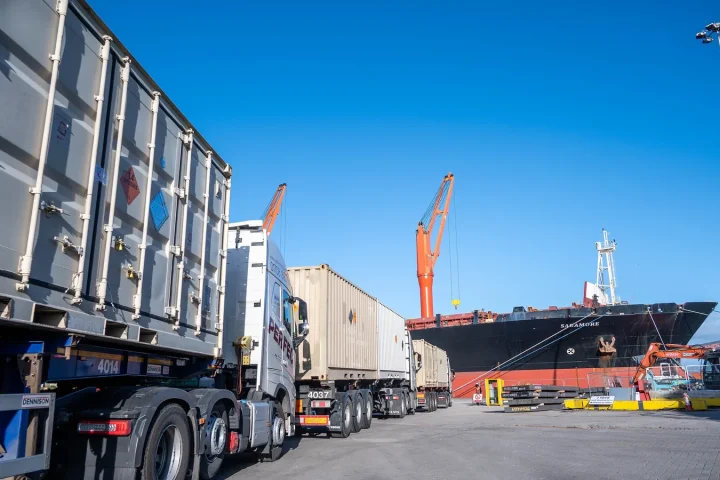
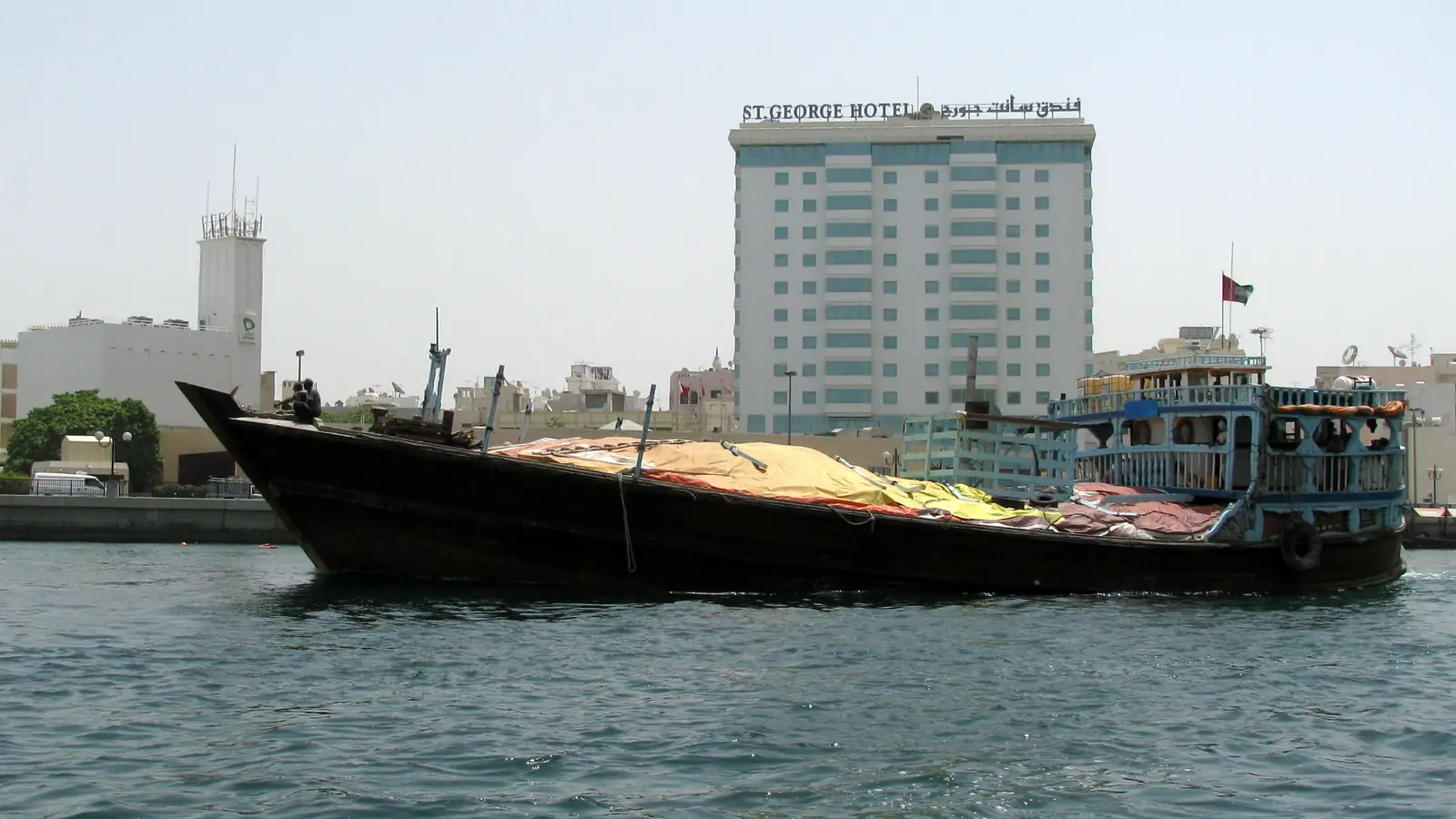
A buyer in Africa, Central Asia or the Gulf wants goods made in Asia or Europe. The supplier will not ship to that country directly, or the buyer wants one consolidated order. So the goods go through Dubai first.
That is the basic idea of re-export Dubai trade: goods are brought into Dubai, handled there, and sent on to another country. This guide explains how the process works for traders, how free zone and mainland routes differ, and which documents matter. It is general information, not legal or customs advice.
In this article
- What re-export means in Dubai
- Why traders use Dubai as a re-export hub
- Free zone vs mainland: two routes compared
- The re-export process in 7 steps
- Re-export documents to prepare
- Origin, labelling and what you can change
- Duty, VAT and costs: what to confirm
- Common mistakes to avoid
- Frequently asked questions
What re-export means in Dubai
Re-export means that goods are imported into a country and then exported again, usually without being sold on the local market. The goods often stay in their original form. Sometimes they are repacked, relabelled or split into smaller lots first.
It is different from a normal import, where the buyer clears the goods for use in the UAE. It is also different from transit, where goods only pass through. In re-export, a Dubai company usually owns or controls the goods for a time and then sells or forwards them to a buyer abroad.
Re-export Dubai rules are separate from temporary admission, a related concept. The Dubai Customs FAQ explains that goods brought in temporarily may need a deposit equal to the customs duty, which is refunded when the goods are re-exported within the allowed time. That is a specific regime with its own rules. Do not assume it applies to normal trading stock.
Why traders use Dubai as a re-export hub
The Dubai re-export hub role comes from location, infrastructure and a trade-friendly setup. Traders choose a re-export Dubai route for practical reasons:
- Consolidation. Goods from several suppliers can be gathered and shipped together.
- Access to ports and airports. Dubai connects to many destinations by sea and air, so onward routing options are wide.
- Storage and handling. Goods can wait for the buyer’s payment, inspection or shipping slot.
- Payment and credit flexibility. A UAE trading company can invoice the buyer abroad and pay the supplier separately.
- Relationships. Many suppliers and buyers already work with Dubai trading houses.
None of this removes the rules. Each step still needs correct documents and a proper declaration. For the import side of the flow, see our guide to importing from Dubai.
Free zone vs mainland: two routes compared
Most traders pick between a free zone route and a mainland route. The right one depends on your licence, your goods and your customer. Our Dubai free zone vs mainland guide covers the licence side. For re-export Dubai shipments, the main points are below.
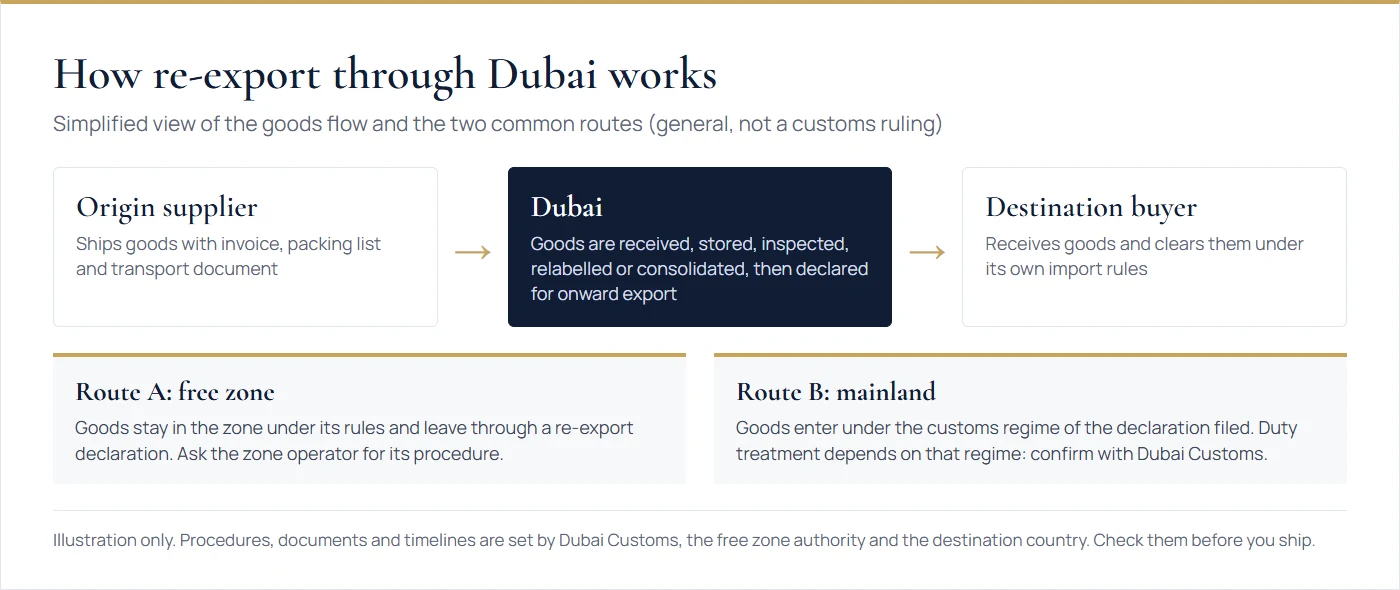
| Point | Free zone route | Mainland route |
|---|---|---|
| Where goods are held | Inside the free zone, under the zone operator’s rules | In a licensed warehouse or facility under the customs regime used |
| Customs status | Goods generally stay outside the UAE domestic market while in the zone | Depends on the declaration filed at import |
| Duty treatment | Generally not charged while goods stay in the zone: confirm with the zone | Depends on the regime and conditions: confirm with Dubai Customs |
| Onward shipping | Re-export declaration from the zone to the destination | Export or re-export declaration under the applicable procedure |
| Selling inside the UAE | Usually treated as an import into the mainland | Possible, with the normal import steps |
| Best for | Stock held for buyers abroad, consolidation, repacking | Traders who also sell to UAE customers |
This table is a simplified comparison. Free zones set their own procedures, so ask the zone operator for the current process before you commit.
The re-export process in 7 steps
The details change by zone, product and destination. This is the usual order of work for a re-export Dubai shipment.
- Confirm the deal. Agree the product, quantity, price and Incoterm with both the supplier and the final buyer.
- Check the goods. Confirm the HS code, and check whether the goods are restricted in the UAE or in the destination country. See our guide to UAE restricted imports.
- Choose the route. Decide between a free zone or a mainland route, and confirm that your licence covers the activity.
- Ship to Dubai. The supplier sends the goods with the commercial invoice, packing list and transport document.
- Declare and receive. The goods are declared on arrival, for example into the free zone or under the regime you chose. See customs clearance in Dubai for how declarations work.
- Handle the goods. Store, inspect, consolidate or repack as agreed, within what the rules allow.
- Re-export. File the re-export declaration, issue your own invoice to the buyer, and ship to the destination.
For any re-export Dubai deal, keep the paper trail from the first step to the last. Matching quantities, descriptions and values across every document prevents most queries.
Re-export documents to prepare
Re-export documents vary by shipment, but traders in re-export Dubai trade usually deal with the following. Treat this as a checklist to confirm, not a complete legal list.
- Commercial invoice from the original supplier, and your own invoice to the buyer abroad.
- Packing list that matches the goods and the invoice.
- Transport document, such as a bill of lading or air waybill, for each leg.
- Customs declarations for the arrival in Dubai and for the re-export.
- Certificate of origin, when the buyer, bank or destination customs asks for one.
- Permits or approvals for restricted or regulated goods, in the UAE and at the destination.
- Free zone documents, such as the zone’s delivery or release forms, when you use that route.
Our trade documentation service helps align these papers before shipment. For the difference between the three main commercial papers, see our invoice, packing list and proforma guide.
Origin, labelling and what you can change
Passing through Dubai does not, by itself, change where goods were made. In general, origin follows the place of production, and the rules for changing it are strict. Do not label goods as made in the UAE unless the goods genuinely qualify.
This matters because a buyer may need proof of origin for duty treatment or a trade agreement. Read our guide to the certificate of origin in the UAE to see who issues it and what it is used for.
Light handling such as repacking or relabelling for the destination market is common in re-export Dubai trade. What is allowed depends on the rules of the free zone or customs regime you use, and on the destination’s labelling laws. Ask before you change any packaging or marking.
Duty, VAT and costs: what to confirm
This guide does not quote duty rates or refund windows, because they depend on the regime, the goods and the date. Confirm them with the right authority before you price a deal.
- Customs duty. Ask Dubai Customs or the free zone how duty applies to your route and whether any deposit or refund process exists. The Dubai Customs FAQ is a starting point, and the U.S. International Trade Administration guide to UAE import tariffs gives wider context on UAE tariffs.
- VAT. Treatment of exports and of goods held in designated areas is set by the UAE Federal Tax Authority. Check it with your tax adviser.
- Handling and storage. Free zone or warehouse fees, handling, repacking and insurance.
- Freight and fees. Freight for both legs, declaration fees and agent charges.
- Finance. Payment terms with the supplier and the buyer rarely match, so plan cash flow.
Build a landed cost sheet for the whole re-export Dubai route, not only for the Dubai leg. Our import and export coordination service can help organise the steps and hand-offs.
Common mistakes to avoid
- Assuming the free zone solves everything. Zone rules, your licence and the destination’s rules still apply.
- Skipping the destination check. Import rules, permits and sanctions or export-control rules at the destination can stop a shipment.
- Mismatched documents. Different descriptions or quantities between invoices and the packing list cause queries.
- Wrong origin claims. Never mark goods with an origin they do not qualify for.
- Unclear Incoterms. Decide who arranges and pays each leg before the goods ship.
- Relying on old information. Check current procedures with Dubai Customs or the zone operator for each shipment.
If you plan to import from the UAE as well as ship onward, keep the two flows separate in your records.
Frequently asked questions
What is re-export in Dubai?
Re-export in Dubai means bringing goods into Dubai and sending them on to another country, usually without selling them on the local market. The goods may be stored, consolidated or repacked first. A re-export declaration is normally filed when they leave, and the buyer abroad clears them under its own import rules.
Is re-export from Dubai the same as transit?
No. In transit, goods only pass through the country, normally on one transport document and without a change of hands. In re-export, a Dubai company usually receives the goods, may store or handle them, and then exports them under a separate declaration and often a new invoice to the buyer.
Do I need a free zone licence to re-export from Dubai?
Not always. Traders can use a free zone or mainland route, depending on the licence activity and the goods. Check that your licence covers trading and re-export activity, and confirm the process with the zone operator or Dubai Customs.
Is customs duty paid on re-exported goods?
It depends on the route and regime. Goods held in a free zone are generally not charged UAE duty while they stay there. Other routes may use deposits or refund processes. Confirm the current rules with Dubai Customs before you quote a price to your buyer.
Which documents are needed to re-export goods from Dubai?
Traders usually need the supplier’s commercial invoice, packing list, transport documents and customs declarations for both the arrival and the departure. A certificate of origin, permits and free zone forms may also apply. The destination country’s rules decide the final list.
Does re-exporting through Dubai change the country of origin?
In general, no. Passing through Dubai does not change where goods were made. Origin follows the place of production and strict rules. Never label goods as made in the UAE unless they genuinely qualify under those rules, and ask the issuing body if unsure.
Related reading
Dubai Free Zone vs Mainland
Which setup fits your trading model.
Customs Clearance in Dubai
Steps, documents and common delays.
Certificate of Origin in the UAE
Who issues it and when buyers ask for it.
Trade Documentation
Invoices, packing lists and shipping papers.
Import from UAE
Sourcing goods through a Dubai trading partner.
Planning a re-export shipment through Dubai?
Send us the product, quantity, origin and destination. We will review the coordination and documents needed and follow with a proposal.