A sea freight quote rarely shows one price. It shows a base rate and a list of extra lines with short codes such as BAF, THC and PSS. Ocean freight surcharges are those extra lines, and they decide whether a cheap-looking quote stays cheap.
This guide explains each charge in plain words, shows who normally pays it under FOB, CIF and DAP, and gives you a method to ask for an all-in quote and compare two offers fairly.
It is a general guide. Charge names, rates and rules differ by carrier, port and trade lane, so always confirm against the written quote. For late-stage costs, see our guide to demurrage and detention charges in Dubai.
In this article
What ocean freight surcharges are
Carriers and forwarders price a container move in two layers. The first is the base rate, the price to move one container between two ports. The second is a set of charges added on top for costs the base rate does not cover.
Carriers publish many of these as separate lines in their tariffs. The public Maersk rate notice for the Far East to UAE lane shows this clearly: the peak season surcharge is a stated amount per container, by container type, with its own effective date. You can read it in the Maersk peak season surcharge notice.
Think of a quote as three blocks, as the chart shows: origin charges, the ocean leg, and destination charges. Surcharges sit in all three.
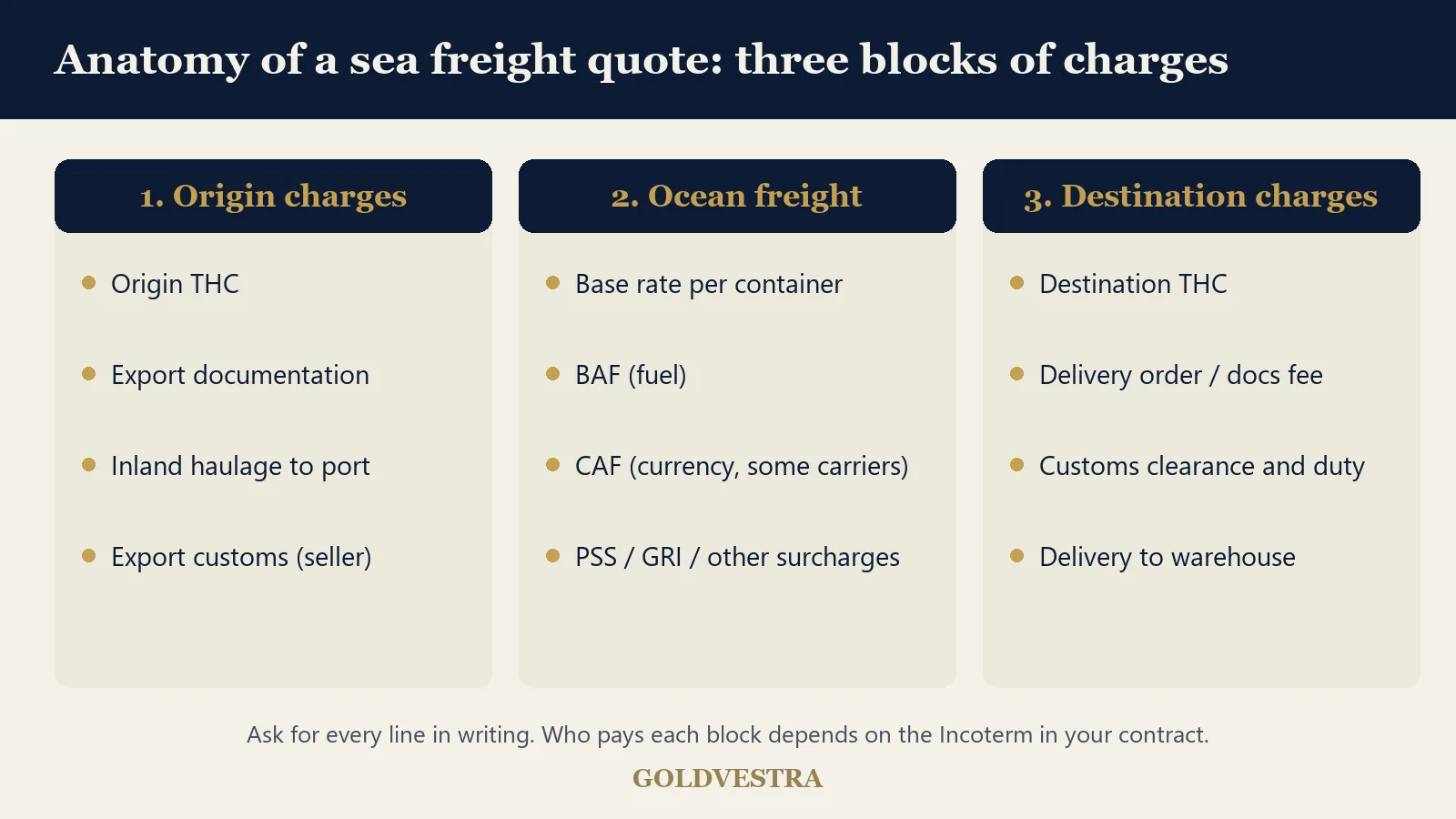
Surcharges are one part of landed cost. For the full picture, including duty, VAT and inland delivery, read our guide to import cost factors.
BAF and CAF: fuel and currency
BAF: bunker adjustment factor
BAF is the fuel surcharge. Ships burn bunker fuel, and its price moves. Instead of changing the base rate each time, carriers keep the base rate stable and adjust BAF.
Most carriers review BAF on a schedule, often monthly or quarterly, using a published method. The amount is usually per container and depends on the lane and container size.
CAF: currency adjustment factor
CAF covers exchange-rate movement between the currency the carrier earns in and the currency it spends in. Some carriers still list it. Many have folded it into the base rate or no longer use it.
If your quote shows a CAF, ask whether it is a fixed amount or a percentage, and which currency pair it follows.
THC: terminal handling charges
THC is the fee for moving a container between the ship and the terminal yard, plus gate and yard handling. It is charged at both ends. Origin THC (OTHC) applies at the port of loading. Destination THC (DTHC) applies at the port of discharge.
THC is a local charge, so it follows the tariff of the port or the carrier at that location. It is billed per container, not per kilo.
Why THC causes arguments
- Some carriers include one side of THC in the freight rate, and others bill it separately.
- The same charge must not appear twice. If the seller already paid origin THC, you should not be billed for it again.
- Destination THC on a CIF shipment is a known grey area, covered in the table below.
Always ask which THC is included in the rate and which is billed locally. If the quote just says “local charges”, ask for the list.
PSS and GRI: seasonal and general increases
PSS: peak season surcharge
Carriers add PSS when demand is high and space is tight. It is a fixed amount per container for a set lane and period, announced in advance. The Maersk notice linked above shows how a PSS is published: lane, container type, amount and start date.
The key point for importers is timing. PSS can start and end between your quote and your sailing, so ask which date the carrier uses to decide the rate.
GRI: general rate increase
A GRI is a carrier-wide increase to the base rate on a lane. Carriers announce it ahead of time, but it only sticks if the market accepts it. A quote that says “subject to GRI” can rise before you ship.
If you ship in busy months, compare modes too. Our guide to air freight vs sea freight shows when the sea leg stops being the cheaper option.
Documentation and other hidden fees
Beyond the headline surcharges, quotes often hide smaller lines. They are usually legitimate, but they add up and are easy to miss. Look for these:
- Documentation fee: the cost of issuing the bill of lading and related paperwork, at origin and sometimes at destination.
- Delivery order (D/O) fee: charged at destination to release the cargo to you or your agent.
- Seal, VGM and similar origin fees: small per-container or per-shipment lines.
- Emergency or congestion surcharges: added by some carriers when a port or route is disrupted.
- Container cleaning, return or inspection-related fees: local charges that depend on the terminal and the shipment.
- Demurrage and detention: not surcharges, but the largest unexpected cost if cargo or containers sit too long. See our guide to demurrage and detention charges in Dubai.
The names differ by carrier. What matters is that every charge appears on the quote with its basis (per container, per bill of lading or per cubic metre) and its currency.
For part-container shipments, the basis changes again, because LCL is usually priced per cubic metre or tonne. Our FCL vs LCL shipping guide explains the difference.
Who pays what under FOB, CIF and DAP
The Incoterm in your contract decides which side pays each block of charges. The table shows the usual allocation for a sea shipment to the UAE. It is a simplified summary of the ICC Incoterms 2020 rules, so check the exact wording in your contract and the ICC Incoterms 2020 overview.
| Charge | FOB | CIF | DAP |
|---|---|---|---|
| Origin THC and export documents | Seller | Seller | Seller |
| Ocean freight, BAF, PSS and other freight surcharges | Buyer | Seller | Seller |
| Destination THC | Buyer | Grey area: seller only if the contract of carriage puts it on the seller; many carriers bill the consignee | Normally seller, as part of carriage to the named place |
| Delivery order and destination documents | Usually buyer | Usually buyer | Agree in writing |
| Import customs clearance, duty and VAT | Buyer | Buyer | Buyer |
| Marine insurance | Buyer’s choice | Seller, minimum cover | Not required by the rule |
The CIF row is where most disputes start. Settle it before you ship, not at the port. Our guides to Incoterms 2020 for importers and DAP vs DDP in the UAE explain the terms in more depth.
How to ask for an all-in quote
An all-in quote lists every charge from the named origin point to the named delivery point, so the final cost has no surprises. Forwarders can give one if you ask for it clearly. Send this checklist with your request:
- State the Incoterm, origin port, destination port, container type and number of containers (or LCL volume and weight).
- Ask for the base rate and each surcharge on its own line: BAF, CAF if any, PSS, GRI and any other.
- Ask for origin and destination charges separately: THC, documentation and delivery order fees.
- Ask for the currency, the basis of each line and the rate validity dates.
- Ask which date fixes the surcharges: booking date, sailing date or arrival date.
- Ask what is not included, in writing: customs clearance, duty, VAT, inland delivery, demurrage and detention.
- Ask for the free days at destination and the terms after they end.
If you work with a forwarder for the first time, our guide on freight forwarder vs customs broker explains who does what. And if you want a second pair of eyes on a quote, send us the quotes you are comparing and we will help you read it.
How to compare two quotes
A lower base rate does not mean a lower total. Two quotes can look 10 percent apart on freight and end up the other way round once surcharges are added. Follow these steps:
- Put both quotes on the same basis: same Incoterm, same ports, same container type and same validity period.
- Build one table with the same rows for both: base rate, BAF, CAF, PSS, GRI, origin charges, destination charges, documents.
- Move every line into one currency, using the same exchange rate for both.
- Mark charges that are missing from one quote. A blank is not a zero; it may be billed later.
- Check which surcharges are fixed and which are “subject to change”.
- Compare transit time and free days as well as price. A slower service with fewer free days can cost more overall.
Finally, ask each forwarder to confirm in writing that the quote is all-in for the named scope. If one will not, that tells you something.
Common mistakes
- Comparing a CIF quote with an FOB quote without adding the missing freight.
- Ignoring destination THC because it was “local”.
- Treating an expired PSS as permanent, or a temporary one as included.
- Forgetting that port and clearance costs at the UAE end are billed separately.
Frequently asked questions
What are ocean freight surcharges?
Ocean freight surcharges are charges added on top of the base shipping rate. They cover costs the base rate does not, such as fuel (BAF), terminal handling (THC), peak demand (PSS) and documentation. Carriers list them as separate lines, and the amounts vary by lane, container type and date.
What does BAF mean in shipping?
BAF stands for bunker adjustment factor. It is a fuel surcharge that carriers adjust as bunker fuel prices change, so the base rate can stay stable. It is usually charged per container and reviewed on a published schedule. Ask your forwarder how the BAF in your quote is calculated and when it changes.
What is the difference between origin THC and destination THC?
Origin THC is the terminal handling charge at the port where cargo is loaded. Destination THC is the charge at the port where it is discharged. Both are billed per container. Which side pays depends on the Incoterm and the contract of carriage, so confirm both lines in writing.
When is the peak season surcharge applied?
Carriers apply a PSS when demand is high and capacity is tight, usually on named lanes for a set period. They announce it in advance with an amount per container and a start date. Ask which date fixes the rate for your shipment, such as booking or sailing date.
Is a quote with no surcharges really all-in?
Not always. Some quotes show only the base rate and bill THC, documents or surcharges later. Ask the forwarder to confirm in writing that the quote includes all charges from origin to the named delivery point, and ask what is excluded, such as duty, VAT and demurrage.
Who pays the ocean freight surcharges, buyer or seller?
It depends on the Incoterm. Under FOB the buyer pays ocean freight and its surcharges. Under CIF and DAP the seller pays them as part of carriage. Local charges at the destination port are a grey area under CIF, so agree who pays them before the goods ship.
Related reading
Demurrage and Detention Charges in Dubai
Costs that start when free days end.
FCL vs LCL Shipping
How container size changes the price basis.
Incoterms 2020 for Importers
What each rule means for your costs.
Import Cost Factors
What really makes up landed cost.
Bill of Lading Explained
The document behind documentation fees.
Need help reading a sea freight quote?
Send us the quotes, the Incoterm and the route. We will help you line up every surcharge and compare the real cost before you book.