A supplier offers you a low price “Ex Works”. It looks simple, until the goods are ready and nobody can file the export declaration. EXW vs FCA is one of the most practical choices an importer makes, because the two terms look alike but split the work and the risk very differently.
This guide compares EXW vs FCA under Incoterms 2020, shows who does what in a table, and explains why FCA is usually the safer term for a buyer in the UAE. It also covers the cases where EXW still makes sense.
It is a general guide, not legal advice. Always confirm the wording against your contract and the ICC Incoterms 2020 overview. For the full set of rules, start with our guide to Incoterms 2020 for importers.
In this article
- EXW meaning: what the buyer takes on
- FCA Incoterm: what changes for the buyer
- EXW vs FCA responsibilities: side-by-side table
- Export clearance: the main EXW risk
- EXW vs FCA: where risk and cost transfer
- When EXW still works
- EXW vs FCA: which Incoterm is safer for importers
- How to use FCA in your contract
- Frequently asked questions
EXW meaning: what the buyer takes on
EXW stands for Ex Works. Under this rule the seller delivers by making the goods available at its own premises, or at another named place such as a factory or warehouse. That is where the seller’s job ends.
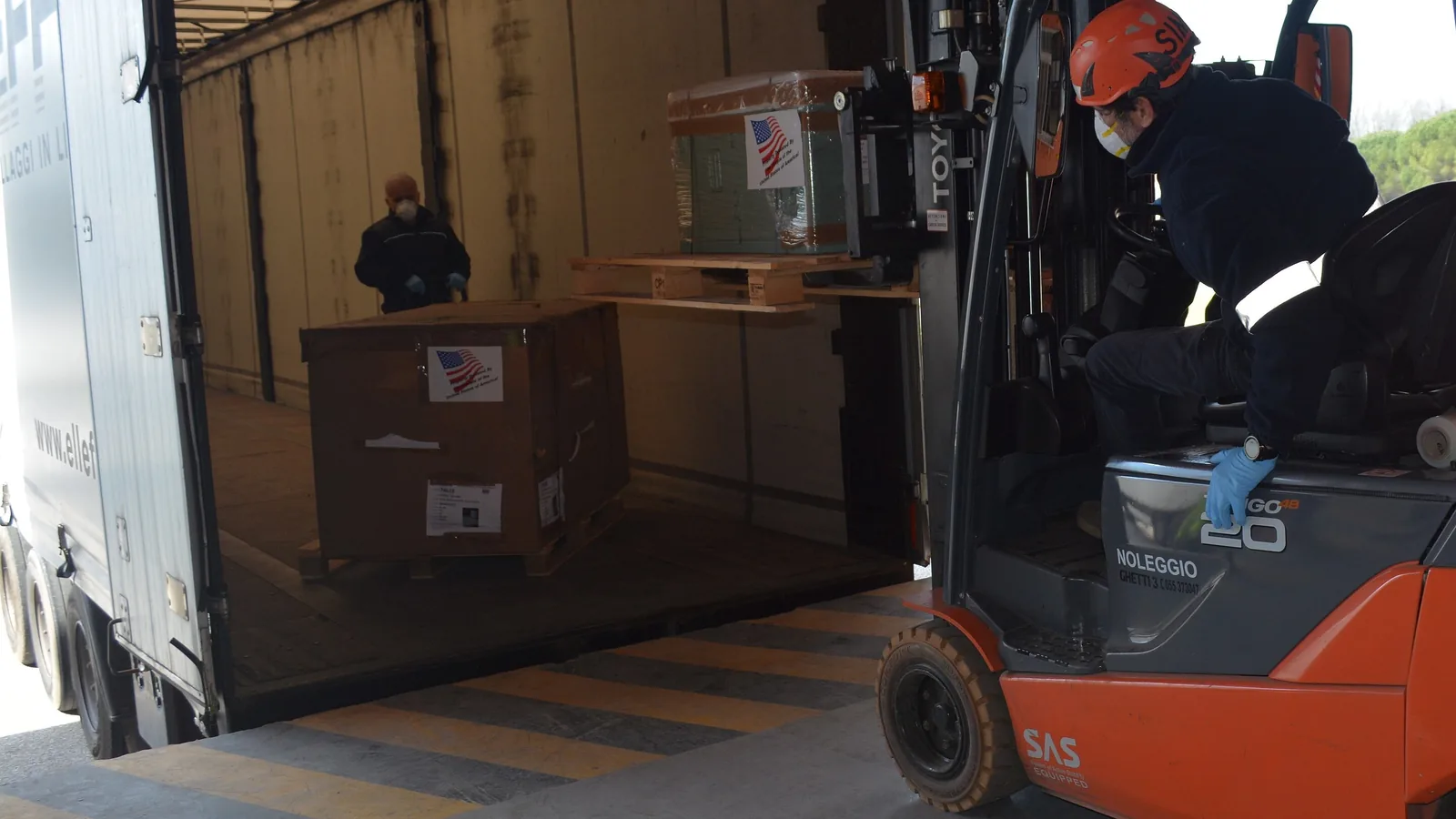
The seller does not load the goods onto your truck. The seller is also not responsible for clearing the goods for export. If the seller helps with either, it does so at your risk and cost.
What EXW means in practice
- You arrange and pay for pickup, loading and the main transport.
- You, or your agent, handle export clearance in the seller’s country.
- You carry the risk from the moment the goods are placed at your disposal, including during loading.
- You also handle import clearance, duty and VAT in the UAE.
This is why EXW looks cheap on a quotation. The seller’s price leaves out everything after the factory gate, so the real cost sits with you.
FCA Incoterm: what changes for the buyer
FCA stands for Free Carrier. The seller delivers the goods to a carrier or another person you nominate, at a named place. It works for any mode of transport, as the U.S. International Trade Administration guide to Incoterms also notes.
Two points decide EXW vs FCA in favour of FCA for most importers:
- The seller clears the goods for export. The export declaration stays with the party that is based in the exporting country.
- Delivery and loading are defined. If the named place is the seller’s premises, the seller loads the goods onto your vehicle and carries the loading risk. If the named place is elsewhere, the seller delivers on its own vehicle, ready for unloading.
The on-board bill of lading option
Incoterms 2020 added an option to FCA for sea shipments. The parties can agree that the buyer instructs its carrier to issue a bill of lading with an on-board notation to the seller after loading. This helps when a letter of credit or the seller’s bank asks for that document.
EXW vs FCA responsibilities: side-by-side table
This table compares EXW vs FCA for a shipment from a supplier abroad to the UAE. It simplifies the ICC rules, so check the exact wording in your contract.
| Item | EXW | FCA |
|---|---|---|
| Delivery point | Goods made available at the seller’s premises or named place | Goods handed to the buyer’s carrier at the named place |
| Loading on the vehicle | Buyer (not the seller’s duty) | Seller, if delivery is at the seller’s premises |
| Export clearance and export licences | Buyer, with seller assistance on request at buyer’s cost and risk | Seller |
| Main carriage (freight) | Buyer | Buyer |
| Cargo insurance | No duty on either side; buyer decides | No duty on either side; buyer decides |
| Import clearance, duty and VAT | Buyer | Buyer |
| Risk transfers | When goods are placed at the buyer’s disposal | On delivery to the carrier at the named place |
| Transport modes | Any mode | Any mode |
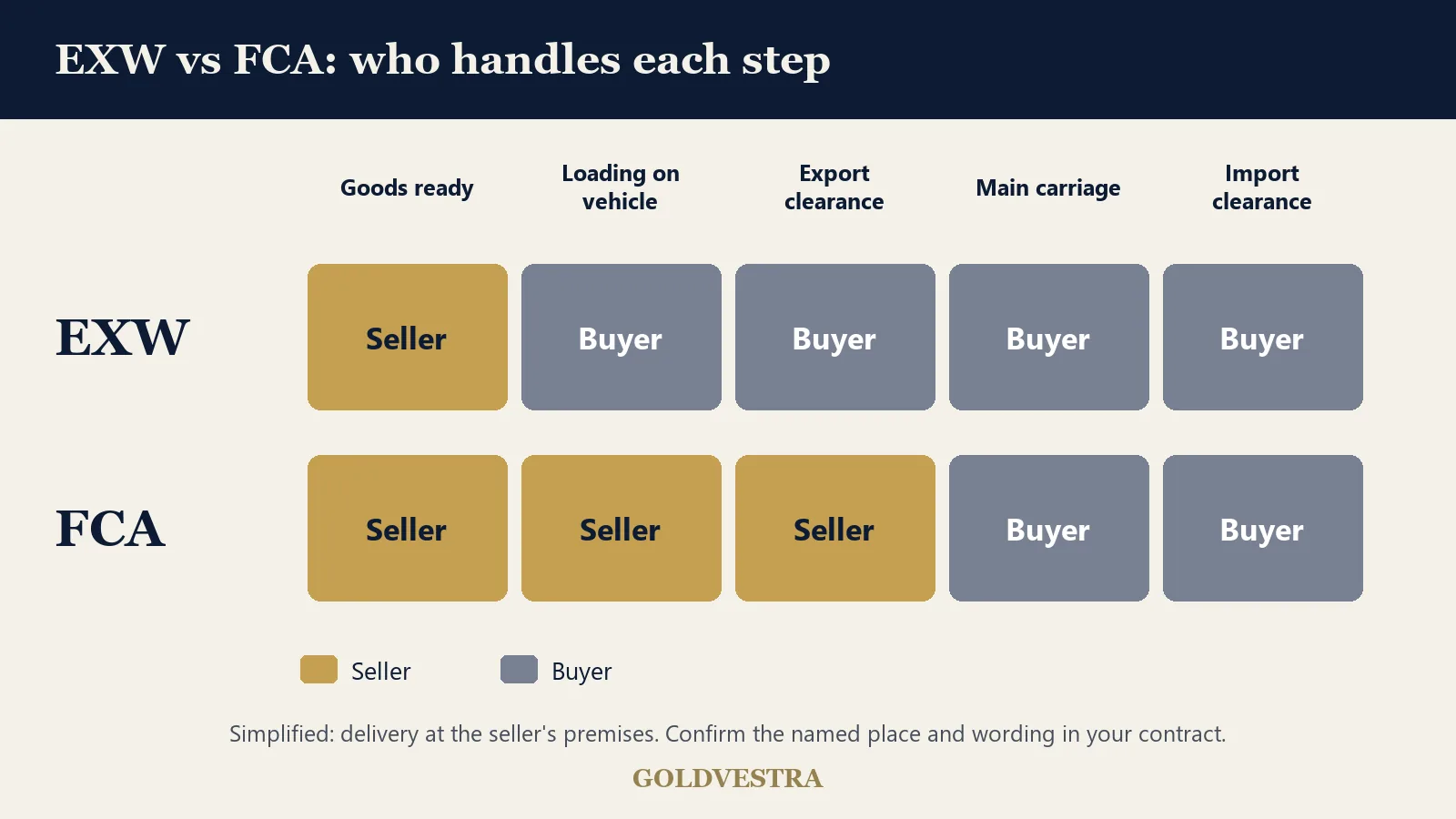
Neither term makes the seller pay for freight or insurance. For that you need terms such as CIF or DAP, covered in our guide to DAP vs DDP in the UAE.
Export clearance: the main EXW risk
Export clearance is where EXW vs FCA matters most. Under EXW, the buyer is responsible for the export formalities in the seller’s country. A buyer in the UAE is often far from that country’s customs system, language and rules.
In some countries it can be hard for a foreign buyer to file an export declaration at all, because the process expects a locally registered exporter. Ask your forwarder what applies in the seller’s country before you accept EXW.
What can go wrong under EXW
- The goods sit at the factory while you look for a local agent to file the export declaration.
- The seller’s papers do not match what the agent declares, and clearance is delayed.
- Export licences or permits are required, and the seller is not obliged to obtain them for you.
- Proof of export, which the seller may need for its own records, is slow to arrive.
The ICC’s own usage guidance warns that parties should think carefully before using EXW for cross-border trade, and points to FCA as the better fit when export clearance matters.
If you use EXW, appoint a forwarder in the seller’s country early. Our guide on freight forwarder vs customs broker explains how the roles split. Prepare the paperwork with our trade documentation checklist.
EXW vs FCA: where risk and cost transfer
In EXW vs FCA, both terms move risk to the buyer at the point of delivery. The difference is where that point sits and who is on site when it happens.
Loading risk
Under EXW, delivery happens before loading. If the goods are damaged while a forklift puts them on your truck, the loss is yours, even if the seller’s staff did the loading. Under FCA at the seller’s premises, delivery happens once the goods are loaded on your vehicle, so the seller carries that risk.
Cost control
In an EXW vs FCA price comparison, EXW can look cheaper, but a seller’s price rarely includes what a local forwarder will charge for pickup, export formalities and handling. FCA prices usually include the export steps, so the quotes are easier to compare.
Neither term requires insurance. Decide who insures the goods and from which point, and read our guide to cargo insurance for importers.
When EXW still works
EXW is not wrong. It suits a buyer who wants full control and has the means to use it. In EXW vs FCA, EXW fits only if all of these are true:
- You have a reliable forwarder or agent in the seller’s country.
- That agent can file export declarations and arrange pickup on your behalf.
- You know the export rules and licence needs for your product.
- You have inspected the seller’s loading practice, or you will supervise loading.
EXW is also common for domestic sales, where no export formalities exist. For cross-border trade, many buyers who start with EXW later switch to FCA with the same seller.
EXW vs FCA: which Incoterm is safer for importers
In the EXW vs FCA choice, FCA is the safer option for most importers. It keeps export clearance with the seller, defines the handover point and gives you a clear moment when the carrier takes the goods.
Choose FCA when
- You do not have an agent in the seller’s country.
- The goods need export documents or permits from the seller’s side.
- You want the seller to carry the loading risk at its own premises.
- A bank or letter of credit needs an on-board bill of lading.
Choose EXW when
- You control the whole origin process through your own agent.
- You want to buy at the factory price and manage every step yourself.
- The sale is domestic or between parties inside one customs area.
Safer does not mean risk-free. FCA still leaves freight, insurance and import clearance with you. If you want one party to coordinate origin pickup, export, freight and UAE clearance, our logistics coordination service can help.
How to use FCA in your contract
- Write the term in full: FCA, the named place, and Incoterms 2020. For example, “FCA [seller’s factory, city, country], Incoterms 2020”.
- Name the exact place. A precise address or terminal avoids disputes about where delivery happens and who loads.
- Name the carrier or forwarder you will nominate, and give the seller a pickup window in writing.
- State who obtains export licences and documents, and which documents the seller must send you.
- Agree insurance separately, and decide whether an on-board bill of lading is needed.
- Ask the seller to send export documents as soon as clearance is done.
Unsure about EXW vs FCA for a purchase? request a quote for your shipment and tell us the supplier country, goods and route. We will help you set up the shipment terms before you commit.
Frequently asked questions
What is the difference between EXW and FCA?
Under EXW the seller only makes the goods available at its premises, and the buyer loads them and clears them for export. Under FCA the seller clears the goods for export and hands them to the buyer’s carrier at a named place, loading them if that place is the seller’s premises.
Which is safer for importers, EXW or FCA?
FCA is usually safer. The seller handles export clearance, and the handover point and loading duty are clearer. EXW leaves export formalities and loading risk with the buyer. EXW can still work if you have a reliable agent in the seller’s country who can manage the whole origin process.
Who pays for export clearance under EXW?
The buyer. Under EXW the seller has no duty to clear the goods for export. The seller must help with documents on request, but at the buyer’s risk and cost. Under FCA, the seller carries out export clearance and pays for it as part of its obligations.
Does FCA include freight or insurance?
No. Under FCA the buyer arranges and pays for main carriage, and neither side must buy cargo insurance. The seller only delivers the goods to your carrier at the named place. If you want the seller to pay freight, look at terms such as CIF, DAP or DDP.
Can I use EXW or FCA for air and sea shipments?
Yes. Both EXW and FCA are rules for any mode of transport, so you can use them for sea, air, road or multimodal shipments. The sea-only rules are different: only FOB, CFR, CIF and FAS are limited to sea and inland waterway transport.
Who is responsible for import clearance under EXW and FCA?
The buyer, under both terms. You, or your customs broker, handle import clearance, duty and VAT in the UAE. The seller does not take on these steps under either rule. Keep the commercial invoice, packing list and transport document ready to avoid delays.
Related reading
Incoterms 2020 for Importers
What each rule means for your costs.
DAP vs DDP in the UAE
Delivered terms and who clears the goods.
Trade Documentation Checklist
The papers you need for each shipment.
Freight Forwarder vs Customs Broker
Who handles which step.
Choosing between EXW and FCA for your next order?
Send us the supplier country, the goods and the route. We will help you set the Incoterm, plan export clearance at origin and line up delivery to the UAE.