

A supplier sends three PDFs that look almost the same. One says proforma, one says invoice, one says packing list. Which one do you pay against, and which one goes to customs?
This guide compares the commercial invoice vs packing list vs proforma invoice in plain terms: what each document is, when it is issued, what it contains and why the numbers must agree. It is general information, not legal or customs advice.
In this article
- Commercial invoice vs packing list vs proforma invoice: the short answer
- What a proforma invoice means
- What a commercial invoice does
- What a packing list covers
- Side-by-side comparison table
- Where each document sits in the deal
- 5 mismatches that delay a shipment
- How to check the set before you pay
- Frequently asked questions
Commercial invoice vs packing list vs proforma invoice: the short answer
Each document answers a different question.
- Proforma invoice: what will you charge if I order? It is an offer, issued before the sale.
- Commercial invoice: what am I being charged for the goods I bought? It is the bill, issued at shipment.
- Packing list: what is physically in each package? It describes the cargo, not the price.
The proforma comes first. The other two travel with the shipment and are read together by the carrier, the bank and customs. If they disagree, someone has to stop and ask why.
What a proforma invoice means
A proforma invoice is a quotation in invoice form. The U.S. International Trade Administration describes it as a negotiating tool between seller and buyer before an export shipment, and notes that it eventually becomes the final commercial invoice used at customs in the importing country.
In practice, the proforma invoice meaning is simple: it fixes the terms you are about to agree. Buyers often need it to open a payment, apply for an import approval or arrange a bank transfer.
What it usually contains
- Seller and buyer names and addresses.
- Product descriptions, quantities and unit prices.
- Currency and total value.
- The delivery term (see our Incoterms guide) and the place it applies to.
- Payment terms and the validity date of the offer.
- Estimated shipping details, if known.
It is not a bill. Treat it as a draft of the deal, and keep it for comparison once the final invoice arrives.
What a commercial invoice does
The commercial invoice is the seller’s bill for the goods. According to the U.S. International Trade Administration, it is a legal document between exporter and buyer that states the goods sold and the amount to be paid, and it is one of the main documents customs uses to determine duties.
That is why it matters more than the other two. The declared value starts here. If you want to see how the value and duty are worked out, read our customs clearance in Dubai guide.
What it usually contains
- Invoice number and date.
- Seller, buyer and, where different, consignee details.
- A clear description of each product, with quantity and unit price.
- Currency, total value and the delivery term.
- Country of origin and HS code, where required.
- Payment terms and bank reference.
Vague descriptions cause trouble. “Spare parts” or “electronic goods” gives the officer little to check against the cargo.
What a packing list covers
A packing list describes how the goods are packed. The U.S. International Trade Administration says an export packing list is more detailed than a domestic one: it itemises the quantity, description and type of package, the number of packages, net and gross weight in kilograms, package marks and dimensions where appropriate.
It usually has no prices. Its job is to let the carrier, the warehouse and the inspector match what is written to what is on the pallet.
What it usually contains
- Reference to the invoice number and date.
- Package count and package type (carton, crate, pallet, drum).
- Contents of each package, with quantities.
- Net and gross weight per package and in total.
- Dimensions or volume, where relevant.
- Shipping marks that match the labels on the cartons.
A packing list is also what you use when you receive the goods. Count the cartons against it before you sign.
Side-by-side comparison table
| Proforma invoice | Commercial invoice | Packing list | |
|---|---|---|---|
| Main purpose | Quote and agree terms | Bill for the goods; value for customs | Describe the physical cargo |
| Issued | Before the order or payment | When the goods ship | When the goods are packed |
| Shows prices | Yes, as an offer | Yes, as the final charge | Usually no |
| Shows weights and packages | Rarely, estimated at most | Sometimes totals | Yes, in detail |
| Used by | Buyer, bank, approval bodies | Customs, bank, carrier, buyer | Carrier, warehouse, inspector, customs |
| Typical mistake | Treated as the final invoice | Value or description differs from the deal | Weights or counts differ from the invoice |
Use the table as a first check. Requirements differ by country, product and carrier, so confirm the exact set with your clearing agent before the cargo is booked.
Where each document sits in the deal
The three documents appear at different moments in the same transaction.
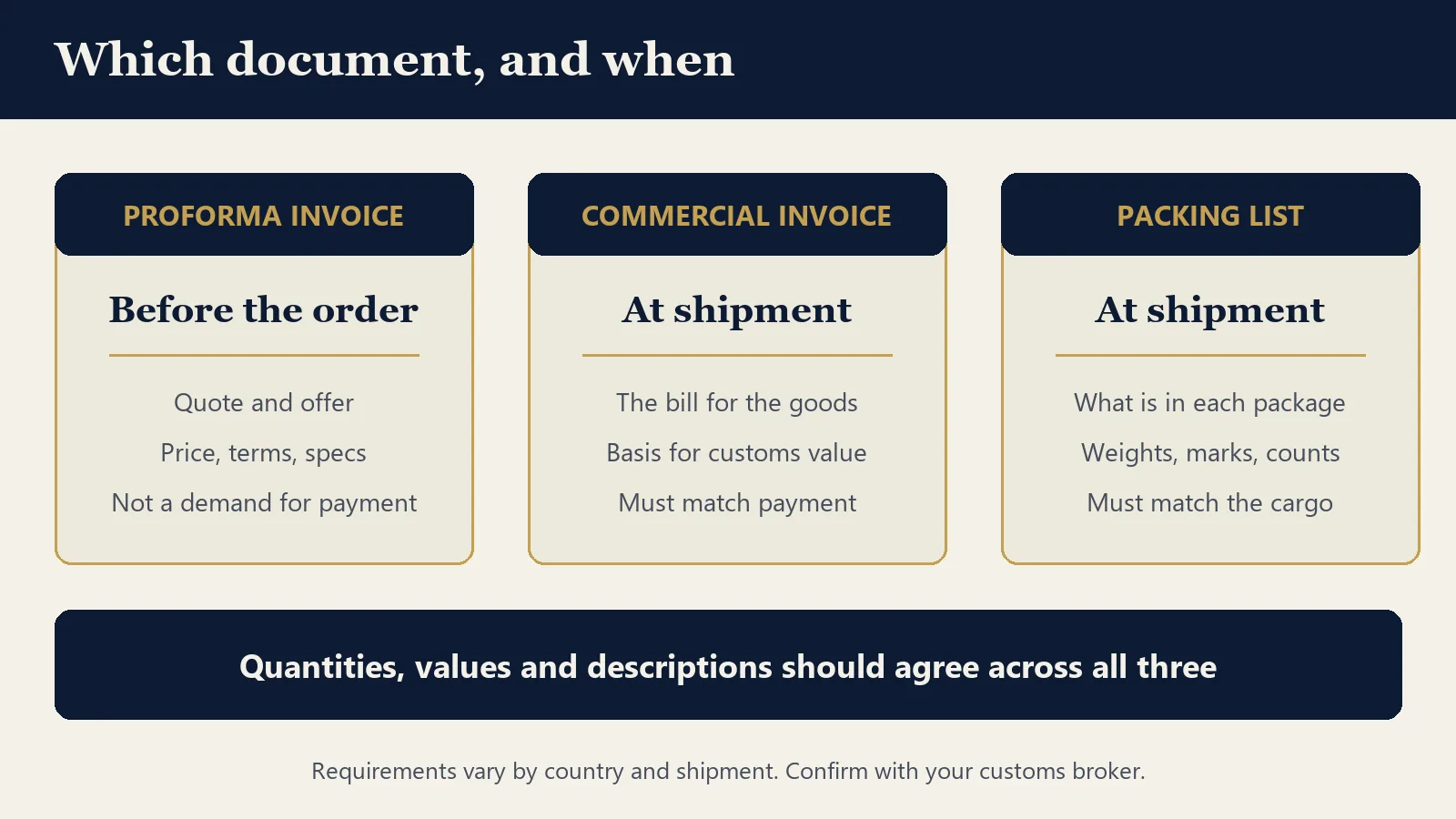
- Quote. The seller sends a proforma invoice with prices and terms.
- Agree and pay. The buyer confirms the order and pays as agreed. See our payment terms guide for common structures.
- Pack and ship. The seller prepares the packing list and the cargo is booked. The carrier issues the transport document; our bill of lading explained article covers it.
- Invoice. The seller issues the commercial invoice for the shipped goods.
- Declare and clear. The importer or agent files the declaration with the invoice and the other papers.
The Dubai Customs FAQ confirms that a customs declaration is filed by a company holding a business code, or by a licensed clearing agent the owner has authorised. The documents above are what that declaration is built from.
5 mismatches that delay a shipment
An invoice mismatch at customs is rarely dramatic. It is usually a small difference that nobody caught before the paperwork was sent.
- Quantity differs. The invoice says 500 units and the packing list counts 480.
- Weight differs. Gross weight on the packing list does not match the transport document.
- Description differs. The invoice names the product one way and the packing list another.
- Value differs from the deal. The commercial invoice does not match the proforma or the payment, with no explanation.
- Parties differ. Buyer or consignee names are spelled differently across documents.
Any of these can lead to questions, a request for corrected documents or a closer look at the cargo. How long that takes depends on the case, so do not count on a fixed turnaround.
If the shipment is already held, our customs clearance in Dubai guide explains the next steps.
How to check the set before you pay
Ask for drafts early. Fixing a typo on a draft costs nothing. Fixing it after the cargo has sailed can cost time and fees.
- Compare the final commercial invoice with the proforma line by line: items, quantities, unit prices, currency, delivery term.
- Compare the packing list with the invoice: same invoice number, same quantities, same descriptions.
- Check totals: package count, net and gross weight, and invoice value.
- Check names and addresses of seller, buyer and consignee against your records and the contract.
- Ask the supplier to explain every difference in writing before shipment.
- Keep the set together: proforma, commercial invoice, packing list, payment proof and transport document.
Our international trade documentation checklist lists the rest of the paperwork, and our trade documentation service is there if you want a second pair of eyes before you pay or ship.
Frequently asked questions
What is the difference between a commercial invoice and a proforma invoice?
A proforma invoice is a quotation issued before the sale to agree price and terms. A commercial invoice is the final bill issued when goods ship, and customs uses it to help determine duty. The proforma is an offer; the commercial invoice is the record of what was actually sold.
What is the difference between a packing list and a commercial invoice?
A commercial invoice states what is sold and what you pay. A packing list describes how the goods are packed: packages, contents, weights and marks. The invoice is about value; the packing list is about the physical cargo. They should agree on quantities and descriptions.
What does a proforma invoice mean in international trade?
A proforma invoice is a preliminary invoice-style document that quotes the goods, prices and terms before shipment. Buyers use it to agree the deal, arrange payment or request approvals. It is not a demand for payment, and it does not replace the final commercial invoice.
Can I use a proforma invoice for customs clearance?
Customs relies on the commercial invoice to determine value and duty, so that is the document to prepare. Whether a proforma is accepted in a particular case depends on the authority and the shipment. Ask your clearing agent before relying on it.
Does a packing list need prices?
A packing list usually does not show prices. Its purpose is to describe packages, contents, weights and marks. Some suppliers add reference numbers that link it to the invoice. Confirm with your clearing agent if a buyer or authority asks for a specific format.
What happens if the commercial invoice and packing list do not match?
A mismatch can lead to questions, a request for corrected documents or a closer check of the cargo, which may delay clearance. Ask the supplier to correct the documents before shipment. Fixing them early is usually faster than fixing them after arrival.
Who prepares each document?
The seller or exporter normally prepares all three. The buyer should review drafts and ask for corrections before shipment. A freight forwarder or clearing agent can check that the set is consistent, but the seller remains the source of the information.
Related reading
Trade Documentation Checklist
The papers behind every shipment.
Bill of Lading Explained
The transport document and who can take delivery.
Customs Clearance in Dubai
Steps, documents and common delays.
Trade Documentation
Documents that support the declaration.
Want the paperwork checked before you pay?
Send us the product, quantity and route. We will review the documents and coordination needed and follow with a proposal.