
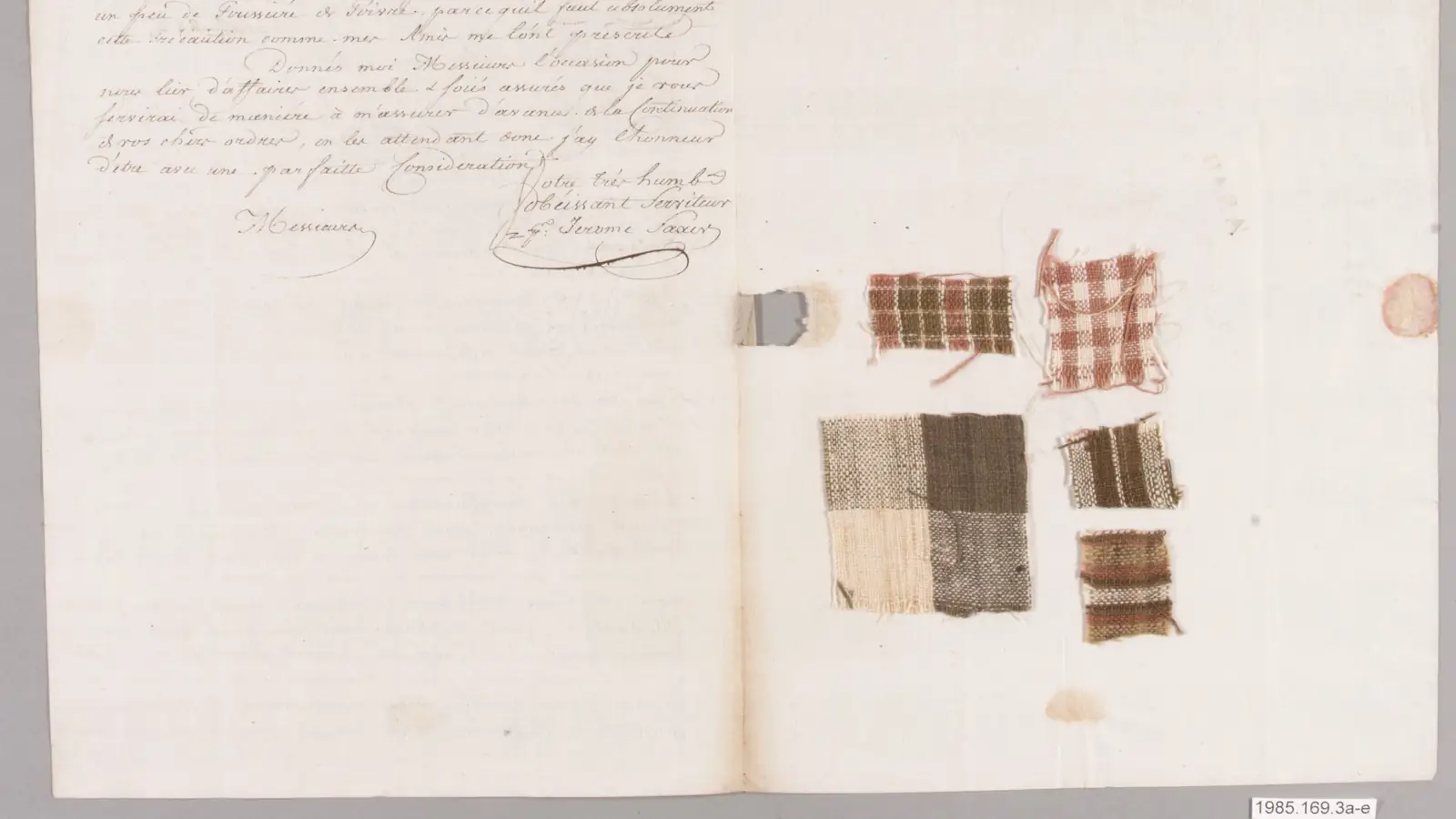
The catalogue looked right. The price was good. Then the bulk order arrived with a different colour, a thinner material or a loose fit, and the supplier pointed to the “standard” version.
A clear process to request product samples from suppliers prevents most of these disputes. This guide explains what to ask for, who pays, which sample types exist, and how to approve a sample so it protects you once production starts.
It follows our guides on how to vet the supplier and how to write an request for quotation (RFQ). Samples are the step between a shortlist and a purchase order.
In this article
- Why samples come before bulk orders
- Sample types: know what you are asking for
- How to request product samples from suppliers: 7 steps
- A short sample request template
- Sample cost, shipping and who pays
- How to approve a sample
- Tie the approved sample to the PO and inspection
- 6 common sample mistakes
- Frequently asked questions
Why samples come before bulk orders
A sample shows what a supplier can actually make. A catalogue or a photo only shows what it wants you to see. Before you commit money, a sample lets you check three things:
- Quality. Material, finish, size, weight, function and packaging.
- Fit with your specification. Whether the supplier read your requirements the way you meant them.
- The supplier itself. How fast it replies, how clear its answers are, and how it handles a small job.
A sample is not proof of bulk quality. It proves the supplier can make the item once. That is why the approved sample must be tied to the order and to a later pre-shipment inspection, which we cover below.
Sample types: know what you are asking for
Suppliers use different names for different things. Say which one you want, or you may pay for the wrong sample.
| Sample type | What it is | Use it to |
|---|---|---|
| Stock or reference sample | An existing item taken from current stock | Judge general quality and the supplier’s standard |
| Custom or development sample | A new item made to your drawings, specification or brand | Check the supplier can build your design |
| Pre-production sample | A sample made with the materials and process planned for bulk | Confirm the final specification before production starts |
| Golden sample | The approved sample that both sides sign and keep | Serve as the reference standard for the whole order |
| Production sample | Units taken from the finished bulk order | Compare the real goods with the golden sample |
For standard items, a stock sample may be enough. For custom products, plan on a development round and a pre-production sample before you approve.
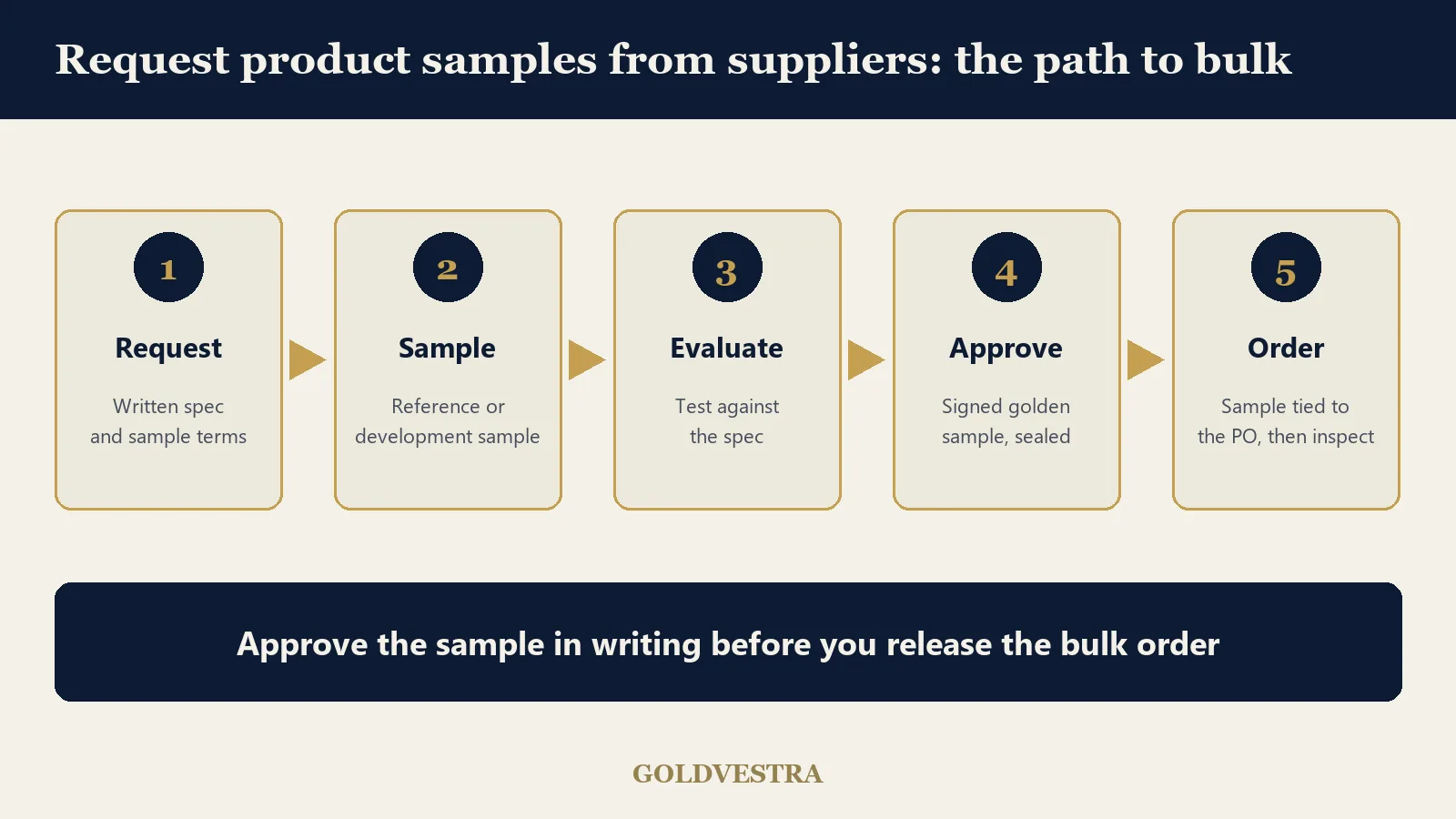
How to request product samples from suppliers: 7 steps
Follow these steps when you request product samples from suppliers. Each one removes a common source of confusion.
- Shortlist first. Request samples only from suppliers that passed your basic checks. Our guide on how to vet the supplier covers those checks.
- Write the specification. List material, dimensions, tolerances, colour references, labelling and packaging. The same text should later appear in your RFQ and the contract.
- Name the sample type. Ask for a stock, custom or pre-production sample, and say how many units you need.
- Ask about terms up front. Cost, lead time, who pays courier charges, and whether the sample fee is credited against a later order.
- Send the request in writing. Use email or a supplier platform message, not only chat. You need a record.
- Confirm before they ship. Ask for photos or a short video of the finished sample, the tracking number and the dispatch date.
- Log what you receive. Photograph the sample as delivered, with the packaging, and record the date. Then test it.
If you are comparing several suppliers, send the same specification to each one. That keeps the samples comparable. Our supplier identification page explains how suppliers are found and shortlisted.
A short sample request template
Adapt this message to your product. Keep it factual and specific. Fill in the brackets.
Subject: Sample request: [product name / model code]
Hello [name],
We are a [type of company] in the UAE and we are evaluating [product] for a purchase of about [quantity] per order. We would like to request [number] samples of [model or specification reference].
Please confirm: (1) the sample price and whether it is credited against a bulk order; (2) the production time for the sample; (3) the courier cost and the courier account you prefer; (4) the material, dimensions and packaging of the sample; (5) the MOQ and the bulk lead time for the same item.
Please attach the datasheet or drawing, and send photos of the sample before dispatch. Delivery address: [address and contact].
Thank you. Kind regards, [name, company, phone]
Do not promise an order in the message. Say you are evaluating, and ask for the minimum order quantity early, so the bulk terms do not come as a surprise later.
Sample cost, shipping and who pays
There is no universal rule. Practice varies by product, supplier and relationship, so ask and agree on it in writing.
Common arrangements
- Free sample, buyer pays courier. Common for low-cost stock items.
- Paid sample, fee credited on a bulk order. Often used for higher-value or custom items. Get the credit condition in writing.
- Paid sample and paid courier, no credit. Possible for fully custom development work.
Shipping and import points to check
- Courier account. Many buyers use their own courier account number to control cost and tracking.
- Commercial invoice for the sample. Samples cross borders like any other goods. Ask for an invoice that describes the item and its value clearly. See our guide to the commercial invoice, packing list and proforma invoice.
- Restricted or regulated items. Some goods need permits even as samples. Check the UAE restricted imports guide before you ask for them.
- Shipping terms. If the supplier quotes terms such as EXW or DAP for the sample, check what they mean in the official ICC Incoterms guidance.
For export paperwork in general, the U.S. International Trade Administration lists common export documents.
How to approve a sample
Approval is a decision, not a feeling. Test the sample against your written specification, and record the result.
- Build a short checklist from your specification: size, material, finish, colour, function, labelling, packaging.
- Measure and test. Use the same tools and method each time. If the product needs lab testing, send it to a lab you choose.
- Compare competing samples side by side, if you requested more than one.
- List deviations in writing. Photograph each one and mark it as accepted, to be corrected or rejected.
- Ask for a corrected sample when changes are needed. Do not accept “we will fix it in production”.
- Sign and seal the golden sample. Both parties sign and date it. Each keeps an identical sealed copy, or one copy and detailed photos, depending on the product.
Only after that, release the bulk order. If the supplier refuses to sign a golden sample for a custom product, treat that as a warning sign.
Tie the approved sample to the PO and inspection
An approved sample only helps if the order refers to it. Put the link in the documents, not in a chat message.
- Purchase order or contract. State that the goods must match the approved sample and the specification, and give the sample reference number and date.
- Tolerances. Write what “match” means: which differences are acceptable and which are not.
- Inspection. Give the inspector the golden sample or its photos and the specification. In a pre-shipment inspection, the inspector compares production units with the sample and reports the differences.
- Audit. For a new factory, review its process as well. Our supplier audit checklist shows what to check on site or remotely.
- Remedies. Agree in the contract what happens if the bulk goods do not match: rework, replacement or price adjustment.
If you would like support with samples, supplier follow-up and coordination, our international procurement service is built for B2B buyers. We confirm the scope with you in writing.
6 common sample mistakes
- No written specification. The supplier makes what it thinks you want.
- Approving a “best of” sample. A hand-picked sample may be better than the average production unit.
- Skipping the pre-production sample for custom goods.
- Changing the specification after approval without updating the PO.
- Not recording the approval. A verbal “looks fine” is hard to prove later.
- Forgetting the packaging. A good product can arrive damaged if the packing method differs from the sample.
Each of these is easy to avoid with one extra email and one signed sheet.
Frequently asked questions
How do I request product samples from suppliers?
Send a written request with your specification, the sample type and quantity you need, and questions on price, lead time and courier cost. Ask for photos before dispatch and a tracking number. Keep the exchange in email or on the supplier platform, so you have a record.
Who pays for product samples?
It depends on the product and the supplier. Stock samples are sometimes free with the buyer paying the courier. Custom samples are usually paid. Ask whether the fee is credited against a bulk order, and get the answer in writing before the sample is made.
What is a golden sample?
A golden sample is the approved sample that both buyer and supplier sign and keep as the reference standard. Bulk production and pre-shipment inspection are compared against it, so disputes about colour, finish or fit can be settled with evidence.
What is the difference between a pre-production sample and a production sample?
A pre-production sample is made before bulk production with the planned materials and process, so you can approve it. A production sample is taken from the finished bulk order, so you can check that the real goods match the approved sample.
Should I order samples from more than one supplier?
Yes, for a new product. Send the same specification to each supplier and compare the samples side by side against one checklist. That shows differences in quality, price and communication before you commit to a bulk order.
How do I link an approved sample to my purchase order?
Name the sample in the purchase order or contract with a reference and date, and state that bulk goods must match it within defined tolerances. Give the same sample and specification to your inspector for the pre-shipment inspection.
Related reading
How to Write an RFQ
Put your specification in writing before you ask for samples.
Pre-Shipment Inspection Guide
Compare the finished goods with the approved sample.
Supplier Audit Checklist
Check the factory behind the sample.
Supplier Identification
How suppliers are found and shortlisted.
Need samples before a bulk order?
Tell us the product, quantity and target market. We will review the sourcing and sample steps with you and follow with a proposal.


