
A wrong HS code, an understated value or a mistaken country of origin can sit unnoticed in a customs declaration for months. Then an audit finds it. Dubai Customs voluntary disclosure is the route Dubai Customs offers to importers who find such errors first and report them on their own.
This guide explains what the policy is for, which errors it can cover, what it excludes and how the filing and payment steps work. It is based on the official policy text, and it does not promise any result.
It is general information, not legal or tax advice. Dubai Customs decides every case, so confirm your own facts with the authority or a qualified adviser.
In this article
- What Dubai Customs voluntary disclosure is
- When to use Dubai Customs voluntary disclosure
- What the Dubai Customs voluntary disclosure policy covers
- What the Dubai Customs voluntary disclosure policy excludes
- How to file a Dubai Customs voluntary disclosure request
- Dubai Customs voluntary disclosure: the 30-day payment rule
- How to prepare for Dubai Customs voluntary disclosure
- Preventing customs declaration errors in Dubai
- Frequently asked questions
What Dubai Customs voluntary disclosure is
Dubai Customs published Customs Policy No. (58/2024) on the Voluntary Disclosure System on 12 June 2024. It sets up the Voluntary Disclosure System. The policy describes it as a disclosure statement that a client submits to inform Dubai Customs of inadvertent errors or violations made during customs clearance and when declaring customs data.
The policy rests on a provision of the Common Customs Law that allows partial or full exemption from customs fines when companies disclose violations before Dubai Customs detects them. In short, the idea is simple: report your own mistake early, and Dubai Customs may reduce or waive the fine.
Note the word may. Article 2 of the policy says fines may be fully or partially waived. It does not set a percentage, and it does not guarantee a waiver. Plan for the duties you owe, not for a fine waiver.
When to use Dubai Customs voluntary disclosure
The policy is meant for errors you find yourself. Typical triggers are an internal review, a supplier correction or a closer look at old files. It fits cases where you learn that a past declaration carried wrong information.
Wrong HS code
A tariff code decides the duty rate and any controls on the goods. If you find that a product was declared under the wrong heading, the duty paid may have been too low. Read our guide to HS code classification to see how codes are chosen and checked.
Wrong customs value
Value errors happen when freight, insurance or related costs are left out, or when the invoice does not match what was paid. The value drives the duty calculation, so a mistake changes the amount due. See customs value in the UAE for the basics.
Wrong country of origin
Origin can affect the duty rate and the documents you need. If a shipment was declared with the wrong origin, the declaration data is wrong even when the goods themselves are fine.
The policy does not name HS code, value or origin one by one. It covers inadvertent errors in declaration data and customs data, and these three are declaration data. Whether a given case qualifies is a question for Dubai Customs.
What the Dubai Customs voluntary disclosure policy covers
Article 6 lists the violations to which voluntary disclosure applies:
- Import and export violations
- Customs declaration violations
- Transit violations
- Warehouse violations
- Violations in areas supervised by customs
- Temporary import violations
- Re-export violations
- Any other customs violation
For an importer, the most common entry is the second one: customs declaration errors in Dubai, meaning wrong data in a declaration already cleared. Errors on temporary imports or re-exports fall in the same system.
What the Dubai Customs voluntary disclosure policy excludes
The limits matter as much as the benefit. Read them before you decide to file.
- Companies targeted for a post-clearance audit. Article 7 says requests are not accepted from companies targeted for post-clearance customs audits.
- Companies already notified. Requests are also not accepted if Dubai Customs has notified you of a referral or the start of an inspection, an investigation or a customs audit.
- Violations you did not disclose. Article 5 says that if Dubai Customs finds other violations not in your request, it deals with them separately.
- Late payment. If you do not settle the financial claim in time, the request and the related decision are void.
- Deliberate violations. The policy is written for inadvertent errors. It does not describe relief for intentional ones.
This is why timing is the whole point. A post-clearance audit is a review of past declarations. Once you are targeted for one, or notified of it, this route is closed.
How to file a Dubai Customs voluntary disclosure request
Articles 3 and 7 set the procedure. The practical sequence is:
- Act immediately. The policy says clients must inform customs as soon as they discover an error or violation.
- Complete the approved form. The Voluntary Disclosure Form is attached to the policy.
- Sign and stamp it. The request must be complete, signed by the responsible person and stamped with the company seal.
- Attach evidence. Include details of the violation, supporting documents and records.
- Submit online. Use the self-audit submission service in the electronic customs systems.
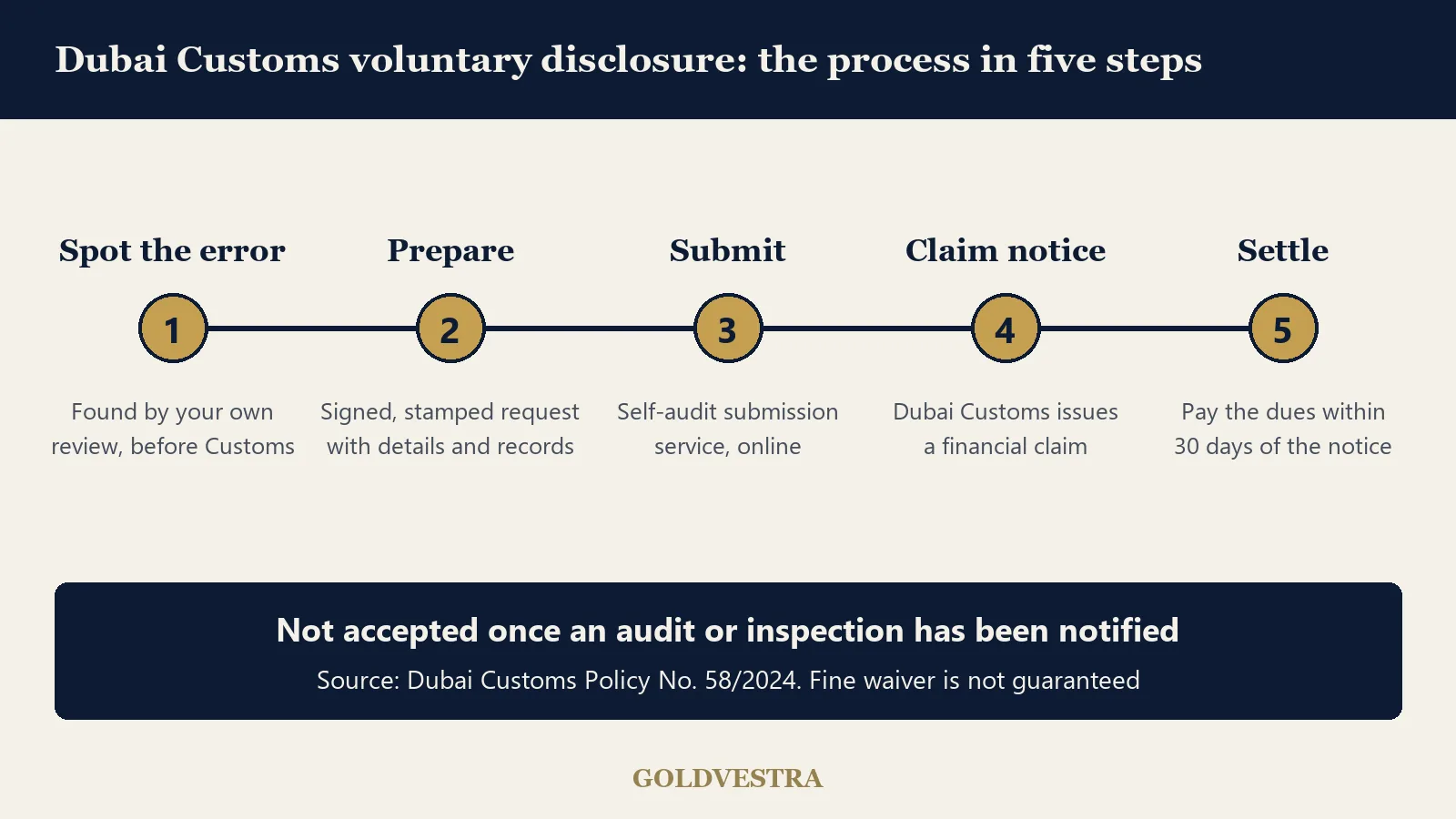
Article 9 names two channels: the Dubai Customs self-audit finding service and the Dubai Trade self-audit submission page. Check both for the current form and access rules, as portals can change.
If you handle declarations through Dubai’s electronic customs platform, our guide to the Mirsal 2 customs system explains how the system works. Clients must also complete any actions that result from the disclosure with the relevant authorities.
Dubai Customs voluntary disclosure: the 30-day payment rule
A disclosure does not remove the duty. Under Article 4, you must settle the due customs duties within 30 days from the date you receive the financial claim notification.
If you miss that window, Dubai Customs treats the request and the related decision as null and void. It then reserves the right to take any further action it considers necessary.
So the cash planning comes first. Work out the likely duty difference before you file, and make sure finance can pay quickly once the notice arrives.
How to prepare for Dubai Customs voluntary disclosure
The policy does not give a preparation checklist, but the filing requirements point to a sensible one. Treat the list below as practical advice, not as policy text.
- List every affected declaration. Article 5 means anything you leave out may be handled separately.
- Gather the records. Invoices, packing lists, bills of lading, payment proofs and the original declarations.
- Write down what went wrong. The wrong code, value or origin, the correct data and the reason for the mistake.
- Check for a pattern. If the same product or supplier repeated the error, review all of those entries.
- Name the signatory. Decide who is the responsible person and who holds the company seal.
- Confirm the audit position. Check that you have no customs notification of an audit or inspection.
If the paperwork is scattered, a documentation partner can help you organise it. Our Trade Documentation service covers the commercial and customs documents behind a shipment, and Trade Consultation can help you think through the route before you file. You can also request a quote for support.
Preventing customs declaration errors in Dubai
The cheapest correction is the one you never need. A few habits cut the risk of repeat errors.
- Fix the tariff code once per product and record the reasoning. Start with HS code classification.
- Build a repeatable value check that covers freight, insurance and other cost lines. See customs value in the UAE.
- Match origin documents to the declared origin before the declaration goes in.
- Keep shipment records together so a past declaration can be rebuilt quickly.
- Have a second person review the data before submission.
These steps do not replace a disclosure when an error has already happened. They make the next one less likely.
Frequently asked questions
What is Dubai Customs voluntary disclosure?
It is a system under Customs Policy No. 58/2024 that lets a client tell Dubai Customs about inadvertent errors in customs clearance or declaration data. If it is done before Dubai Customs discovers the error, customs fines may be fully or partially waived.
Does voluntary disclosure guarantee a fine waiver?
No. The policy says fines may be fully or partially waived. It gives no percentage and no guarantee, and Dubai Customs decides each case. The importer must still pay the customs duties that are due, so plan for the duty even if the fine is reduced.
When is it too late to disclose?
Once the company is targeted for a post-clearance audit, or has been notified of a referral or start of an inspection, investigation or customs audit, the request is not accepted. The policy also requires that the violation is disclosed before Dubai Customs discovers it.
How long do I have to pay after disclosing?
You must settle the due customs duties within 30 days from the date you receive the financial claim notification. If you do not pay within that period, the voluntary disclosure request and the related decision are considered null and void, and Dubai Customs may take further action.
How do I submit a voluntary disclosure request?
Complete the approved form, sign it by the responsible person, stamp it with the company seal and attach details, supporting documents and records. Then submit it through the self-audit submission service, available through Dubai Customs or the Dubai Trade portal.
What happens to violations I did not disclose?
If Dubai Customs finds other violations that were not in your request, it deals with them separately. That is why a Dubai Customs voluntary disclosure should list every affected declaration you know of, not only the first error you found.
Related reading
Mirsal 2 Customs System
How Dubai’s customs platform fits into your declarations.
HS Code Classification for Importers
How to choose and check a tariff code.
Customs Value in the UAE
How the value for duty is built up.
Found an error in a past declaration?
Send us the shipment and document details. We will help you organise the records and think through the route before you file with Dubai Customs.