A container leaves the port on time. Three weeks later it arrives with water damage, or it does not arrive at all. The question that follows is simple: who pays, and was the cargo insured?
Cargo insurance for importers answers that question before it is asked. This guide explains who arranges the cover under FOB and CIF, what marine cargo insurance includes, what it leaves out and how a claim works. It is general information, not insurance or legal advice.
In this article
- Why cargo insurance for importers matters
- Who arranges insurance: FOB vs CIF
- Institute Cargo Clauses: 3 cover levels
- What marine cargo insurance covers
- What is usually not covered
- When risk transfers and cover starts
- Sum insured and policy types
- How to make a cargo claim
- Checklist for importers
- Frequently asked questions
Why cargo insurance for importers matters
Goods in transit pass through many hands. They are lifted, stacked, shipped, trucked and stored. Each step carries a risk of damage or loss.
The carrier is not a replacement for insurance. A carrier’s liability is normally limited by the transport contract and by law, and it usually depends on proving where and how the damage happened. That limit can sit far below the value of the goods.
Cargo insurance for importers fills that gap. It is a contract between the insured party and an insurer to compensate loss or damage to the goods during the insured journey, within the policy terms.
It also belongs in the landed cost. Premiums are one line among the import cost factors, and a small one next to an uninsured loss.
Who arranges cargo insurance: FOB vs CIF
The sales contract decides who buys the cover. In practice that means the Incoterms rule. Our Incoterms 2020 for importers guide covers every rule; here is how it affects marine cargo insurance.
| Incoterms 2020 rule | Who must insure? | Minimum cover required |
|---|---|---|
| FOB (Free On Board) | Neither party has to. In practice the buyer insures from loading onward. | None set by the rule. |
| CIF (Cost, Insurance and Freight) | The seller must buy the insurance. | Institute Cargo Clauses (C), the lowest level. |
| CIP (Carriage and Insurance Paid To) | The seller must buy the insurance. | Institute Cargo Clauses (A), the broadest level. |
The ICC Incoterms rules set these minimums. For CIF and CIP, the contract must also state the sum insured. The usual benchmark in the rules is the contract price plus 10%.
The CIF vs FOB insurance trap
Many buyers read “CIF” and assume the cargo is fully protected. It is not. CIF gives the lowest level of cover, which lists only a few causes of loss. If you want broader protection, you need to agree it with the seller or buy extra cover yourself.
The reverse mistake is just as common. Under FOB, nobody has insured the goods unless you do it. The seller’s duty ends when the goods are on board, but the risk of loss moves to you at that point.
So the first rule of cargo insurance for importers is this: read your Incoterms rule, then check who holds a policy and for what level.
Institute Cargo Clauses: 3 cover levels
Most marine cargo policies worldwide use the Institute Cargo Clauses. They come from the London market, and the current wording dates from 2009, according to an insurer overview of the Institute Cargo Clauses 2009. Three standard levels exist.
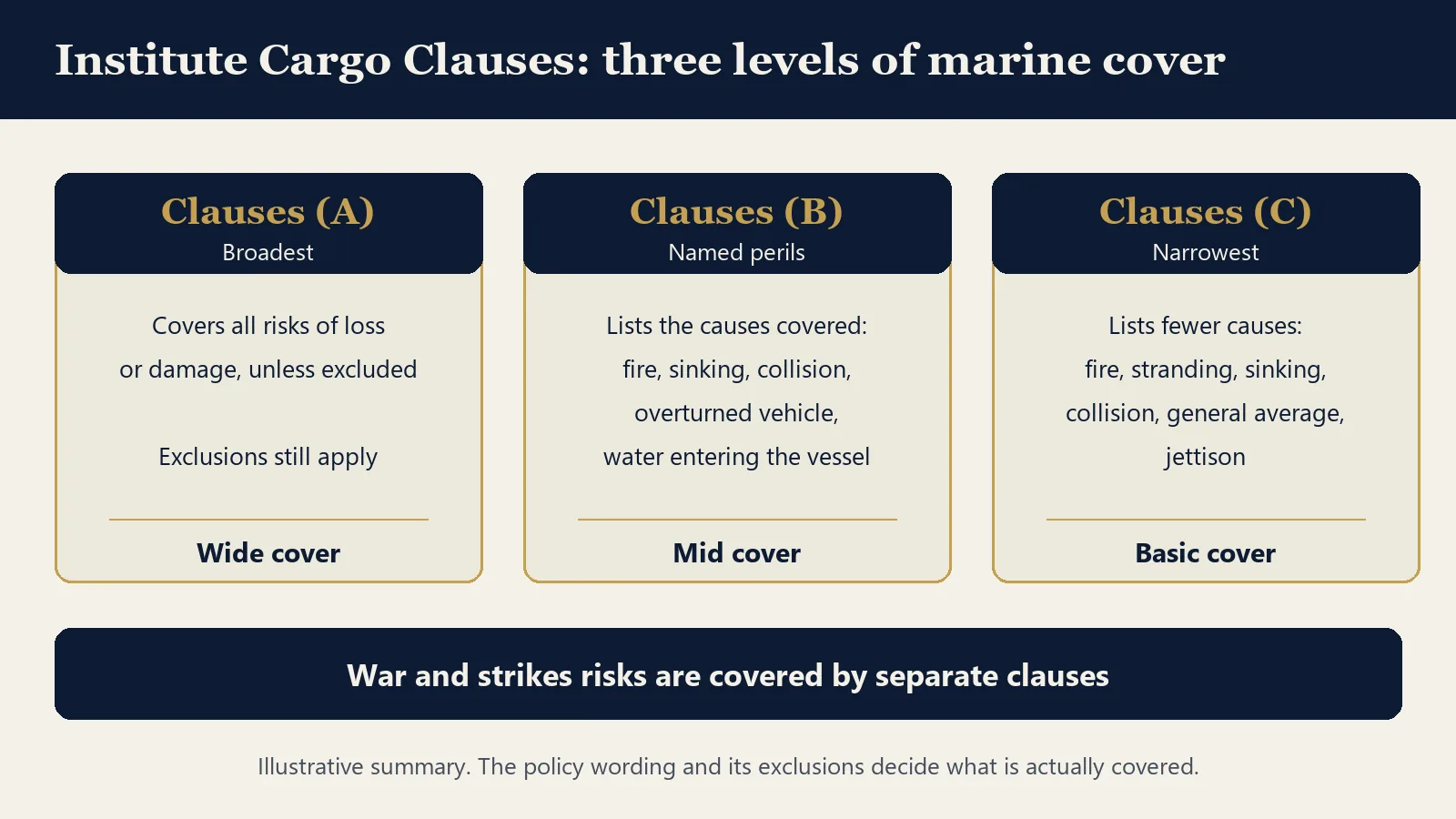
- Clauses (A): the broadest level, often called all risks cover. It insures loss or damage from any cause unless the clauses exclude it.
- Clauses (B): a named-perils level. It covers only the causes listed, such as fire, a vessel sinking or colliding, or sea water entering the vessel.
- Clauses (C): the narrowest named-perils level. It lists fewer causes, mainly major casualties such as fire, stranding, sinking and collision.
“All risks” is a misleading phrase. It does not mean every loss is paid. It means any accidental loss is covered unless an exclusion applies, and the exclusions are real.
There are separate Institute Cargo Clauses for air freight. If you ship by air, ask your broker or insurer which wording applies. Our guide to air freight vs sea freight shows how the two modes differ in risk and handling.
What marine cargo insurance covers
The exact scope depends on the clauses and the policy schedule. As a guide, a policy with broad cover typically responds to:
- Fire and explosion on board or during handling.
- Vessel casualties, such as sinking, grounding, stranding or collision.
- Heavy weather and sea water damage to the goods.
- Overturning or derailment of the road or rail vehicle carrying the goods.
- Loss overboard or jettison to save the voyage.
- Theft, pilferage and non-delivery, under the broader (A) level.
- Rough handling during loading, unloading or transhipment, under the broader (A) level.
General average
General average is a marine rule. When cargo is deliberately sacrificed to save the ship and the rest of the cargo, every cargo owner shares the cost. All three clause levels respond to general average, so an insured importer is not asked to find that money alone.
Cover beyond the sea leg
The clauses are written for the whole journey, not only the voyage. Cover generally follows the goods from the seller’s warehouse, through port, vessel and onward trucking, to the final delivery point named in the policy. The transit clause sets the start, the end and the time limits, so read it for your own route. If the cargo is held at a port, the time spent matters.
Mixed loads need extra care. Under FCL vs LCL shipping, other shippers’ goods share your container, and handling changes. Tell your insurer how the cargo is packed and shipped.
What is usually not covered
Even the broadest level has exclusions. Importers are most often caught by these:
- Inadequate packing. Loss caused by packing that is not strong enough for the journey.
- Inherent vice. Damage caused by the nature of the goods, such as fruit that ripens or metal that rusts on its own.
- Ordinary leakage, wear and tear. Normal loss in weight or volume is not an insured event.
- Delay. Loss of market, or lost sales because goods arrived late, is not paid, even if the delay came from an insured cause.
- Wilful misconduct by the insured.
- Financial default of the carrier or operator, in the cases the clauses list.
- War and strikes. These sit under separate clauses and must be added if you want them.
Two points matter most in daily practice. First, packing is your responsibility, so confirm the supplier’s packing standard before shipment. A pre-shipment inspection can catch weak packing early. Second, ask about war and strikes cover rather than assuming it.
Also check the policy for conditions on specific goods. Fragile, perishable, high-value or temperature-sensitive cargo may need special terms. We do not state what any insurer will accept.
When risk transfers and cover starts
Risk transfer and insurance are two separate things. Risk transfer comes from the sales contract. Insurance cover comes from the policy. Importers get into trouble when the two do not line up.
Under FOB and CIF, risk passes to the buyer when the goods are on board the vessel at the port of shipment. From that moment, the buyer bears the loss, whether the seller or the buyer holds the policy.
That is why the policy should name the right party as the insured. If the seller buys insurance under CIF, make sure the policy or certificate lets you claim, and that you receive the document before the goods arrive.
- Confirm the Incoterms rule in the contract.
- Find out who is buying the insurance, and at which clause level.
- Check that the policy starts when the risk reaches you, with no gap.
- Ask for the certificate with the shipping documents.
Sum insured and policy types
The sum insured is the maximum the insurer will pay for a loss. Set it too low and the claim will not cover the real loss.
A common approach is to insure the invoice value plus freight and a margin for related costs and expected profit. Incoterms CIF and CIP use the contract price plus 10% as the baseline. Duty is often payable on the CIF value, so a shortfall can hurt twice. Check how your declared value is built in our guide to import cost factors.
Single-shipment policy
A single-shipment policy covers one named consignment. It suits occasional importers or one-off orders.
Open cover
An open cover is an ongoing agreement for many shipments over a period. Each shipment is declared to the insurer under the agreed terms. It suits importers who ship regularly, as the terms stay consistent and cover is not forgotten when a shipment is rushed.
Ask your broker or insurer which fits your volumes. We cannot say which terms or prices are available to you, because that depends on the insurer and the goods.
How to make a cargo claim
Claims succeed or fail on speed and paperwork. Follow this order when cargo arrives damaged or short.
- Inspect on delivery. Check the cargo before you sign. Note any damage or shortage on the delivery receipt.
- Notify quickly. Tell the insurer or its surveyor, and the carrier, as soon as you see the problem. Deadlines apply.
- Protect the evidence. Keep the packaging, take photos and do not dispose of damaged goods before the surveyor sees them.
- Limit further loss. Take reasonable steps to protect undamaged goods. The policy normally expects this.
- Preserve the carrier claim. Written notice to the carrier within its time limit keeps the insurer’s recovery rights alive.
- Send the claim file. Submit the documents the insurer asks for.
A typical file includes the policy or certificate, the commercial invoice, the packing list, the bill of lading, the delivery receipt with remarks, photos and any survey report. The documents must agree with each other, a point our trade documentation checklist makes in detail.
Whether a claim is paid depends on the policy terms and the insurer’s assessment. Nothing here is a promise of payment.
Checklist for importers
- Know your Incoterms rule and who must insure.
- Confirm the clause level: (A), (B) or (C).
- Ask whether war and strikes cover is included.
- Set the sum insured with freight and a margin in mind.
- Make sure the policy names you or lets you claim.
- Confirm the packing standard with the supplier.
- Check that cover starts when the risk reaches you.
- Keep the policy, invoice, packing list and bill of lading together.
- Know who to notify, and how fast, if something goes wrong.
Run through this list once when you agree the order and again before shipment. If you want one team to line up carriers and hand-offs, see our logistics coordination service. Cargo insurance for importers is cheap to arrange at the start and impossible to buy after the loss.
Frequently asked questions
What is cargo insurance for importers?
Cargo insurance for importers is a policy that compensates loss or damage to goods during transit, within its terms. It protects the importer where the carrier’s liability is limited or hard to prove. The sales contract decides who buys it.
Who pays for cargo insurance, the buyer or the seller?
It depends on the Incoterms rule. Under CIF and CIP, the seller must buy the insurance. Under FOB, neither party is obliged to, so the buyer normally arranges it. Check the contract rule and ask for the policy or certificate.
What does marine cargo insurance cover?
Marine cargo insurance covers physical loss of or damage to goods during the insured journey. Broad (A) cover includes any accidental cause unless excluded. Narrower (B) and (C) cover only the listed perils, such as fire, sinking or collision. The policy wording decides.
What is the difference between Institute Cargo Clauses A, B and C?
Clauses (A) give the broadest cover, often called all risks. Clauses (B) and (C) are named-perils covers, with (C) listing the fewest causes. Exclusions apply to all three, and war and strikes risks need separate clauses.
Does CIF include full insurance?
No. Under Incoterms 2020, CIF requires only minimum cover, Institute Cargo Clauses (C). That is the narrowest level. If you want broader protection, agree it with the seller or arrange extra cover yourself.
What is not covered by cargo insurance?
Common exclusions include inadequate packing, inherent vice, ordinary leakage or wear, delay, wilful misconduct and, unless added, war and strikes. Read the exclusions in your policy before you ship.
When does cargo insurance cover begin and end?
Cover starts and ends as the policy’s transit clause states, usually following the goods from the named origin point to the named final destination. Time limits can apply. Check the dates and delivery points on your own certificate.
Related reading
Incoterms 2020 for Importers
Who pays, who insures and when risk moves.
Air Freight vs Sea Freight
Compare cost, speed and risk by mode.
FCL vs LCL Shipping
How container loading changes handling.
Import Cost Factors
Where insurance fits in the landed cost.
Logistics Coordination
One team for carriers and hand-offs.
Planning your next import?
Tell us the product, quantity and route. We will review the shipping terms and coordination needed, and follow with a proposal.