The bars look right, the mill quotes a good price and the cargo is ready to load. Then the shipment reaches the UAE without the right certificate and sits at the port.
For rebar, importing steel to UAE is a regulated step. Carbon steel bars for concrete reinforcement need a UAE Certificate of Conformity under ECAS before they are placed on the market. This guide shows what that means for buyers, which test reports to ask for, how the HS code and the 5% duty fit in, and what to check before you place an order.
It is written for contractors, traders and project buyers who source steel abroad. It is general information, not legal advice. Confirm every point for your own shipment with MoIAT or your clearing agent.
In this article
Which steel needs ECAS when importing steel to UAE
The Emirates Conformity Assessment Scheme (ECAS) is run by the Ministry of Industry and Advanced Technology (MoIAT). Our ECAS certificate guide explains how it works in general. For steel, the clearest rule today covers one product group.
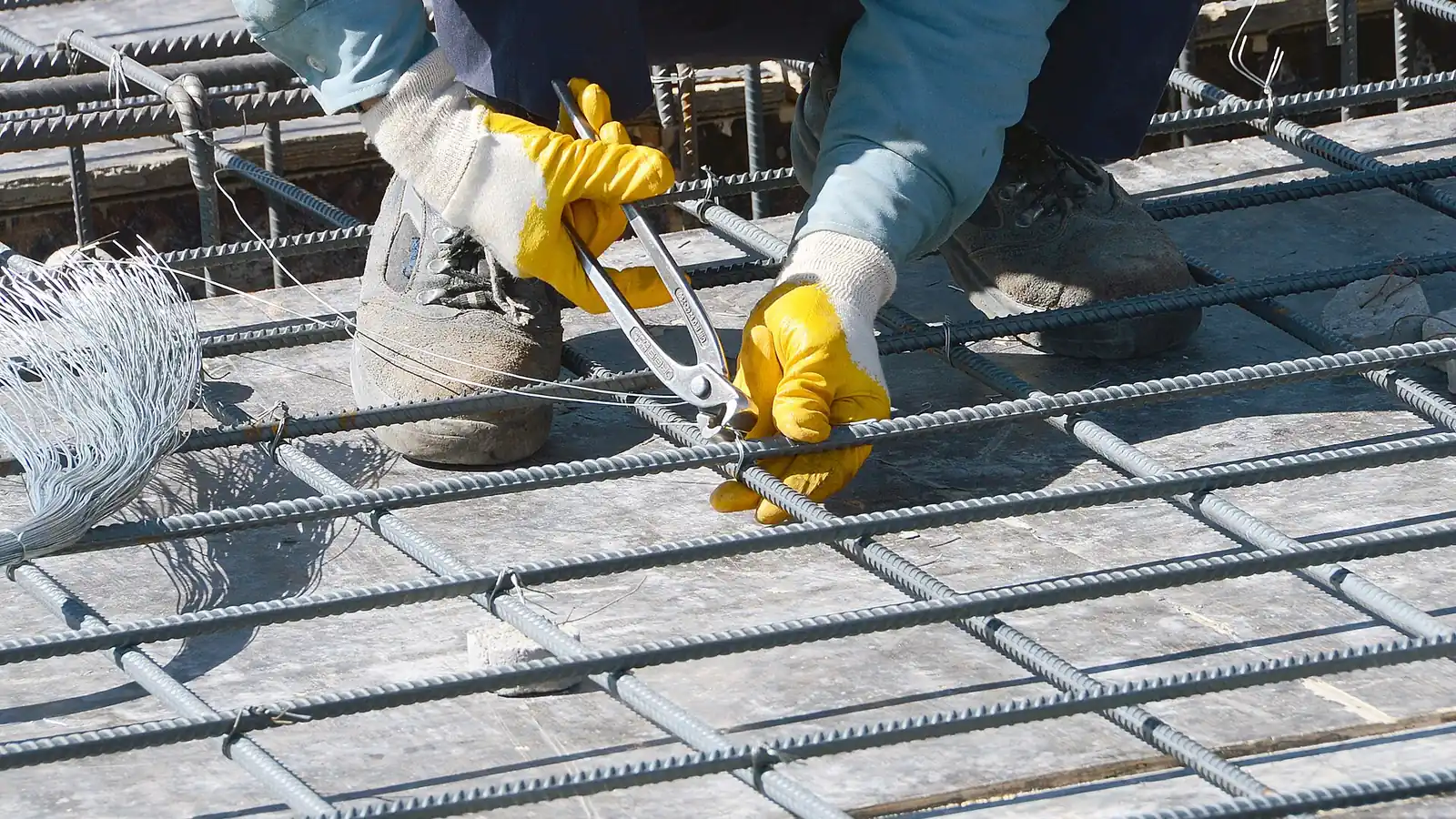
Cabinet Resolution No. (121) of 2023 on the UAE Scheme for Steel Bars for Concrete Reinforcement applies to carbon steel bars for concrete reinforcement, and to the steel billets that mills roll into those bars or coils. It covers products imported or made in the country, including in free zones.
So when importing steel to UAE, the scope is not “all steel”. It is rebar and the billets behind it. If your order is ribbed bar or billet, treat the certificate as a must-have. If it is anything else, read the section on other steel products below.
Rebar is one of several categories in our guide to importing construction materials to the UAE. The same logic applies: sort the order by product group first, then check the rules for each group.
What the rebar rule requires
The text of the resolution was notified to the World Trade Organization before it was issued. The points below come from that English text notified to the WTO and from the MoIAT website. The final published resolution is the authority, so check it for the exact wording.
The importer carries the duty
The scheme defines the “applicant” widely. It includes the producer, but also an importer, an agent, a store or a distributor, and any representative responsible for importing the product. If you are importing steel to UAE in your own name, expect to be treated as the applicant.
The applicant must hold a certificate of conformity for the product before it goes on the market. It must also give MoIAT and the authorities the technical documents, including test reports, on request.
Records are kept for ten years
The applicant must keep the reports that show the product is safe for at least ten years from the date of the last batch. In practice, ask your supplier how long it keeps batch records and whether it will share them if a dispute arises.
Each batch has a digital record
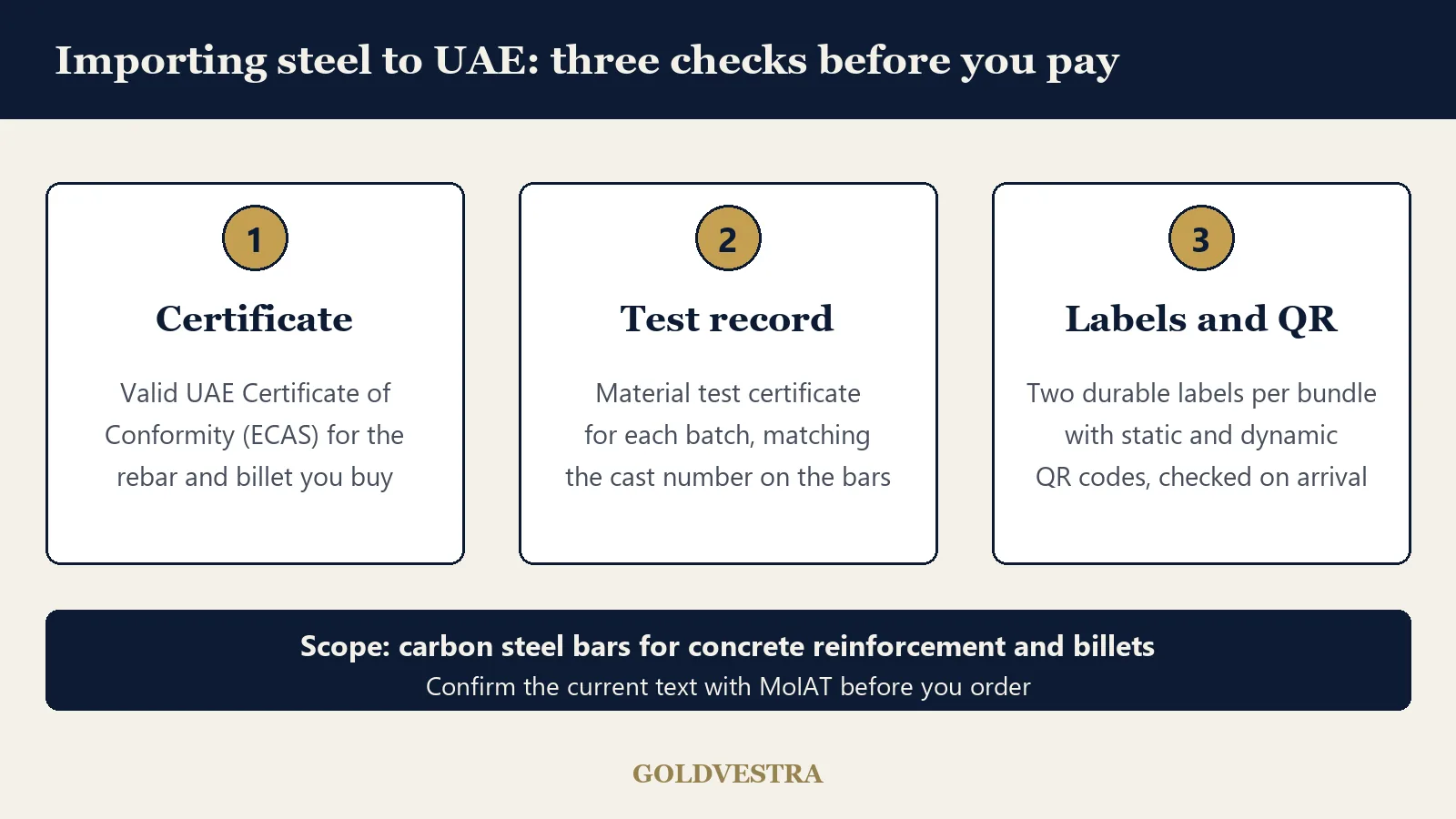
The scheme describes a Digital Material Passport. It is a digital record of the test information for each batch: standard, grade, form, diameter, cast number, chemical analysis and mechanical properties.
Bundles or coils carry durable labels with two QR codes. A static code lets you check the certificate of conformity. A dynamic code opens the batch record. This is why a clean paper certificate alone is no longer enough.
Producers have extra duties
Mills must show an ISO 14001 environmental management certificate and an independently verified environmental product declaration. You do not file these, but a mill that cannot talk about them is a warning sign.
Test reports to ask for before importing steel to UAE
When importing steel to UAE, ask for documents in this order. Match each one to the cast number on the bars, not just to the supplier name.
| Document | What to check |
|---|---|
| UAE Certificate of Conformity | Issued for the exact product and mill you are buying from, still valid, and traceable on the MoIAT Conformity Hub or through the static QR code. |
| Material test certificate | One per batch. Shows the standard, grade, diameter, cast number, chemical analysis and mechanical properties. The scheme lists EN 10204, the standard on inspection document types, so ask which type the mill issues. |
| Digital Material Passport | The dynamic QR code opens the batch record. The figures must match the paper certificate and the labels. |
| Independent laboratory report | Your own request, not a legal step. Useful for a large order or a new mill. Ask for a laboratory accredited for the tests, with samples drawn from your batch. |
| Billet declaration | If the mill buys billets, ask for the billet source and its certificate of conformity. The scheme requires purchased billets to come from a source with one. |
A report is only as good as its link to your cargo. Our pre-shipment inspection guide explains how an inspector can check bundle marking, count and sampling at the mill, before you pay the balance.
HS code and the 5% duty on steel
Two separate questions come up at the border when importing steel to UAE. One is duty. The other is conformity. The HS code answers the first. The ECAS certificate answers the second.
For duty, the Dubai Customs FAQ gives the standard rate as 5% of the CIF value, as we explain in our UAE import duty guide. CIF means the goods, freight and insurance. A lower freight line or a missing insurance cost does not change the rule.
Ribbed reinforcing bars usually sit under heading 7214 of the Harmonized System, but the exact line depends on the product. Our HS code classification guide shows how to settle the code with your supplier and agent.
Keep the two aligned. If the invoice says one product, the HS code another and the certificate a third, expect questions. Use the same description, grade and standard on all three.
Steel other than rebar: what we cannot confirm
Not every case of importing steel to UAE involves rebar. Plates, beams, sections, wire, pipes, sheet and coils can follow other rules, and rules change by product.
This guide does not claim that any of them needs ECAS, or that none does. We did not find a source we can cite for that. Check the product on the MoIAT site and the Conformity Hub, or ask your clearing agent to confirm in writing.
For project buyers, a consultant or authority may also ask for approval of the material for a specific site. That is a different step from market access. If you plan a larger package, our construction equipment and materials sourcing and raw materials sourcing pages show how we approach it.
Pre-order checklist for importing steel to UAE
- Confirm the product group. Is it rebar or billet? If not, confirm the rule for that product in writing.
- Ask for the certificate first. Get the UAE Certificate of Conformity number before you negotiate the price.
- Check it yourself. Look up the certificate on the Conformity Hub. Do not rely on a PDF alone.
- Set the specification. Write the standard, grade, diameters and tolerances into the purchase order.
- Require batch documents. Ask for a material test certificate and QR labels for every batch.
- Agree the HS code. Settle the code and the product description with your agent before the invoice is issued.
- Plan the inspection. Book a pre-shipment check of marking, bundle count and samples.
- Tie payment to documents. Link the balance to approved certificates and a matching packing list.
Common mistakes
- Buying on a mill price list and asking for the certificate after the order.
- Accepting a certificate from a different mill or an older product range.
- Reading a test report without checking the cast number on the bundle label.
- Treating the 5% duty as the only cost and ignoring delay at the port.
- Assuming a rule for rebar also covers other steel, or the reverse.
Each mistake in importing steel to UAE is cheap to prevent before the order and costly after the cargo has shipped.
Frequently asked questions
Do I need ECAS to import rebar into the UAE?
Yes, for carbon steel bars for concrete reinforcement. Cabinet Resolution No. (121) of 2023 requires the applicant, which includes the importer, to hold a certificate of conformity before the product is placed on the market. Confirm the current text with MoIAT before you place the order.
Does the rule cover steel billets?
Yes. The scheme covers billets that mills roll into rebar or coils, as well as the finished bars. It applies to products imported or made in the UAE, including free zones. Ask your mill whether its billets are certified, and ask for the certificate number in writing.
Which test reports should I ask the supplier for?
Ask for the UAE certificate of conformity, a material test certificate for each batch and access to the batch record through the QR code. For a large order, you can add a report from an accredited independent laboratory, drawn from your own batch.
What customs duty applies to imported steel?
Dubai Customs gives the standard customs duty as 5% of the CIF value for most goods. The exact rate depends on the HS code of the product. Confirm the code and the duty with your clearing agent before you ship the goods.
Is the HS code the same as the ECAS scope?
No. The HS code sets the duty line. The ECAS scope depends on the product definition in the rule. A bar can have the right HS code and still need a certificate, so check both before you pay the supplier.
Does ECAS apply to all steel products?
We cannot say that it does. The rule we verified covers carbon steel bars for concrete reinforcement and billets. For plates, sections, pipes or coils, check the product with MoIAT or your clearing agent, and get the answer in writing.
Related reading
ECAS Certificate in the UAE
What the certificate is and who needs one.
Importing Construction Materials
A buyer’s guide by product group.
HS Code Classification
How to settle the code before shipping.
Pre-Shipment Inspection
Check goods at the source before you pay.
Sourcing steel or rebar from abroad?
Tell us the product, grade, quantity and origin. We will help you plan the supplier checks and import documents before you place the order.