

Sourcing raw materials across borders is not like buying finished goods. The product is often measured by grade, purity or moisture, not by a catalogue photo. A small gap between what you ordered and what arrives can stop a production line.
This guide walks B2B buyers in the UAE and the GCC through the process of sourcing raw materials. You will see how to write a spec, which certificates to ask for, how bulk and container shipping differ, and how to protect payment. It is general guidance, not advice on a specific supplier or material.
Our raw materials industry page shows the categories we work on. For the wider buying cycle, see procurement planning.
In this article
- What sourcing raw materials means for a B2B buyer
- Sourcing raw materials: 6 steps from spec to delivery
- Write clear raw material specifications
- Raw material quality certificates to request
- Find and check a raw materials supplier
- Test samples before you commit
- Bulk raw material shipping vs containers
- Inspection and payment protection
- Contract points that save disputes
- Classification and customs
- Common mistakes to avoid
- Frequently asked questions
What sourcing raw materials means for a B2B buyer
Raw materials are the inputs a business transforms into something else. Think metals, polymers, chemicals, minerals, agricultural inputs or wood. Buyers purchase them in large lots, often on a recurring basis.
Three things make this category different:
- Quality is technical. It is defined by test results, not looks.
- Volumes are large. One bad lot costs far more than one bad sample.
- Handling matters. Moisture, contamination and packing can change the product on the way.
In sourcing raw materials, a reliable raw materials supplier is therefore one that can prove quality, not only quote a price. The rest of this guide shows how to ask for that proof.
Sourcing raw materials: 6 steps from spec to delivery
Use this workflow for sourcing raw materials as a checklist. Skip nothing on a first order with a new supplier.
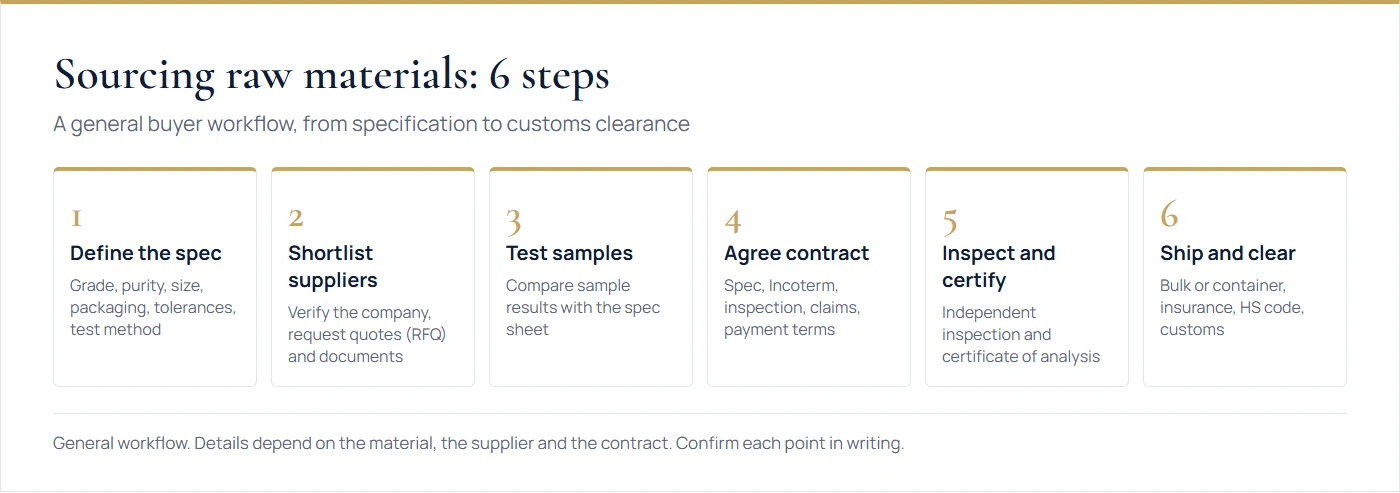
- Define the specification. Write down the grade, tolerances and test methods.
- Shortlist suppliers. Verify each company and request comparable quotes.
- Test samples. Check them against the spec sheet, ideally in an independent lab.
- Agree the contract. Fix the spec, Incoterm, inspection, claims and payment terms.
- Inspect and certify. Confirm quality and quantity before the cargo leaves.
- Ship and clear. Choose bulk or container, insure the cargo and file the declaration.
Our international procurement service supports each of these steps for importers who prefer a single point of coordination.
Write clear raw material specifications
Most disputes start with a vague order. Raw material specifications turn “good quality” into numbers both sides can test.
A usable spec sheet normally covers:
- Material name and grade, plus any standard it should meet.
- Key properties, such as purity, size, moisture or content limits, each with a tolerance.
- The test method for each property, so both labs measure the same way.
- Packaging type, labelling and net weight per unit.
- Total quantity, delivery window and allowed variation in quantity.
Ask the supplier to confirm the sheet in writing and attach it to the contract. If the supplier proposes its own typical values instead, treat those as a starting point, not as a guarantee.
Raw material quality certificates to request
Raw material quality certificates are the paper trail that connects the spec to the actual lot. The most common ones are listed below. Which of them apply depends on the material and the destination.
| Document | What it shows | Why a buyer asks for it |
|---|---|---|
| Certificate of analysis (CoA) | Test results for a specific batch or lot | Compares the lot with the agreed spec |
| Safety data sheet (SDS) | Hazards, handling and storage for chemical products | Needed for safe handling and for the carrier |
| Certificate of origin | Where the goods were produced | Supports duty treatment and trade rules |
| Independent inspection or quality report | Findings from a third-party inspector | Gives an unbiased check of quality and quantity |
| Weight or quantity certificate | Quantity loaded, by a neutral party | Helps settle shortfall claims |
| Phytosanitary or treatment certificate | Plant health or treatment of packing and goods | Required for some plant-based goods and wood packaging |
Check each certificate against the others. Batch numbers, quantities and product names should match the invoice and the packing list. A certificate issued only by the seller is useful, but an independent one carries more weight.
Find and check a raw materials supplier
When sourcing raw materials, start by deciding whether you need a producer or a trader. A producer controls the process, while a trader may offer wider choice and smaller lots. Neither is better in every case, and our guide to how to vet international suppliers covers the checks in detail.
For a first order, ask each supplier for:
- Company registration details you can verify through an official source.
- A current CoA for the grade you want, and a sample from the same production.
- Packing and loading practices for the product.
- Names of the standards the material is tested against.
- A written quote that repeats your spec and Incoterm.
Send the same request to every shortlisted supplier. That makes quotes comparable. Do not assume that the lowest price meets the same spec as the others.
Test samples before you commit
In sourcing raw materials, a sample is only useful if it represents the shipment. Ask for samples drawn from the production lot you will receive, and keep a sealed reference sample on your side.
- Test the sample in an independent laboratory, not only at the supplier.
- Compare every result with the spec sheet and the CoA.
- Record who drew the sample, when, and from which lot.
- Agree in advance what happens if the shipment does not match the approved sample.
Treat sample approval as one gate, not the end of the process. The shipment itself still needs checking.
Bulk raw material shipping vs containers
Bulk raw material shipping means moving loose cargo in large quantities, usually on a vessel built for it. Containers suit smaller lots in bags, drums or other packaging. The right choice depends on the material, the quantity and the ports on both sides.
| Point | Bulk shipping | Container shipping |
|---|---|---|
| Typical cargo | Loose, uniform material in large lots | Packed goods in bags, drums, boxes or tanks |
| Handling | Loaded and discharged by specialised equipment | Standard container handling |
| Packaging cost | Low, as the cargo is loose | Higher, as each unit is packed |
| Flexibility | Fewer sailings and larger commitments | Smaller lots and more frequent departures |
| Contamination risk | Depends on hold cleanliness and handling | Depends on packaging and container condition |
| Quantity check | Usually by draft survey or weighbridge | Usually by packing list and container weights |
There is no single quantity at which bulk becomes better. Ask your forwarder to quote both options. For packed cargo, our guide to FCL vs LCL shipping explains how full and shared containers compare. Insurance is covered in our article on cargo insurance for importers.
Inspection and payment protection
When sourcing raw materials, inspection and payment terms work together. Pay too early and you lose leverage. Inspect too late and you cannot act on what you find.
Inspect before the cargo leaves
Appoint an independent inspector to check quality, quantity, packing and loading. Our guide to pre-shipment inspection explains the scope and timing. The inspector should sample according to a method written into the contract.
Match payment to proof
Payment terms decide who carries the risk. The U.S. International Trade Administration guide to methods of payment describes the main options and the risk each places on the buyer and the seller. Our article on international trade payment terms adds the UAE context.
- Link each payment stage to a document, such as the CoA or the inspection report.
- Avoid paying the full amount before the goods are inspected, where the supplier is new.
- Use a bank-based method for larger first orders, if the supplier agrees.
- Keep every agreement in writing, including changes to the spec.
Contract points that save disputes
A short, clear contract is better than a long vague one. For sourcing raw materials, check that it includes:
- The full spec sheet, with test methods and tolerances.
- The Incoterm and the named place of delivery. See the Incoterms guide for importers and the International Chamber of Commerce (ICC) pages for the official rules.
- How quality and quantity are verified, and by whom.
- The claims process: how to report a problem, and within what period.
- Remedies for off-spec goods, such as replacement, discount or rejection.
- The payment schedule and the documents that trigger each payment.
Have the contract reviewed by a qualified lawyer before you sign, especially for large or recurring orders.
Classification and customs
Every raw material needs a correct HS code on the declaration. The code drives duty, permits and sometimes restrictions, so confirm it before you order, not at the port. Material descriptions on the invoice and certificates should match the code you choose.
Some materials need permits or special handling, for example chemicals. Check the import rules for your product with the Dubai Customs FAQ and your clearing agent. Never assume that a product that is free to move in one country is free everywhere.
Common mistakes to avoid
- Ordering without a written spec. Both sides then argue about what was agreed.
- Relying on a seller-only certificate. Add an independent check for new suppliers.
- Approving a sample from a different lot. The sample must match the shipment.
- Paying everything up front. Link payment to documents and inspection.
- Ignoring packing and loading. Contamination often happens after production.
- Skipping classification. A wrong HS code causes delay and extra cost.
Good sourcing raw materials practice is mostly discipline: write it down, test it, verify it, then pay.
Frequently asked questions
What is the first step in sourcing raw materials internationally?
Write a clear specification. List the grade, key properties with tolerances, test methods, packaging and quantity. A written spec lets you compare quotes fairly, test samples objectively and settle disputes. Without it, suppliers quote against different assumptions and the cheapest offer may not be comparable.
What is a certificate of analysis and why does it matter?
A certificate of analysis lists the test results for a specific batch of material. Buyers compare it with the agreed specification to see whether the lot meets requirements. It is most reliable when the batch number matches the cargo and when an independent party confirms the results.
Should I buy raw materials in bulk or in containers?
It depends on the material, the quantity and the ports. Bulk suits large lots of loose, uniform cargo. Containers suit smaller lots in bags, drums or other packaging. Ask your forwarder to quote both options and compare handling, contamination risk and delivery timing.
How do I protect payment when buying from a new raw materials supplier?
Tie payment to documents and inspection rather than paying the full amount in advance. Use a bank-based method for larger first orders if the supplier accepts. Confirm quality and quantity with an independent inspector before final payment, and keep all agreed terms in writing.
Do I need a pre-shipment inspection for raw materials?
It is strongly advisable for new suppliers and large orders. An independent inspector checks quality, quantity, packing and loading before the cargo leaves. You can then act on problems while the goods are still with the supplier, which is far cheaper than after arrival.
Which documents do I need to clear raw materials into the UAE?
Customs normally needs the commercial invoice, packing list and transport document, plus any permits for regulated products. Certificates such as a CoA or certificate of origin may be needed depending on the material. Check requirements with Dubai Customs or your clearing agent before shipping.
Related reading
Pre-Shipment Inspection Guide
What an inspector checks before cargo ships.
HS Code Classification
Find the right code before you import.
Procurement Planning
Plan recurring purchases with less risk.
International Procurement
Support from supplier search to delivery.
Planning to source raw materials?
Share the material, grade, quantity and destination. We will review the requirements and follow with a proposal.


