You have a supplier quotation, a carton list and a freight forwarder asking for the volume. One wrong number and the booking, the container choice or the freight bill is off. A correct CBM calculation prevents that.
This guide shows the CBM calculation formula, how to convert units, a worked multi-carton example and how the result decides between a full container and shared space. It also shows the air freight link, where CBM turns into volumetric weight.
It is written for first-time importers and procurement staff. Figures for container capacity are approximate, so confirm them with your forwarder before you book.
In this article
- What CBM means in shipping
- CBM calculation formula and unit conversion
- How to calculate CBM step by step
- CBM calculation example with several cartons
- CBM container capacity: what fits in 20ft and 40ft
- How CBM decides FCL or LCL
- CBM and air freight volumetric weight
- Common CBM calculation mistakes
- Frequently asked questions
What CBM means in shipping
CBM stands for cubic metre. It measures how much space your cargo takes up, not how much it weighs. One CBM is a cube of one metre on each side.
Forwarders, shipping lines and airlines use cubic meter shipping figures to price space. Sea freight for LCL cargo is often charged on the greater of weight or volume. Air freight turns volume into a weight figure. Container planning starts with total CBM.
A reliable CBM calculation is therefore the first step of any quote. It also helps you compare offers, because every forwarder should start from the same volume.
CBM calculation formula and unit conversion
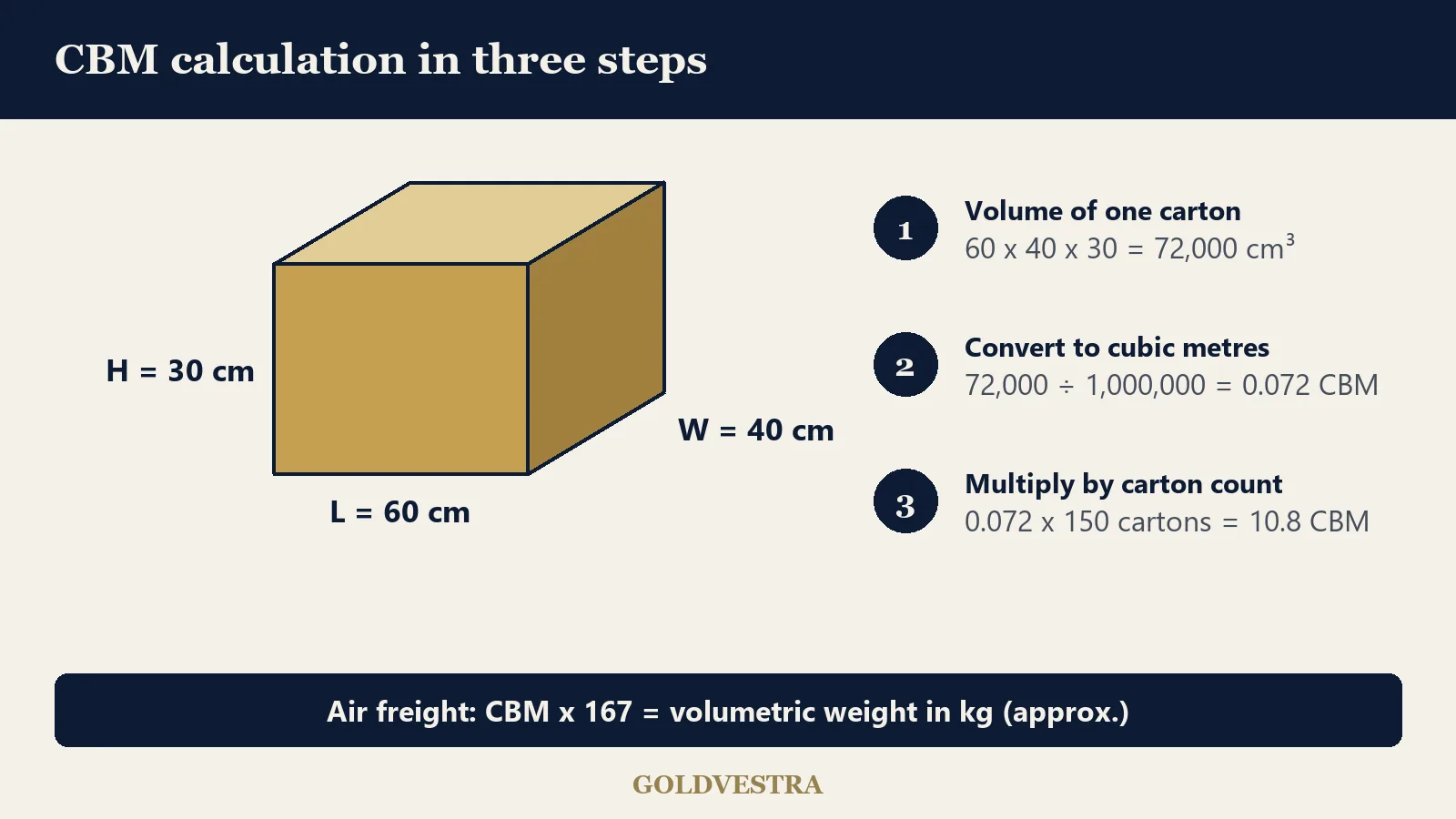
The CBM calculation formula is simple. Multiply length by width by height of the carton, then convert the result into cubic metres.
CBM = length x width x height (all in metres)
Most cartons are measured in centimetres, so the formula usually looks like this:
CBM = length (cm) x width (cm) x height (cm) ÷ 1,000,000
Unit conversion for CBM
| If your carton size is in | Divide the volume by | Example |
|---|---|---|
| Metres | 1 (no conversion) | 0.6 x 0.4 x 0.3 = 0.072 CBM |
| Centimetres | 1,000,000 | 60 x 40 x 30 = 72,000 ÷ 1,000,000 = 0.072 CBM |
| Millimetres | 1,000,000,000 | 600 x 400 x 300 = 72,000,000 ÷ 1,000,000,000 = 0.072 CBM |
| Inches | about 61,024 | 24 x 16 x 12 = 4,608 ÷ 61,024 = about 0.0755 CBM |
| Feet | multiply by 0.0283 | 1 cubic foot = about 0.0283 CBM |
Keep three or four decimals while you work. Round only the final total.
How to calculate CBM step by step
Follow these steps for every carton size on your order. This is how to calculate CBM without errors.
- Measure the outer carton. Use the outside length, width and height of the packed carton, not the product inside.
- Write all three sizes in the same unit. Centimetres are the easiest.
- Multiply the three sizes. This gives the volume in cubic centimetres.
- Divide by 1,000,000. This converts the volume to CBM per carton.
- Multiply by the number of cartons. Do this for each carton size.
- Add the totals. The sum is the CBM of the whole shipment.
Ask your supplier for carton sizes in the packing list. If pallets are used, measure the loaded pallet, including the pallet base, as one unit.
CBM calculation example with several cartons
Here is a CBM calculation example for an order with three carton sizes. The numbers are illustrative.
| Product | Carton size (cm) | Volume (cm³) | CBM per carton | Cartons | Total CBM |
|---|---|---|---|---|---|
| Product A | 60 x 40 x 30 | 72,000 | 0.072 | 150 | 10.800 |
| Product B | 50 x 35 x 25 | 43,750 | 0.04375 | 200 | 8.750 |
| Product C | 80 x 60 x 40 | 192,000 | 0.192 | 20 | 3.840 |
| Total | 370 | 23.39 |
The shipment is about 23.39 CBM. That is the figure to give your forwarder, together with the gross weight and the packing list.
Carton count alone does not show the volume. Product C has the fewest cartons, yet each carton is more than two and a half times the volume of a Product A carton.
CBM container capacity: what fits in 20ft and 40ft
Container capacity is the second half of the job. Once you know the total, compare it with the space inside. See the carrier’s page on container types and sizes for the equipment types.
| Container | Approximate internal volume | Practical loading note |
|---|---|---|
| 20ft dry | about 33 CBM | Real loads are usually lower than the nominal figure |
| 40ft dry | about 67 CBM | Fits roughly twice a 20ft load by volume |
| 40ft high cube | about 76 CBM | Taller, so better for light, bulky cartons |
These are approximate figures that vary by container series and carrier. Treat them as a planning guide and confirm exact space with your forwarder.
Usable space is smaller than the nominal figure. Carton shapes leave gaps, pallets add height and some goods cannot be stacked. Weight also matters: dense goods can reach the container weight limit before they fill the space.
In the worked example, 23.39 CBM sits well below a 20ft nominal capacity. A 20ft container looks like a fit, but check the gross weight and how the cartons stack before you accept it.
How CBM decides FCL or LCL
Your total CBM is the main input when you choose between a full container (FCL) and shared space (LCL). For the full comparison, read our guide to FCL vs LCL shipping.
- Small volume: LCL is usually cheaper because you pay only for the space you use.
- Large volume: an FCL container often becomes better value because you pay a flat rate for the whole box.
- In between: ask for both an FCL and an LCL quote. There is no fixed threshold that suits every route.
LCL cargo is often charged by freight tonne, which means the greater of one CBM or 1,000 kg. Dense cargo can therefore cost more than its volume suggests. Also check the local charges that come on top, as covered in ocean freight surcharges.
CBM and air freight volumetric weight
Airlines charge on the higher of actual weight and volumetric weight. A common rule is 6,000 cm³ per kilogram, which equals about 167 kg per CBM. Read more in Maersk’s guide to air cargo chargeable weight.
Volumetric weight (kg) = CBM x 167
For the example above, one Product A carton at 0.072 CBM has a volumetric weight of about 12 kg. The whole 23.39 CBM order comes to about 3,906 kg.
If the real weight is lower than 3,906 kg, the airline would charge the volumetric figure. Some carriers and express services use a different divisor, so confirm it. Our guide to volumetric weight vs chargeable weight explains the billing rule in detail. For the wider trade-off between speed and cost, see air freight vs sea freight.
Common CBM calculation mistakes
- Using product sizes instead of the outer carton size.
- Mixing centimetres and metres in the same formula.
- Rounding every carton before multiplying by the quantity.
- Forgetting the pallet base and any extra packaging.
- Trusting the supplier’s CBM figure without checking it against the carton sizes.
- Ignoring weight when the cargo is dense.
Run your own CBM calculation before you pay a deposit or book space. If you want a second pair of eyes on the numbers, our logistics coordination service can check the volume, the container choice and the routing with you.
Frequently asked questions
How do you calculate CBM?
Multiply the carton length, width and height in metres to get CBM for one carton. If you measure in centimetres, multiply the three sizes and divide by 1,000,000. Then multiply by the number of cartons and add the totals for every carton size in the shipment.
What is the CBM calculation formula in cm?
The formula is length (cm) x width (cm) x height (cm) ÷ 1,000,000. For a carton of 60 x 40 x 30 cm, the volume is 72,000 cm³, so the CBM is 0.072. Use outer carton sizes and keep several decimals until the final total.
How many CBM fit in a 20ft and a 40ft container?
As a rough guide, a 20ft dry container holds about 33 CBM, a 40ft about 67 CBM and a 40ft high cube about 76 CBM. Usable space is lower because of gaps, pallets and weight limits. Always confirm the figures with your forwarder.
How is CBM linked to air freight volumetric weight?
Airlines convert volume into weight using a divisor, commonly 6,000 cm³ per kg. That equals about 167 kg per CBM, so volumetric weight is CBM x 167. The airline charges the higher of actual weight and volumetric weight, so bulky, light cartons cost more to fly than their scale weight suggests.
Is cubic meter shipping charged by CBM or by weight?
Both can matter. LCL sea freight is often charged on the greater of CBM or weight, using one CBM as one tonne. Full containers are usually priced per container. Air freight uses the higher of actual and volumetric weight. Ask your forwarder which basis applies to your quote.
Should I trust the CBM on my supplier’s packing list?
Check it. Take the carton sizes and quantities from the packing list and run your own CBM calculation. Differences often come from inner sizes, rounding or missing pallets. A wrong figure can change the container choice and the freight cost.
Related reading
FCL vs LCL Shipping
How importers choose the right load.
Air Freight vs Sea Freight
Choosing the right mode for your cargo.
Ocean Freight Surcharges
The charges that come on top of the base rate.
Invoice vs Packing List vs Proforma
Which document shows carton sizes.
Need a shipping quote based on your CBM?
Send us your carton sizes, quantities and route. We will help you check the volume, choose between FCL and LCL and plan delivery to the UAE.