You get an air freight quote and the weight on it is higher than the weight of your goods. The invoice follows the quote. Many first-time importers assume something is wrong. Usually nothing is: the airline is billing for the space your cargo takes, not only for what it weighs.
This guide explains volumetric weight in plain words: the formula, a worked example, how it becomes chargeable weight, and how packing choices change your air freight cost.
It is a general guide. Divisors, rounding and minimums vary by carrier and forwarder, so confirm them in writing. For the wider mode decision, see air freight vs sea freight.
In this article
Volumetric weight: the short answer
Volumetric weight is a weight figure worked out from the size of your shipment. It is also called dimensional weight or DIM weight. It shows how much space the cargo uses in the aircraft, expressed in kilograms.
An aircraft runs out of space before it runs out of lifting capacity when the cargo is light and bulky. So the carrier compares two numbers and bills the higher one:
- Actual weight: the gross weight of the packed shipment on a scale.
- Volumetric weight: the size of the packed shipment converted into kilograms.
- Chargeable weight: whichever of the two is higher. This is the weight your air freight rate is multiplied by.
The volumetric weight formula
Measure the outside of the packed cargo, including the pallet or crate, at the longest point of each side. Then use this volumetric weight formula:
Volumetric weight (kg) = length (cm) × width (cm) × height (cm) ÷ 6,000
A divisor of 6,000 means 1 m³ equals about 167 kg (1,000,000 cm³ ÷ 6,000 = 166.7). It is the figure most commonly quoted for air cargo, and it is the one we use in the examples below. It is not universal, so ask which divisor your carrier applies.
| Input | Formula | Result |
|---|---|---|
| Dimensions in cm | L × W × H ÷ 6,000 | Result in kg |
| Volume in m³ (CBM) | CBM × 166.7 | Result in kg (at 6,000) |
| Dimensions in inches | L × W × H ÷ 366 | Result in kg (at 6,000) |
| Divisor of 5,000 (some couriers) | L × W × H (cm) ÷ 5,000 | Higher figure: 200 kg per m³ |
Count every piece. Add up the figure for each carton or pallet, or measure the whole consolidated shipment, as your forwarder instructs.
Worked example: three cartons, one pallet
Example 1: a light, bulky carton
One carton measures 60 × 50 × 40 cm and weighs 8 kg.
- Volume: 60 × 50 × 40 = 120,000 cm³
- Volumetric figure: 120,000 ÷ 6,000 = 20 kg
- Actual weight: 8 kg
- Chargeable weight: 20 kg per carton
You ship 10 identical cartons. Actual weight is 80 kg. Chargeable weight is 200 kg. The rate applies to 200 kg.
Example 2: a dense, compact carton
One carton measures 40 × 30 × 30 cm and weighs 18 kg.
- Volume: 40 × 30 × 30 = 36,000 cm³
- Volumetric figure: 36,000 ÷ 6,000 = 6 kg
- Actual weight: 18 kg
- Chargeable weight: 18 kg per carton
Here the cargo is heavy for its size, so the scale weight wins.
Example 3: a pallet
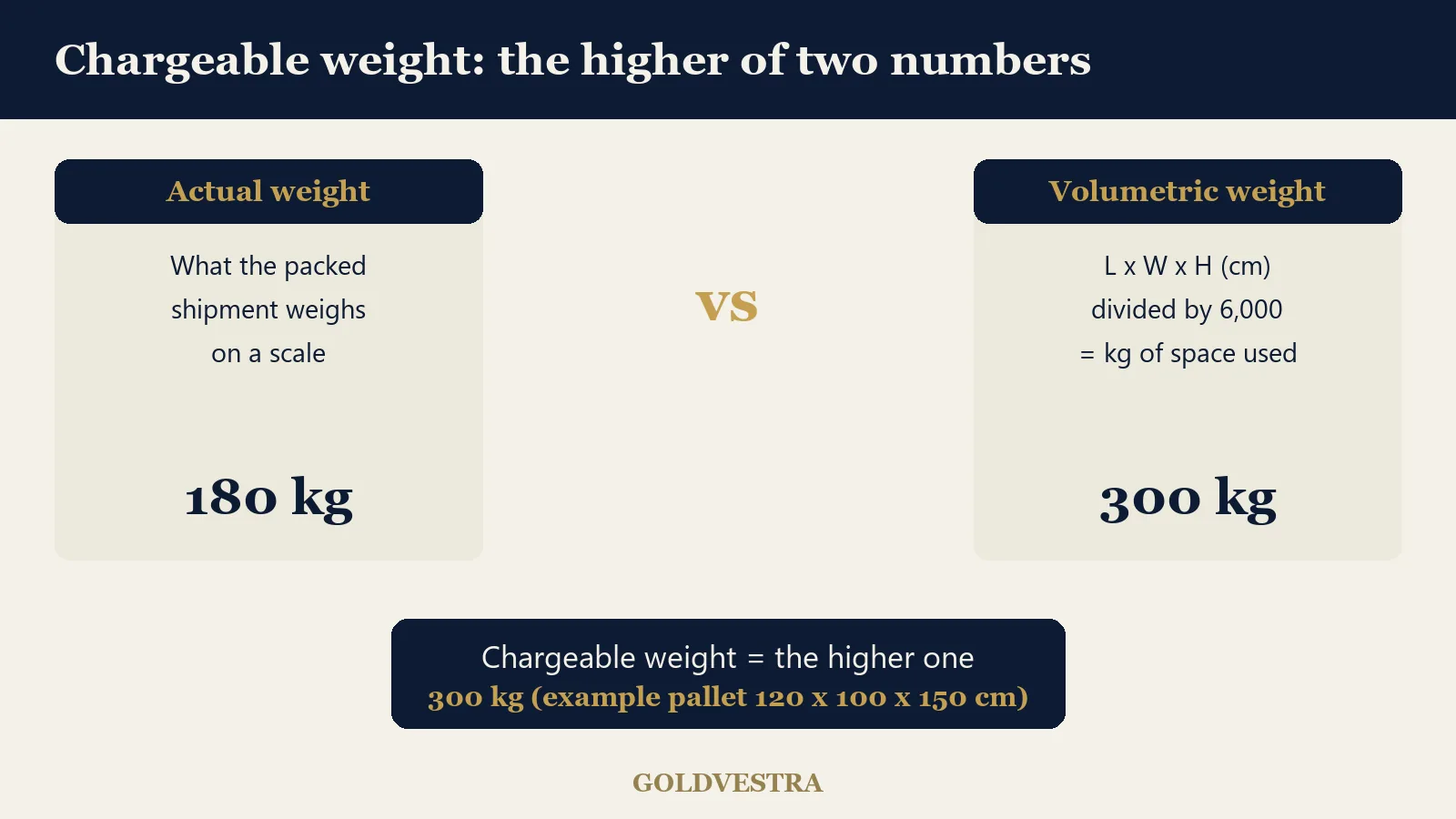
A pallet of cargo measures 120 × 100 × 150 cm and weighs 180 kg.
- Volume: 120 × 100 × 150 = 1,800,000 cm³
- Volumetric figure: 1,800,000 ÷ 6,000 = 300 kg
- Actual weight: 180 kg
- Chargeable weight: 300 kg
You pay for 300 kg although the pallet weighs 180 kg. The extra 120 kg is the price of the space.
How chargeable weight is decided
Chargeable weight is a simple comparison. Calculate the space-based figure, read the actual gross weight, and take the larger number.
Your air freight cost is then built on that figure. Typically it is the chargeable weight multiplied by a rate per kilogram, plus surcharges and local charges. Many carriers also apply a minimum charge and round the weight up, so a small shipment may cost more than the arithmetic suggests.
The result usually appears on the air waybill and on your forwarder’s quote. If you want to know what the document itself does, read air waybill vs bill of lading. For the other items that make up the final bill, see import cost factors.
Why airlines bill this way
An aircraft hold has two limits: a maximum payload in kilograms and a fixed amount of usable space. Cargo that is light but bulky fills the space and leaves payload unused. If the airline billed only by scale weight, a carton of pillows would pay far less than a carton of metal parts for the same space.
The volumetric divisor puts a price on space. Dense cargo is billed on its real weight. Bulky cargo is billed on the room it takes. That is why volumetric weight matters most for packaging, textiles, plastics, furniture and other light goods.
How packing changes your air freight cost
You cannot change the actual weight of your goods, but you can often change the size of the box. Small changes add up across a shipment.
Take Example 1 again. Redesign the carton to 55 × 45 × 35 cm so the goods fit with less empty space:
- Volume: 55 × 45 × 35 = 86,625 cm³
- Volumetric figure: 86,625 ÷ 6,000 ≈ 14.4 kg per carton
- 10 cartons: about 144 kg chargeable, instead of 200 kg
That is a reduction of roughly 28% in billable weight. Ask your supplier about these options:
- Right-size cartons so there is little void space.
- Use flat-pack or nested packaging where the product allows it.
- Remove bulky retail boxes for the transit leg if the product is repacked later.
- Stack cartons so the pallet height is used without overhang.
- Keep within the height limit your carrier accepts for the aircraft type.
- Do not cut protection to save space. Damage costs more than a few kilograms.
If the shipment is large, run the numbers for sea freight too. Volume cargo is billed by CBM at sea, and the space penalty is different. See our guide to FCL vs LCL shipping for the sea-side maths.
What to confirm before you book
Ask your airline or forwarder for these points in writing. Do not assume the 6,000 divisor applies to your shipment.
- Which divisor applies (6,000, 5,000 or another).
- How dimensions are measured: each piece, rounded up to the next whole centimetre, or the whole pallet.
- How the weight is rounded (for example to the next 0.5 or 1 kg).
- Whether a minimum charge applies to your shipment.
- Whether the quote uses chargeable weight, and which figure it assumed.
- Maximum piece size and height for the aircraft type or the route.
- Whether the carrier will re-measure at the airport and bill any difference.
If you already have carton sizes and gross weights, request a quote and we will help you compare the quotes on the same basis.
Cargo rules in the industry are coordinated by bodies such as the IATA cargo programmes, but each airline and forwarder sets its own commercial terms.
Common mistakes importers make
- Quoting from the supplier’s net product weight instead of the packed gross weight.
- Measuring the product, not the carton or the pallet.
- Forgetting that the pallet itself adds height and weight.
- Comparing two quotes built on different divisors or different assumed dimensions.
- Giving the forwarder estimated dimensions, then paying a correction after re-measurement.
- Ignoring chargeable weight when choosing between air and sea.
A short packing list with final carton sizes and gross weights avoids most of these. Ask the supplier for it before the cargo is packed, not after.
Frequently asked questions
What is volumetric weight in air freight?
It is a weight calculated from the size of your packed shipment. It shows how much space the cargo uses on the aircraft, in kilograms. Carriers compare it with the actual weight and bill the higher figure as chargeable weight.
What is the volumetric weight formula?
Multiply length, width and height in centimetres, then divide by 6,000. The result is in kilograms. For a 60 × 50 × 40 cm carton, that is 120,000 ÷ 6,000 = 20 kg. Confirm the divisor with your airline or forwarder.
What is the difference between volumetric weight and chargeable weight?
The volumetric figure is the space-based one. Chargeable weight is the final billing weight, which is the higher of the actual weight and the volumetric weight. Your air freight rate per kilogram is applied to the chargeable weight, plus any surcharges or minimum charges.
How many kilograms is one cubic metre in air freight?
At a divisor of 6,000, one cubic metre equals about 167 kg. If the carrier uses 5,000, it equals 200 kg. Cargo that weighs less than that per cubic metre is billed on volume, not on its scale weight, so light and bulky goods cost more per kilogram.
Is dimensional weight the same as volumetric weight?
Yes. Dimensional weight, DIM weight and volumetric weight describe the same idea: a weight figure calculated from package size. Carriers use different divisors, so the same box can have a different dimensional weight with different carriers. Always ask which divisor your quote assumes.
Can I reduce the chargeable weight of my shipment?
Often, yes. You cannot change the actual weight, but you can reduce the box size. Right-sized cartons, less void space and better pallet stacking lower the billable figure. Keep enough protection to prevent damage in transit, because a damaged shipment costs far more than a few saved kilograms.
Related reading
Air Freight vs Sea Freight
How to choose the right mode for your cargo.
Air Waybill vs Bill of Lading
What each transport document does.
Import Cost Factors
What really makes up landed cost.
FCL vs LCL Shipping
How sea cargo is billed by volume.
Need an air freight quote based on your real carton sizes?
Send us the carton dimensions, gross weights and route. We will help you compare the actual and space-based weight before you book.