
You paid customs duty when the cargo arrived. Then the buyer cancelled, or a better market opened abroad, and the goods are leaving the country again. Is that duty gone for good?
Not always. Duty drawback UAE rules allow a refund of duty on foreign goods that are re-exported, if you meet set conditions. This guide explains who qualifies, which time limits apply, what to prepare and how a drawback differs from a re-export deposit.
It is written for importers and traders who pay duty on arrival and later re-export. It is general information, not customs advice. Confirm every point for your own shipment with Dubai Customs or your clearing agent.
In this article
What duty drawback in the UAE means
Drawback is a refund of customs duty that was already paid. It is triggered when foreign goods leave the country again. The UAE applies the common rules of the Gulf Cooperation Council (GCC). Article 97 of the GCC Common Customs Law and its implementing rules says customs duties collected on foreign goods are refunded, fully or in part, at re-exportation under the conditions set in the implementing rules.
In plain terms, duty drawback UAE is about unwinding a duty payment when the goods never stay in the market. You paid on import. You prove the same goods left. Customs returns the duty actually paid.
It is different from a simple customs refund for an error, such as a wrong rate. It is also different from the usual re-export from Dubai route, where goods may move under another regime and duty is never paid in the first place.
If you are new to duty itself, start with our UAE import duty guide and the explainer on customs value in the UAE. They show how the amount you might reclaim was calculated.
Who qualifies for duty drawback UAE claims
The conditions below come from Article 16 of the implementing rules in the GCC Common Customs Law and its implementing rules, published by a UAE customs authority. They are the baseline for any customs duty refund UAE claim on re-exported goods.
| Condition | What the rules say |
|---|---|
| Who claims | The person in whose name the goods were imported, or another person who can prove to customs that they bought the goods. |
| Minimum value | The re-exported goods must be worth at least US$5,000, or the equivalent in local currency. |
| Where the goods go | They must be re-exported to a destination outside the GCC member states. |
| Condition of goods | They must not have been used locally and must be in the same condition as when imported. |
| Shipment | One consignment, so customs can match it to the import documents. Part shipments are allowed if you prove they belong to the same consignment. |
| Amount refunded | Only the customs duty actually paid on those goods. |
Read the table as a duty drawback UAE checklist. If one line fails, ask your broker before you spend time on the claim.
Goods that stay in a free zone are normally not cleared into the mainland, so there may be no duty to reclaim. Our guide to Dubai free zone vs mainland explains why the status of the goods matters.
The two time limits
Timing is where most duty drawback UAE claims fail. The same article sets two separate clocks:
- Re-export within one Gregorian year from the date you paid the customs duty.
- Claim within six Gregorian months from the date of re-exportation.
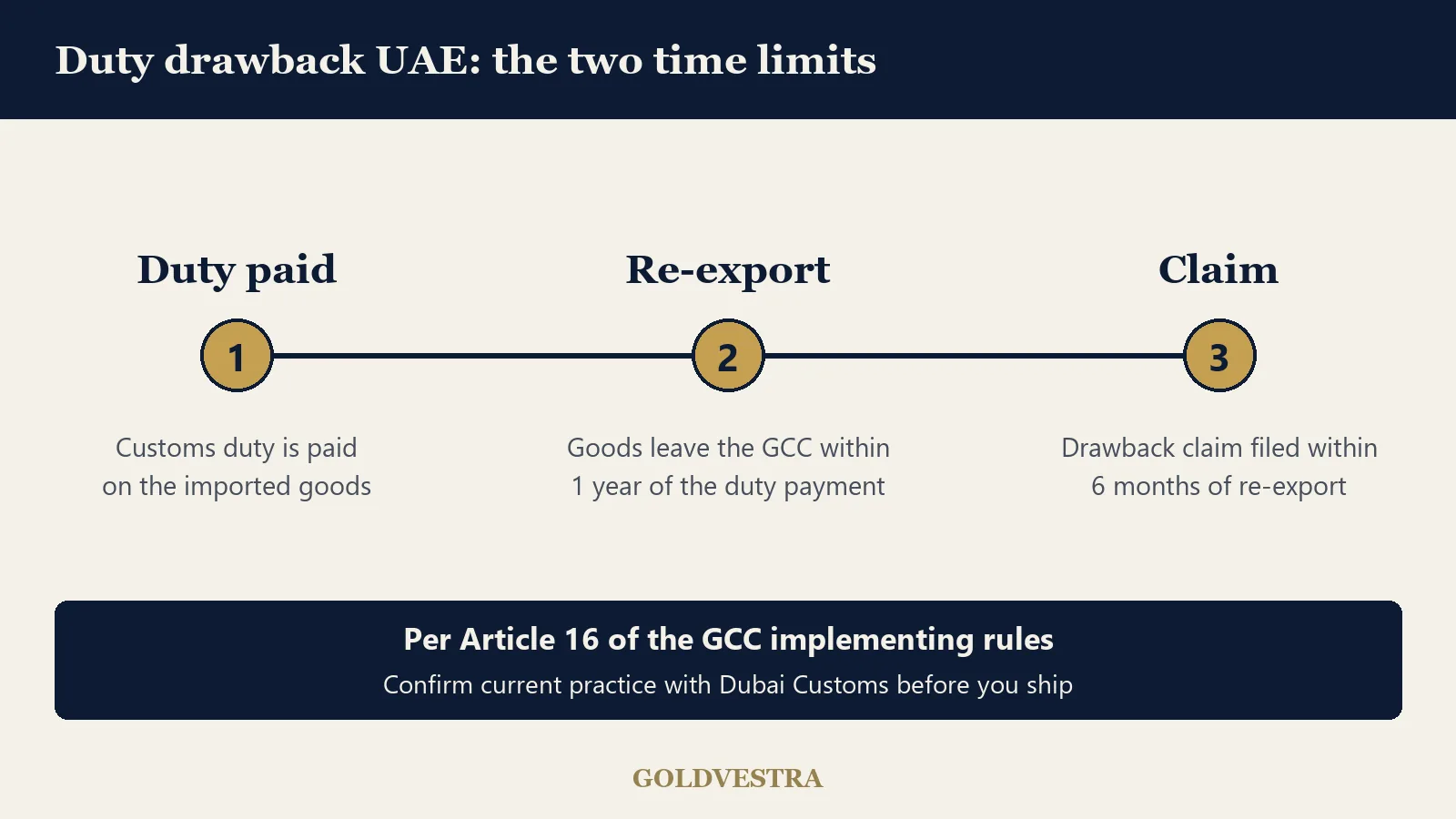
The first clock starts at payment, not at arrival or at the invoice date. The second starts at the re-export, not at the day the goods reach the buyer.
These figures are taken from the published text of the rules. Dubai Customs applies them through its own systems and policies, and the rules can be reviewed. Check the current period with Dubai Customs before you rely on a date.
Documents to prepare
The rules do not give a single checklist, but they point to what customs must be able to match. For a duty drawback UAE file, gather these before you file:
- Import documents for the original shipment, including the customs declaration and proof of the date and amount of duty paid.
- Proof that you are the right claimant: the import in your name, or evidence that you bought the goods.
- The re-export declaration for the outgoing shipment, using the unified customs declaration.
- Commercial invoice and packing list for both movements, so quantities and descriptions match.
- Evidence that the goods are unused and in the same condition, such as inspection photos or a stock record.
Mismatched descriptions or quantities are the usual cause of delay. Our trade documentation service can help you line up the paperwork before the goods leave.
Duty drawback UAE vs re-export deposit
Traders often mix up duty drawback UAE refunds and a deposit. The Dubai Customs FAQ describes the deposit case. For goods brought in temporarily, a deposit equal to the customs duty applies, and it is refunded when the goods are re-exported within the timelines allowed for temporary admission.
The same FAQ says goods covered by an ATA carnet need no deposit. For an ATA carnet, the temporary admission period is 6 months or the validity of the carnet, whichever is shorter.
| Duty drawback | Re-export deposit | |
|---|---|---|
| Duty paid | Yes, in full, at import | A deposit equal to the duty is taken |
| Typical use | Goods imported for the market, then re-exported | Goods brought in temporarily, such as exhibition goods or samples |
| When money returns | After re-export and verification of documents | On re-export within the allotted timeline |
| Source of the rule | GCC implementing rules, Article 16 | Dubai Customs temporary admission policy |
So the question is how the goods entered. If you cleared them as normal imports, think duty drawback UAE. If you declared a temporary admission, think deposit refund. Ask your broker which regime your declaration used.
6 steps to reclaim customs duty
- Check eligibility. Test your duty drawback UAE claim against the table above: claimant, value, destination, condition, single consignment.
- Note the dates. Write down the duty payment date. It sets your one-year re-export limit.
- Keep the goods unused. Store them in the same state and keep the original packaging and marks.
- Re-export with the right declaration. Use the unified customs declaration and make sure it matches the import documents.
- File the claim in time. Submit the duty drawback UAE claim within six months of the re-export date. The Dubai Customs website lists a refund claim service under its finance and refund services.
- Track the refund. Duty is refunded after re-export and verification of all required documents. Keep a copy of every submission.
If you want a second pair of eyes on the file, you can request a quote and tell us the product, the import date and the destination. We will help you map the documents.
Common mistakes
- Missing the clocks. Re-exporting in month 13, or filing in month 7 after the goods left.
- Using the goods locally. Even light use can break the same-condition rule.
- Splitting the cargo without proof. Part shipments need a clear link to one consignment.
- Claiming more than was paid. Drawback covers only the duty actually paid, not freight or other costs.
- Mismatched documents. Different quantities or descriptions on import and export papers.
- Assuming duty drawback UAE covers every tax. The rules speak of customs duties. Check with the relevant authority how any other tax is handled.
For the wider exit process, read how re-export from Dubai works step by step. Our import and export coordination service covers the coordination around it.
Frequently asked questions
What is duty drawback in the UAE?
Duty drawback UAE is a refund of customs duty paid on foreign goods that are later re-exported outside the GCC. Under Article 97 of the GCC Common Customs Law, the refund is full or partial and follows the conditions in the implementing rules. You must prove the goods left.
How long do I have to re-export goods and claim the refund?
Under Article 16 of the GCC implementing rules, goods must be re-exported within one Gregorian year of paying the duty. The drawback claim must then be made within six Gregorian months of re-export. Confirm the current periods with Dubai Customs before you ship.
Is there a minimum value for a duty drawback UAE claim?
Yes. The GCC implementing rules set a minimum of US$5,000, or its equivalent in local currency, for the value of the re-exported goods. Goods worth less do not qualify under that article. Check with Dubai Customs whether a different threshold applies today.
Can I claim a refund on goods I have already used?
No. The implementing rules require goods not to have been used locally after import and to be in the same condition as when imported. Used or modified goods fail this test, so the duty paid on them is normally not refunded through drawback.
What is the difference between drawback and a re-export deposit?
Duty drawback UAE refunds duty you paid on a normal import after you re-export the goods. A re-export deposit is taken on temporary admission and returned on re-export within the allowed time. Dubai Customs says ATA carnet goods need no deposit. Ask your broker which regime you used.
Who can file the claim?
The re-exporter must be the person in whose name the goods were imported, or someone who can prove to customs that they bought the goods. Your clearing agent can prepare the file, but the claim rests on that proof. Keep the purchase papers with the import documents.
Related reading
Re-Export from Dubai
How the process works for traders.
UAE Import Duty Guide
How duty is calculated on declared value.
Customs Value in the UAE
How the value for duty is set.
Dubai Free Zone vs Mainland
How the setup changes duty and customs steps.
Re-exporting goods you already paid duty on?
Send us the product, import date and destination. We will help you line up the import and re-export documents before the goods ship.