
You have a quote, a sample you like and a factory ready to start. Then comes the question that stalls many first orders: how do you send the money safely? Paying Chinese suppliers from UAE looks simple, but a wrong account name or an unclear fee can cost far more than the transfer itself.
This guide compares the three routes UAE importers use most: bank wire (T/T), local-currency collection platforms and escrow-style order protection. It shows what to verify, how deposits and balances are usually structured, which fee and exchange-rate lines to ask about and which red flags to act on.
It is general information, not financial or legal advice. Fees, cut-off times and transfer speeds vary by bank and provider, so confirm every figure in writing before you pay.
In this article
- Paying Chinese suppliers from UAE: the three main routes
- Bank wire (T/T) for paying Chinese suppliers from UAE
- Collection platforms for paying Chinese suppliers from UAE
- Escrow for paying Chinese suppliers from UAE
- Side-by-side comparison
- 5 checks before paying Chinese suppliers from UAE
- Deposit and balance structure for paying Chinese suppliers from UAE
- Fee and FX lines for paying Chinese suppliers from UAE
- Red flags when paying a Chinese supplier from Dubai
- Frequently asked questions
Paying Chinese suppliers from UAE: the three main routes
Most factories accept one or more of three routes. Each moves money in a different way and carries a different risk.
- Bank wire (T/T): your UAE bank sends funds to the supplier’s bank account in China or Hong Kong.
- Collection platform: a licensed third party takes your payment locally and pays the supplier in its own currency.
- Escrow-style protection: a sourcing marketplace holds your payment until you confirm the order, under its own rules.
Your choice depends on order size, how well you know the supplier and what the supplier accepts. For a wider view of how payment fits into the whole deal, read our guide to payment terms in international trade.
Bank wire (T/T) for paying Chinese suppliers from UAE
A telegraphic transfer, or T/T, is the default for paying Chinese suppliers from UAE on factory orders. Your bank sends a SWIFT payment to the account named on the proforma invoice. Many importers like it because it is direct and widely accepted.
What to know about T/T bank transfer to China
- The payment goes through your bank and often at least one intermediary bank. Each can deduct a charge.
- Your bank may ask for the invoice or contract before it releases a payment to China.
- Once the money is sent, getting it back is slow and uncertain. A wire has no built-in buyer protection.
- Time to arrive varies by bank, currency, cut-off times and public holidays in both countries.
Who pays the bank charges
A SWIFT payment carries a charge option. OUR means you pay all charges, SHA means charges are shared and BEN means the supplier pays. Agree the option with the supplier before you pay. Otherwise the supplier may receive less than the invoice and ask you to cover the gap.
Collection platforms for paying Chinese suppliers from UAE
Some importers use a collection or payment platform for paying Chinese suppliers from UAE instead of a direct wire. You pay into a local account, and the provider pays the supplier in China. The aim is a simpler payment and a clearer rate.
This route can work well for repeat orders, but treat the provider as a counterparty and check it first:
- Is the provider licensed or regulated where it operates? Ask for proof.
- Who is the legal payee, and does the supplier confirm in writing that it accepts payment this way?
- What exchange rate applies, and when is it fixed?
- What happens if the supplier says it has not received the money?
Never accept a platform that appears only in a chat message from the supplier. The supplier and the platform should both appear in the contract or the proforma invoice.
Escrow for paying Chinese suppliers from UAE
Large sourcing marketplaces offer order protection. You pay through the platform, which holds the funds until you confirm delivery or a dispute process ends. The US International Trade Administration overview of payment methods lists escrow among the options for smaller cross-border sales.
This gives a buyer more protection than a plain wire, but only inside the platform’s rules. Read them before you rely on them.
- Cover usually applies only to orders paid through the platform. A side payment by bank wire is normally outside it.
- Claim windows, covered amounts and required evidence differ by platform and can change.
- Protection depends on the order terms matching what was agreed. Keep specifications, quantity and delivery date in the order itself.
- A supplier who asks you to leave the platform and pay by wire is a warning sign.
Side-by-side comparison
| Bank wire (T/T) | Collection platform | Escrow-style protection | |
|---|---|---|---|
| Main strength | Direct and widely accepted | Local-currency payment and a clearer rate | Funds held until you confirm the order |
| Cost lines to ask about | Bank fee, intermediary fee, FX spread | Platform fee, FX rate | Platform fee, any card or payment fee |
| Main risk | No buyer protection once sent | Provider and payee must be genuine | Cover limited to platform rules |
| Best fit | Verified suppliers and repeat orders | Repeat orders with a regulated provider | First orders with a new supplier |
Fees and transfer times are not listed here on purpose. They differ by bank, provider and currency, so request a written quote before each payment.
5 checks before paying Chinese suppliers from UAE
Whatever route you use, these checks protect you most when paying Chinese suppliers from UAE. They take little time compared with recovering a lost payment.
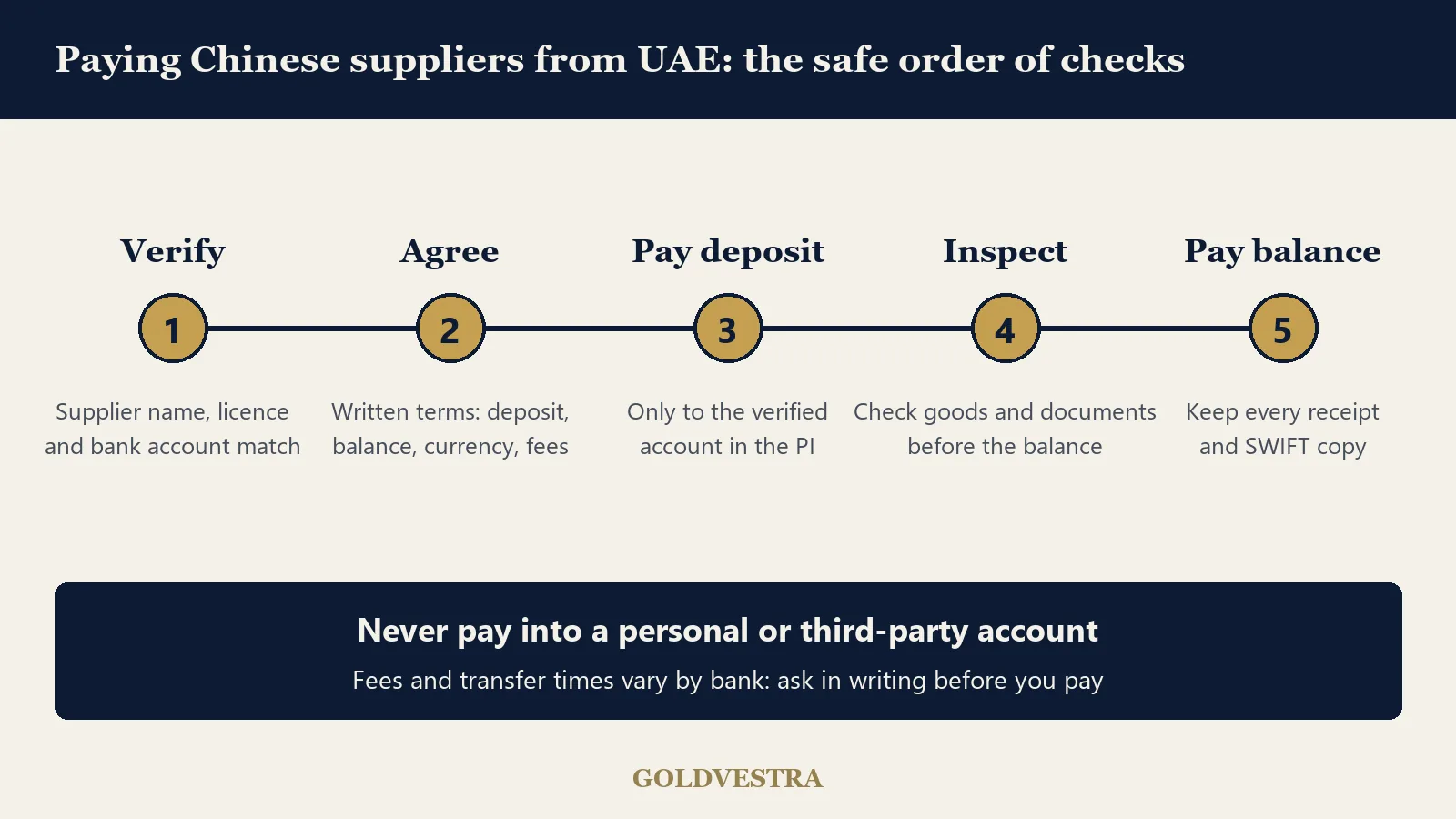
- Match the company name. The bank account must be in the supplier’s registered Chinese company name, the same name as on the contract, proforma invoice and business licence.
- Check the licence. Ask for the business licence and compare the company name and unified social credit code with the contract.
- Confirm bank details by a second channel. Call a number you found independently, not one from the email that carries the bank details.
- Put the terms in writing. Record currency, deposit, balance, charge option and the event that triggers the balance.
- Keep records. Save the invoice, the SWIFT copy and the supplier’s receipt confirmation for every payment.
Personal accounts and third-party accounts are the biggest warning. A genuine factory can usually pay from and receive into its own corporate account. Our guide to 9 red flags of supplier payment fraud goes deeper on this.
Deposit and balance structure for paying Chinese suppliers from UAE
Most factory orders are paid in two parts: a deposit when the order is confirmed and a balance later. The exact split is a negotiation, and it depends on the product, the supplier and your history together.
- Deposit: paid against the proforma invoice, before production starts.
- Balance: paid after you have seen the goods or the inspection result, and usually before the cargo is released or against copies of the shipping documents.
- Sample or tooling charges: ask whether they are inside the order price or separate and whether they are refundable.
A new supplier may ask for more upfront, while a long-standing one may offer easier terms. Use that in your negotiating with Chinese suppliers: a clean payment history is a reason to ask for better terms on the next order. For other structures such as letters of credit and open account, see payment terms in international trade.
Payment timing also connects to inspection and shipping. Our guide to importing from China to the UAE shows where each payment fits in the full process, and our Import from China page explains how we support importers on this route.
Fee and FX lines for paying Chinese suppliers from UAE
The transfer fee is rarely the whole cost. Before you pay, ask your bank or provider to list every line:
- Sending fee: the charge your bank applies per transfer.
- Intermediary fees: charges taken by banks in the middle of the chain, if any.
- Receiving fee: the charge the supplier’s bank applies, and who bears it.
- FX spread: the gap between the rate you receive and the market rate. It is often the largest hidden cost.
- Rate lock: whether the rate is fixed when you instruct the payment or when it is settled.
- Currency of the invoice: whether it is in USD, CNY or another currency, and who carries the conversion risk.
When paying Chinese suppliers from UAE, compare the total amount the supplier will receive, not only the headline fee. Ask the supplier to confirm the received amount against the invoice.
Red flags when paying a Chinese supplier from Dubai
Payment fraud usually shows up in the payment details, not in the product. Stop and verify if you see any of these:
- New bank details that arrive by email shortly before payment, especially if the supplier’s email style changed.
- An account name that differs from the company on the contract.
- A request to pay a personal account, a different company or a third country without a written reason.
- Pressure to pay today or lose the price.
- A refusal to sign a contract or to show a business licence.
- A price far below every other quote for the same specification.
If one of these appears, pause the payment and verify through a second channel. A genuine supplier will accept a short delay for a security check.
Frequently asked questions
What is the safest way to pay a Chinese supplier from the UAE?
No route is risk-free. A bank wire to the supplier’s verified corporate account suits trusted partners. Escrow-style protection suits first orders. Whatever you use, match the account name to the supplier’s registered company, confirm details by a second channel and keep every receipt.
Can I pay a Chinese supplier’s personal account?
It is risky and best avoided. The account should be in the supplier’s registered company name, matching the contract and invoice. A request for a personal or third-party account is a common fraud sign. If the supplier insists, ask for a written reason and verify it independently first.
How long does a T/T bank transfer to China take?
It varies by bank, currency, cut-off times, intermediary banks and public holidays in both countries. Your bank cannot promise a fixed time for every payment. Ask it for an estimate for your specific transfer and allow extra time before a production or shipping deadline.
What does a bank wire to a Chinese supplier cost?
Costs vary by bank. Ask for the sending fee, any intermediary and receiving fees, the charge option (OUR, SHA or BEN) and the FX spread. The exchange-rate margin is often the largest hidden cost, so compare the total amount the supplier receives.
How much deposit should I pay a Chinese factory?
There is no fixed rule. The deposit and balance split is negotiated and depends on the product, the order size and your history with the supplier. Agree it in writing on the proforma invoice and link the balance to inspection or shipping documents.
Is escrow better than a bank wire for a first order?
It can be, because funds are held until you confirm the order. But protection covers only orders paid through the platform and follows its rules, claim windows and limits. Read those terms first and never move the payment outside the platform.
Related reading
Payment Terms in International Trade
How advance payment, L/C and open account compare.
Supplier Payment Fraud: 9 Red Flags
Warning signs to check before you pay.
How to Negotiate with Chinese Suppliers
Tactics for price, terms and deposits.
How to Import from China to the UAE
The full process, step by step.
Placing an order with a Chinese factory?
Send us the product, quantity and supplier details. We will help you structure the sourcing and the supplier checks before you commit a payment.