

You are shipping samples or stand material to a Dubai trade show, and customs wants duty and VAT paid up front for goods you will take home again. An ATA carnet UAE process can avoid that cash burden, but only for the right goods and the right plan.
This guide explains how the ATA carnet UAE system works, what it covers, who issues it in Dubai, how customs release works and when a carnet is the wrong tool. It is general information, not legal or customs advice. Confirm every figure with Dubai Chambers or Dubai Customs before you ship.
In this article
- What an ATA carnet is
- What an ATA carnet UAE covers
- When an ATA carnet UAE is not suitable
- Who issues the ATA carnet UAE in Dubai
- 5 steps from application to closing
- Security deposit: sources differ
- How customs release works for an ATA carnet UAE
- Common ATA carnet UAE mistakes
- Frequently asked questions
What an ATA carnet is
An ATA carnet is an international customs document that lets you bring goods into a country temporarily without paying import duties and taxes at the border. The Dubai Chambers ATA carnet service page describes it as covering temporary import and export, typically for trade shows and exhibitions.
ICC calls it the “Passport for Goods” and says one document can cover several border crossings. Per ICC, the carnet is accepted in over 80 countries, though coverage differs by country.
Think of the ATA carnet UAE as a customs promise. You promise the same goods will leave again. A guarantee backs that promise, so customs does not need to collect duty at each border.
What an ATA carnet UAE covers
The ATA carnet UAE system follows the international model. ICC lists these goods as typical carnet cargo:
- stands, displays and products for trade fairs and exhibitions;
- commercial samples shown to overseas buyers;
- professional equipment such as cameras, instruments and tools for film crews, artists and engineers;
- sports gear and personal effects for athletes and teams.
For the UAE, the US International Trade Administration guide to UAE temporary entry adds that commercial samples for exhibitions must be distinguishable, match the exhibition and be in a quantity suited to the event.
Dubai Chambers also lists categories in its deposit calculator, for example non-electrical machinery, jewellery, electronic equipment and books. If your goods fit none of them, ask the Chambers before you plan the trip.
If you are still choosing what to show buyers, see our guide to requesting product samples from suppliers first. Samples you will give away or sell are a different case, covered next.
When an ATA carnet UAE is not suitable
An ATA carnet UAE is for goods that come back out. It is the wrong tool in four common cases:
- Goods you will sell. Goods sold locally need a normal import with duty and VAT paid. Under the temporary entry rules, goods that are sold, lost, stolen, damaged or distributed can trigger duties and fines.
- Perishable or consumable items. ICC excludes items that cannot be returned in the same condition, and the US guide excludes perishable or consumable goods meant for processing or repair.
- Partial shipments. The US guide states that partial shipments are not accepted under the ATA system, so list only what travels together.
- Long projects. Standard temporary admission is generally six months, renewable up to one year, per the US guide. Heavy machinery for projects follows separate rules, so ask customs about the right route.
If the goods will stay in Dubai and later leave for another market, read our guide to re-export from Dubai. It covers the other routes for cargo that passes through the UAE.
Who issues the ATA carnet UAE in Dubai
Carnets are issued by a national guaranteeing association in each country, as part of the ATA Carnet International Guaranteeing Chain. In Dubai, Dubai Chambers plays that role for the ATA carnet UAE, as its service page shows.
The page says both Chamber members and non-members can apply. It names two core documents: a commercial invoice and an authorisation letter for your representatives or agents. The Chambers may ask for more.
It also lists fees in AED, between 900 and 2,300 depending on membership and speed, with extra charges for additional countries. Treat those as a snapshot from October 2026 and check the current page before budgeting.
5 steps from application to closing
Here is the typical path for an ATA carnet UAE application, based on the Dubai Chambers page and the ICC process.
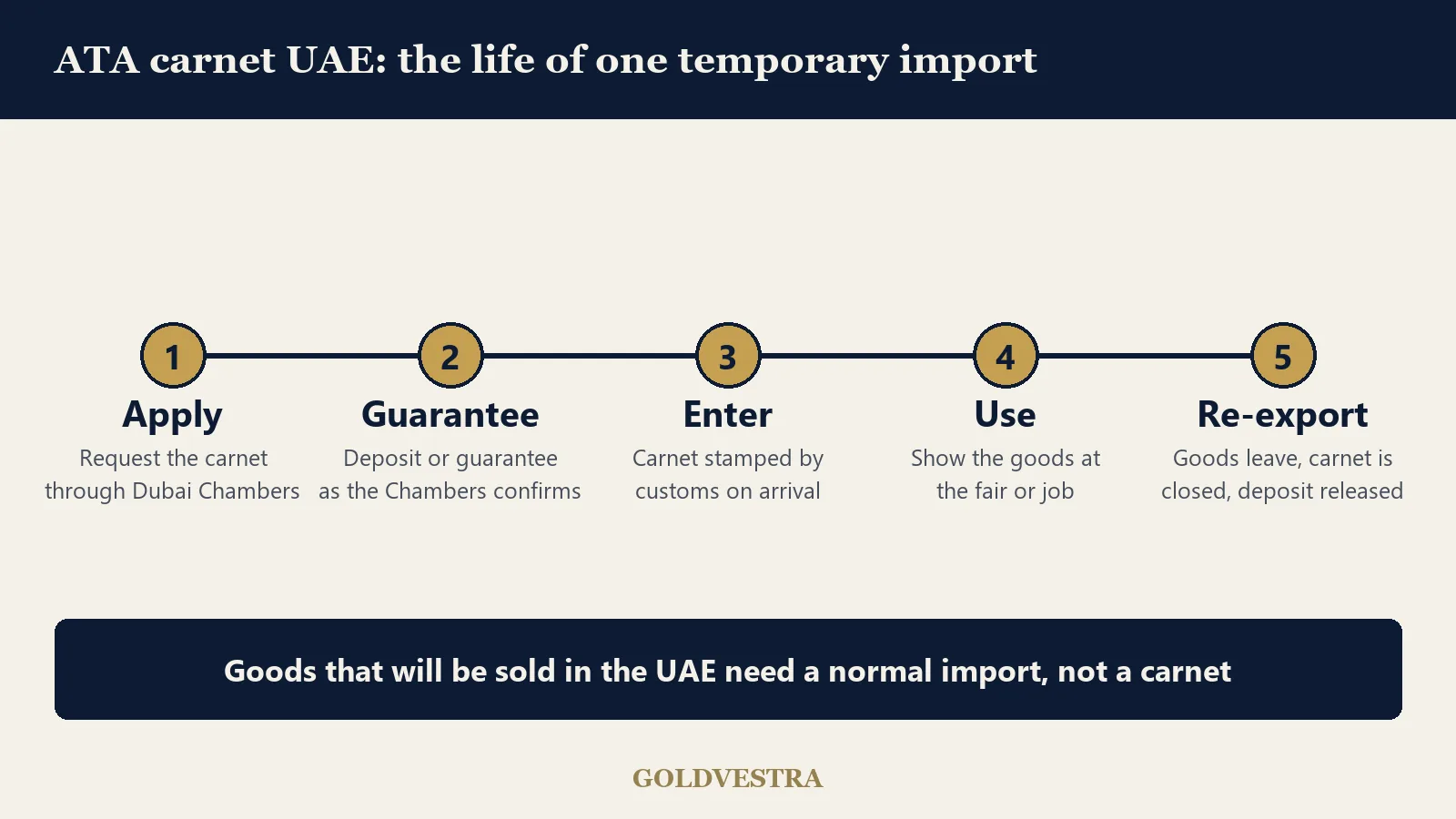
- Apply. Use the Dubai Chambers online services portal. Create an account, submit the invoice and authorisation letter, and list your goods.
- Wait for review. The Chambers states approval within two business days if the requirements are met.
- Provide the guarantee. Pay the fees and the deposit or guarantee the Chambers confirms for your case.
- Present the carnet. Show it to customs on entering and leaving each country, and keep the goods exactly as listed.
- Re-export and close. Return the goods within the validity period and return the carnet so the guarantee can be released.
Keep your invoices, packing list and ATA carnet UAE papers together. Our trade documentation checklist shows which other papers customs usually asks for.
Security deposit: sources differ
The ATA carnet UAE deposit is where published sources disagree, so do not rely on one article, including this one.
- The Dubai Chambers calculator uses total invoice value multiplied by total tax divided by 100. It says the final amount is shared when you submit the request and is refunded after the carnet is properly discharged.
- The US guide says companies must submit a cash or bank guarantee equivalent to the customs duties before approval.
- Other public statements have described holders as not needing to post a deposit with customs.
These may reflect different dates or different parties, such as the Chambers and customs. Ask Dubai Chambers for the exact amount for your goods in writing, and ask your clearing agent how it applies at the border.
How customs release works for an ATA carnet UAE
On arrival, customs checks the ATA carnet UAE against the goods before release. This sits inside the normal import flow described in our guide to customs clearance in Dubai.
The US guide says ATA goods can leave through any of the four customs offices, whatever the port of entry, in one or more consignments. Physical verification is required. It lists ATA carnet centres at Dubai Cargo Village, Jebel Ali, Dubai International Airport and Al Maktoum International Airport.
It also warns about two costs. Late re-export can incur a fine of 272 US dollars per week of delay, capped at 20% of the goods’ value. Processing outside normal business hours carries a AED 100 service charge per carnet.
If you need help lining up the paperwork and the freight dates, our trade documentation service and logistics coordination service are built for this kind of coordination.
Common ATA carnet UAE mistakes
Most ATA carnet UAE problems come from planning, not paperwork. Avoid these:
- Listing goods you may sell at the show. Decide first, or use a normal import.
- Booking freight before the carnet is approved.
- Sending partial shipments that do not match the general list.
- Missing the return date, which can bring fines.
- Assuming the deposit is zero without written confirmation.
Build a short check into every ATA carnet UAE plan: goods list, return date, deposit and exit port. Do it before the stand material leaves your warehouse.
Frequently asked questions
What is an ATA carnet in the UAE?
An ATA carnet is an international customs document that allows temporary import and export of goods without duties or taxes, typically for trade shows and exhibitions. In Dubai it is issued through Dubai Chambers. The goods must leave the country again within the validity period.
How long is an ATA carnet valid?
Dubai Chambers describes validity of up to one year, and ICC says a carnet can cover multiple trips within that time. The issuing association may shorten it. Always check the expiry date printed on your carnet and plan re-export well before it.
Who issues an ATA carnet in Dubai?
Dubai Chambers issues the ATA carnet in Dubai as the national guaranteeing association. Both members and non-members can apply through the online services portal. You submit a commercial invoice and an authorisation letter, and the Chambers may request more documents.
Do I need a security deposit for an ATA carnet in the UAE?
Sources differ. Dubai Chambers publishes a deposit calculation based on invoice value and tax, refundable after the carnet is discharged. Other sources mention a guarantee equal to duties or no deposit at all. Confirm the exact requirement with Dubai Chambers before you apply.
Can I sell goods brought in on an ATA carnet?
No, not under the carnet. Goods must be re-exported. If they are sold, lost, damaged or distributed, duties and fines can apply. To sell locally, you need customs approval, payment of duties and compliance with all other conditions. Plan a normal import for goods intended for sale.
Can I use a carnet for commercial samples?
Yes, for exhibitions. The US guide says exhibition samples must be distinguishable, match the exhibition and be in a quantity suited to the event. Samples you plan to give away or sell are not suitable. Ask customs if you are unsure about your goods.
Related reading
Re-Export from Dubai
How goods pass through the UAE and leave again.
Customs Clearance in Dubai
Steps and documents for release of cargo.
Trade Documentation Checklist
The papers traders prepare before shipping.
Planning a temporary import to Dubai?
Send us your goods list, event dates and ports. We will help you check the documents and shipping steps before the cargo moves.