You have found a product in China and a price that works. Now the real questions start. Who handles customs in the UAE? How do you pay a supplier you have never met? What will the goods really cost when they reach Dubai?
This guide shows how to import from China to UAE in seven clear stages, from supplier search to delivery. It is written for B2B buyers and first-time importers. It is general information, not legal or customs advice.
In this guide
- The short answer: how to import from China to UAE
- Before you start: licence, goods and rules
- Step-by-step: how to import from China to UAE (Dubai)
- China supplier payment: how to pay safely
- China to UAE shipping: sea, air and the right Incoterm
- Import duty from China to the UAE and other costs
- UAE customs clearance and delivery
- Common mistakes to avoid
- Frequently asked questions
The short answer: how to import from China to UAE
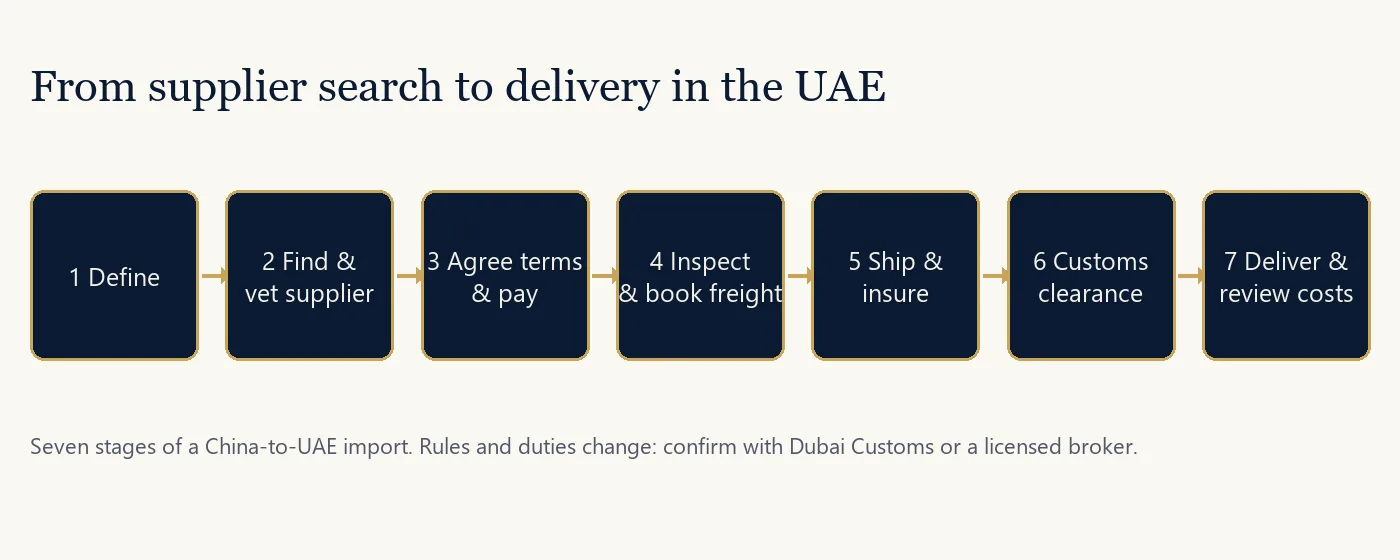
To import from China to UAE, you need a valid trade licence, a customs registration, a supplier you have vetted, a clear contract and a licensed customs broker. Then you ship the goods, clear them at a UAE port or airport, and pay duty and VAT where they apply.
The process is the same whether the goods land in Jebel Ali, Khalifa Port or Sharjah, but the paperwork details vary by product and by where you clear. Treat every rate and permit in this article as a starting point to confirm, not a final answer.
- Stage 1: define the product, quantity and HS code.
- Stage 2: find and vet suppliers.
- Stage 3: agree price, Incoterm and payment terms.
- Stage 4: inspect the goods and book freight.
- Stage 5: ship and insure the cargo.
- Stage 6: clear customs in the UAE.
- Stage 7: deliver, then compare real costs with your budget.
Before you start: licence, goods and rules
Do the groundwork first before you import from China to UAE. It prevents the most expensive surprises later.
Licence and customs registration
Importing for resale needs a trade licence that covers your goods. You also need a customs account with the authority of the emirate where you clear. Your choice between a free zone and a mainland licence changes duty treatment and where you can sell. Our guide to Dubai free zone vs mainland explains the trade-offs.
Check the product is allowed
Some goods need an import permit or conformity approval before they can enter. Others are restricted. Ask the relevant authority, or a licensed broker, about your product before you place an order. Electronics, food, cosmetics and chemicals are typical examples that need extra checks. For the electronics case, see our checklist for sourcing electronics from China.
Find the HS code
The Harmonized System (HS) code decides your duty rate and your documents. A wrong code can mean the wrong duty, delays or penalties. Read our guide to HS code classification before you finalise a quote.
Step-by-step: how to import from China to UAE (Dubai)
Here is the full path to import from China to UAE, in the order you will usually work through it.
Step 1. Define what you need
To import from China to UAE without surprises, write a short specification: product, materials, quantity, quality level, packaging and target landed cost. The clearer the brief, the more comparable the quotes. A written request for quotation keeps suppliers on the same page.
Step 2. Find and vet suppliers
Search through trade fairs, B2B platforms and referrals. Then verify. Check the business registration, ask for references, request samples and confirm that the factory exists. Our guide on how to vet international suppliers lists the checks to run. If you want help, see our global sourcing service for China.
Step 3. Agree the terms
Fix the unit price, minimum order quantity, lead time, quality standard and Incoterm in writing. Settle the payment method at the same time. The next two sections cover both.
Step 4. Inspect and book freight
Inspect before the goods leave the factory, not after they arrive. A pre-shipment inspection checks quantity, quality and packing against your order. Then book space with a freight forwarder.
Step 5. Ship and insure
Every order you import from China to UAE needs confirmed shipping documents and cargo insurance. Keep the bill of lading or air waybill safe, because you need it to claim the goods. Track the shipment until it reaches the UAE port.
Step 6. Clear customs
Your broker files the import declaration, pays duty and VAT where due, and arranges release. Details are in the clearance section below.
Step 7. Deliver and review
Move the goods to your warehouse or customer. Then compare real costs with your estimate. The gap tells you what to fix on the next order.
China supplier payment: how to pay safely
Payment is where many first orders to import from China to UAE go wrong. A supplier may ask for a large advance, and a buyer may want to pay only after delivery. The right method sits between the two.
| Method | How it works | Who carries more risk |
|---|---|---|
| Bank transfer in advance | You pay all or part before shipping | The buyer |
| Deposit plus balance | A deposit starts production; the balance is paid against shipping documents | Shared |
| Documentary collection | Banks pass documents; you pay or accept to receive them | Shared, leaning on the supplier |
| Letter of credit | A bank pays the supplier when the documents comply | Lower for both, with bank fees |
For a first order, a split between deposit and balance is common. Whatever you choose, pay only to a bank account in the supplier’s registered company name, and never to a personal account. The U.S. International Trade Administration also summarises these methods. Our full guide to international trade payment terms compares them in detail.
China to UAE shipping: sea, air and the right Incoterm
Sea freight or air freight
Sea freight suits heavy or bulky cargo and large orders. Air freight suits urgent, light or high-value goods. Many buyers who import from China to UAE use sea for stock and air for urgent replenishment. Our comparison of air freight vs sea freight helps you decide.
FCL or LCL
A full container (FCL) gives you the whole box. Less than container load (LCL) shares space with other cargo and suits smaller orders. Read FCL vs LCL shipping to see where the break-even sits.
Choose the Incoterm carefully
The Incoterm says who pays for freight, insurance and export clearance, and where the risk passes to you. For example, under FOB the supplier delivers the goods on board at the Chinese port, and you take over from there. Under CIF the supplier arranges freight and insurance to the UAE port. Learn the rules in our Incoterms guide for importers. For the route itself, see our import from China page.
Import duty from China to the UAE and other costs
Import duty from China to UAE shipments depends on several things. The trade.gov country guide lists them: whether the business is onshore or in a free zone, the nature of the goods, the source of the goods, trade agreements and other regulations. It also warns that tariffs and duties are revised often. Read its page on UAE import tariffs and check the current rate for your HS code with the customs authority or your broker.
Duty is only one part of your landed cost when you import from China to UAE. Build a full estimate before you commit:
- Product price from the supplier.
- Packing, inspection and export clearance in China.
- International freight and cargo insurance.
- Import duty and VAT, where they apply. The Federal Tax Authority publishes the VAT rules.
- Port, terminal, broker and documentation charges.
- Inland transport and storage in the UAE.
- Bank fees and currency conversion.
Customs value is commonly based on the cost of the goods plus freight and insurance to the UAE border, so a higher freight bill can raise duty too. Confirm the method with your broker. Our article on import cost factors shows how each line adds up.
UAE customs clearance and delivery
Customs clearance is the last legal step when you import from China to UAE: it turns shipped cargo into legally imported goods. A licensed clearing agent usually handles it for the importer.
Documents to prepare
- Commercial invoice with an accurate description, value and HS code.
- Packing list that matches the cargo.
- Bill of lading or air waybill.
- Certificate of origin, where required or useful.
- Import permits or conformity certificates for regulated goods.
Mismatches between these papers are a common cause of delay. Our international trade documentation checklist helps you check them before shipping.
What happens at the port
The broker lodges the declaration with the customs authority, which may inspect the cargo. After duty and VAT are settled and customs releases the goods, you collect them or arrange delivery. Dubai importers can find procedures and e-services on the Dubai Customs website. Other emirates have their own customs authorities.
Common mistakes to avoid
- Skipping the HS code check. It drives duty and permits.
- Paying 100% upfront to an unverified supplier.
- Ignoring inspection. Problems found in Dubai are expensive to fix.
- Budgeting only the product price. Freight, duty, VAT and fees can change the margin.
- Leaving the Incoterm vague. Unclear terms cause disputes over who pays.
- Assuming rules never change. Re-check duty and permits for every new product.
A simple rule helps when you import from China to UAE: do not pay the balance until the documents, inspection result and landed-cost estimate all agree with the order.
Frequently asked questions
How do I import from China to UAE for the first time?
Register your trade licence and customs account, define the product and its HS code, vet and contract a supplier, agree payment terms and an Incoterm, inspect the goods, book freight, and clear customs through a licensed broker. Confirm duty, VAT and any permits before you pay for the order.
What documents do I need to import goods from China to Dubai?
Most shipments need a commercial invoice, packing list and a bill of lading or air waybill. Some goods also need a certificate of origin, a conformity certificate or an import permit. Your customs broker confirms the exact list for your product before the cargo ships.
How much is import duty from China to the UAE?
It depends on the HS code, the value of the goods, and whether they clear onshore or in a free zone. Rates and rules for goods you import from China to UAE are revised from time to time. Check the official tariff or ask a licensed customs broker for your product before you quote a landed cost.
How long does shipping from China to the UAE take?
Transit time to import from China to UAE depends on the mode, port pair and schedule. Air freight is much faster than sea freight, but it costs more per kilogram. Add time for production, inspection, export clearance and UAE customs. Ask your forwarder for current schedules and build a buffer into your plan.
How should I pay a supplier in China?
Common options are bank transfer, documentary collection and letter of credit. For a first order, many buyers split payment between a deposit and the balance against shipping documents. Match the method to the supplier risk and the order value, and write the schedule into the contract.
Do I need a customs broker to import into the UAE?
Many importers use a licensed customs clearing agent because declarations, duty calculation and port procedures are technical. A broker can also flag restricted goods early. Whether you must use one depends on your set-up and the port, so confirm with the customs authority where you clear.
Related pages and articles
Import from China
Our route page to import from China to UAE.
Global Sourcing: China
Supplier search and sourcing support.
Sourcing Electronics from China
A checklist for electronics orders.
Import Cost Factors
What goes into your landed cost.
Planning to import from China to UAE?
Send us the product, quantity and destination. We will review the route and follow with a proposal.