Every year the same thing happens. A UAE buyer places an order in January, the supplier says the factory closes soon, and the goods reach Dubai weeks later than planned. For Chinese New Year 2027 importers the fix is early planning.
This guide explains the 2027 dates, how factories and ports usually behave, and when to lock orders, inspection and shipping space. It ends with a dated checklist you can send to your team and your suppliers.
It is written for UAE B2B importers and traders, and every Chinese New Year 2027 date in it is a planning aid. Closure lengths and cut-off dates vary, so confirm each one with your supplier and forwarder in writing.
In this article
- Chinese New Year 2027 dates
- What happens to factories and logistics
- Order cut-off timeline for importers
- The gap between production and shipping
- Pre-shipment inspection before the holiday
- Booking space: sea and air freight
- Post-holiday restart risk
- Dated checklist for Chinese New Year 2027
- What to ask your supplier in writing
- Frequently asked questions
Chinese New Year 2027 dates
Chinese New Year, also called Lunar New Year or Spring Festival, falls on 6 February 2027, a Saturday. The Hong Kong government general holidays calendar for 2027 lists 6 February as Lunar New Year’s Day, with further general holidays on 8 and 9 February.
Mainland China sets its own public holiday schedule by official announcement. Check it when it is published, because the mainland dates and the Hong Kong dates are not the same.
The celebration runs for about two weeks and ends with the Lantern Festival. For Chinese New Year 2027 importers, the impact is longer than the public holiday. Factories, ports and trucking all slow down before and after it.
What happens to factories and logistics
Many workers travel to their home towns before the festival. Factories often reduce output in the days before the holiday, then stop for a period that depends on the supplier.
Closure lengths vary. A large exporter may close for a short time. A small workshop may close for much longer. Never assume a standard figure: ask each supplier for its exact closing and reopening dates.
- Before the holiday: a rush of orders, tight production slots and fully booked cargo space.
- During the holiday: factories closed, few trucks, limited customs and port activity, slow replies.
- After the holiday: staff return in stages, some workers do not come back, and backlogs take time to clear.
The result is a supply chain that is crowded before 6 February and slow after it. Chinese New Year 2027 shipping plans must cover both ends. Plan for both ends, not only the holiday itself.
Order cut-off timeline for importers
The safest approach for Chinese New Year 2027 importers is to work backwards from the date goods must leave China. If you also need a general planning method, see our guide to procurement planning.
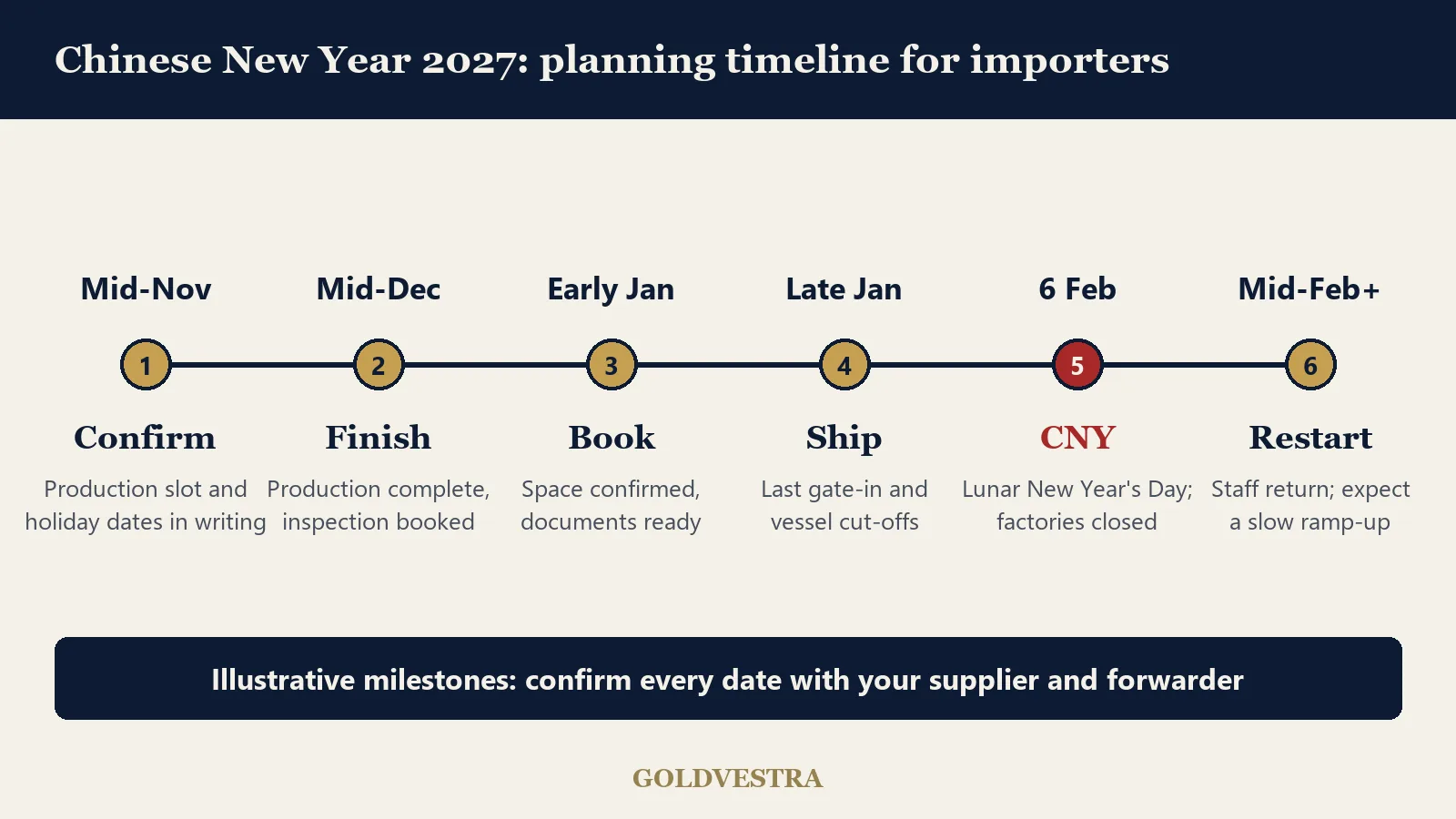
- Decide your target arrival date in the UAE. Count back through sea or air transit, port handling and customs clearance.
- Find the last vessel or flight you can realistically make. Your forwarder can tell you the cargo cut-off for that sailing.
- Subtract the time needed for inspection and trucking to the port. Leave a buffer for rework if the goods fail.
- Subtract production time. The remaining date is the latest day to place and confirm the order.
- Add a safety margin. Holiday weeks are not the time to run with zero slack.
If the maths says the order date has already passed, you have two choices. Reduce the order to what can be shipped in time, or accept that the goods will ship after the restart and plan stock to cover the gap.
The gap between production and shipping
Many Chinese New Year 2027 importers watch the production date and forget the shipping date. Finished goods still have to be packed, inspected, trucked to the port, cleared for export and loaded.
That gap is where holiday orders fail. A factory may finish on time, but if the cargo misses the last cut-off, it waits until after the holiday.
- Ask for a production schedule with a ready-to-ship date, not only a finish date.
- Agree who books the truck and who handles export documents.
- Check that packing lists and invoices are ready, so the cargo is not held for paperwork.
- For routing and mode, review air freight vs sea freight before you decide.
Our guide to import from China to the UAE covers the full process from supplier to your warehouse. It helps to know each step before you set the dates.
Pre-shipment inspection before the holiday
A pre-shipment inspection is more valuable than usual before the holiday. Factories under time pressure may rush the final steps. A failed lot found after the cargo has left is far harder to fix than one found at the factory.
- Book the inspector early. Inspection dates also fill up before the holiday.
- Schedule the inspection when production is nearly complete, so there is time for rework before the cut-off.
- Agree the inspection standard and sample plan with the supplier in advance.
- Do not release the balance payment until the report is accepted.
If a lot fails, you need a decision quickly: rework, partial shipment or delay. Build that decision time into your timeline. Otherwise a failed inspection becomes a post-holiday shipment by default.
Booking space: sea and air freight
Space for Chinese New Year 2027 cargo gets tight in the weeks before the holiday as many shippers move cargo at the same time. Carriers may adjust sailings, and rates often move up when demand is high. Treat any figure as a quote for that day only.
- Sea freight: ask your forwarder for the earliest booking window and the cargo cut-off for each sailing. Confirm the equipment is available at the loading port.
- Air freight: useful for urgent, high-value or light goods, but capacity and prices can also tighten.
- Split shipments: sending part of the order early can protect your stock, if the supplier can produce in batches.
Remember the extra charges that arrive in busy periods. Our guide to ocean freight surcharges explains the usual add-ons so you can compare quotes properly.
If you want help lining up supplier dates, inspection and space together, our international procurement service can coordinate the steps for UAE buyers.
Post-holiday restart risk
Do not assume work resumes on the first day after the holiday. For Chinese New Year 2027 importers, the restart is often the bigger risk. Factories restart in stages. Some staff return late, and some do not return at all, which can reduce output for a while.
Suppliers also have a backlog of orders from other customers. Your order may wait in a queue, even if you confirmed it before the break.
- Do not count on full production in the first weeks after reopening.
- Ask when raw material suppliers and sub-contractors restart, not only the factory.
- Expect ports and trucking to clear their backlog gradually.
- Keep safety stock for the period between 6 February and the first new arrivals.
This is also a good time to review supplier terms and lead times. If a supplier is repeatedly late, see our advice on negotiating with Chinese suppliers and consider a backup source.
Dated checklist for Chinese New Year 2027
These dates are planning milestones, not official deadlines. Shift them to fit your product, route and supplier.
| When | Action |
|---|---|
| Mid-November | Confirm closing and reopening dates with every supplier in writing. Review stock levels and open orders. |
| Late November | Place or confirm orders that must ship before the holiday. Get a production schedule with a ready-to-ship date. |
| Early December | Ask your forwarder for booking windows and cargo cut-offs. Book inspection dates. |
| Mid-December | Check production progress. Decide on split shipments if needed. |
| Early January | Run pre-shipment inspections. Prepare packing lists, invoices and export documents. |
| Mid January | Confirm space and the vessel or flight. Arrange trucking to the port. |
| Late January | Make the last gate-in. Keep records of shipment and tracking. |
| 6 February | Chinese New Year 2027 begins. Expect slow replies. |
| After the holiday | Confirm the restart date, ask for a new production schedule and re-check payment and shipping plans. |
Share this Chinese New Year 2027 table with your team and suppliers, and ask them to confirm each line in writing.
What to ask your supplier in writing
- What are the exact closing and reopening dates for the factory and for key sub-suppliers?
- What is the last day you can ship goods for this order?
- Can you produce and ship in batches?
- Who will answer messages during the holiday?
- What happens to my order and price if production slips past the holiday?
Keep the answers in your Chinese New Year 2027 order file. If the supplier is new, our import from China page explains how Goldvestra supports buyers sourcing from China.
Frequently asked questions
When is Chinese New Year 2027?
Chinese New Year 2027 falls on 6 February 2027, a Saturday. The celebration continues for about two weeks, ending with the Lantern Festival. Public holiday dates differ between mainland China and Hong Kong, so check the official calendar for the place where your supplier operates.
How long do Chinese factories close for Chinese New Year?
It varies by supplier. Some factories close for a short period, while smaller workshops may stay closed for much longer. Many also slow down before the holiday and restart in stages afterwards. Ask each supplier for exact closing and reopening dates in writing.
When should importers place orders before Chinese New Year 2027?
Work backwards from the last cargo cut-off. Subtract trucking, inspection and production time, then add a safety margin. For many orders this means confirming in the autumn, not in January. Your supplier and forwarder can confirm realistic dates for your goods.
Can I import from China during Chinese New Year?
Yes, but expect delays. Factories, trucking and some port services slow down, and replies take longer. Cargo that is already booked and ready may still move. New orders usually wait until after the restart, so plan stock to cover the gap.
Why do shipping delays continue after Lunar New Year?
Staff return in stages, factories work through backlogs and cargo piles up at ports. Carriers also adjust sailings around the holiday. The effect can last for weeks, so do not expect normal lead times straight after the break. Ask your forwarder for realistic transit times.
Should I inspect goods before Chinese New Year?
Yes. A pre-shipment inspection finds problems while the goods are still at the factory and time remains for rework. After the holiday, fixing a failed lot is slower and shipping space is harder to get. Book the inspector early and agree the standard first.
Related reading
Import from China to UAE
The full process from supplier to warehouse.
Pre-Shipment Inspection Guide
How to check goods before they ship.
Air Freight vs Sea Freight
Choosing the right mode for your cargo.
Procurement Planning for B2B Buyers
From specification to supplier choice.
Planning orders around Chinese New Year 2027?
Send us your product, quantities and target arrival date. We will help you line up supplier dates, inspection and shipping so your goods are not caught by the holiday.