
You have agreed a price with an overseas supplier, but neither side wants to move first. The supplier worries about not being paid. You worry about paying for goods that never arrive. A letter of credit for importers solves this by putting a bank’s promise between the two parties.
This guide explains how an import L/C works from the buyer’s side, which types exist, the steps from application to payment and the documentary discrepancies that delay payment. It also shows when an L/C is a better choice than a bank transfer (T/T).
It is general information, not banking or legal advice. Terms, fees and requirements differ by bank, so confirm every point with your bank before you apply.
In this article
How a letter of credit for importers works
A letter of credit (L/C), also called a documentary credit, is a written undertaking by a bank to pay the seller, as long as the seller presents documents that comply with the credit’s terms. Most banks apply the ICC’s UCP 600 rules to these credits. See the International Chamber of Commerce (ICC) trade finance page for the current rule set, and the US International Trade Administration guide to letters of credit for a plain overview.
Four parties appear in almost every import L/C:
- Applicant: you, the importer, who asks your bank to open the credit.
- Issuing bank: your bank. It opens the L/C and promises to pay if the documents comply.
- Beneficiary: the supplier or exporter who is paid.
- Advising bank: a bank in the supplier’s country that passes the L/C to the supplier and checks that it is authentic.
A fifth party is optional in a letter of credit for importers transaction. A confirming bank adds its own payment undertaking on top of the issuing bank’s.
The key idea is that banks deal in documents, not goods. Under UCP 600 the credit is separate from the sales contract. If the documents comply, the bank pays, even if you later dispute the quality of the shipment. That is why a letter of credit for importers works best alongside a clear contract and pre-shipment inspection.
Types of letter of credit for importers
Banks offer several forms of letter of credit for importers. The right one depends on your supplier, the order and the risk you want to cover.
- Irrevocable L/C: UCP 600 treats every credit as irrevocable, even if the text does not say so. It cannot be changed or cancelled without the agreement of the issuing bank, any confirming bank and the beneficiary.
- Confirmed L/C: the supplier’s bank adds its own undertaking. Suppliers ask for it when they worry about the issuing bank or the country. It usually adds a charge.
- Sight L/C: the bank pays when it finds the documents compliant.
- Usance (deferred payment) L/C: payment is made at a later date set in the credit, which can help your cash flow. Ask your bank how the credit must be worded.
- Transferable L/C: the beneficiary can transfer all or part of the credit to another party, such as an actual manufacturer. It must be stated as transferable.
- Standby L/C: a backup guarantee. The bank pays if you fail to pay, against a demand and a statement rather than shipping documents. It follows the ISP98 or UCP 600 rules, whichever the credit names.
Not every bank offers every type of letter of credit for importers, and some features need extra approval. Ask for the list your bank supports and the conditions for each.
7 steps of a letter of credit for importers
Here is the usual path of a letter of credit for importers, from contract to payment.
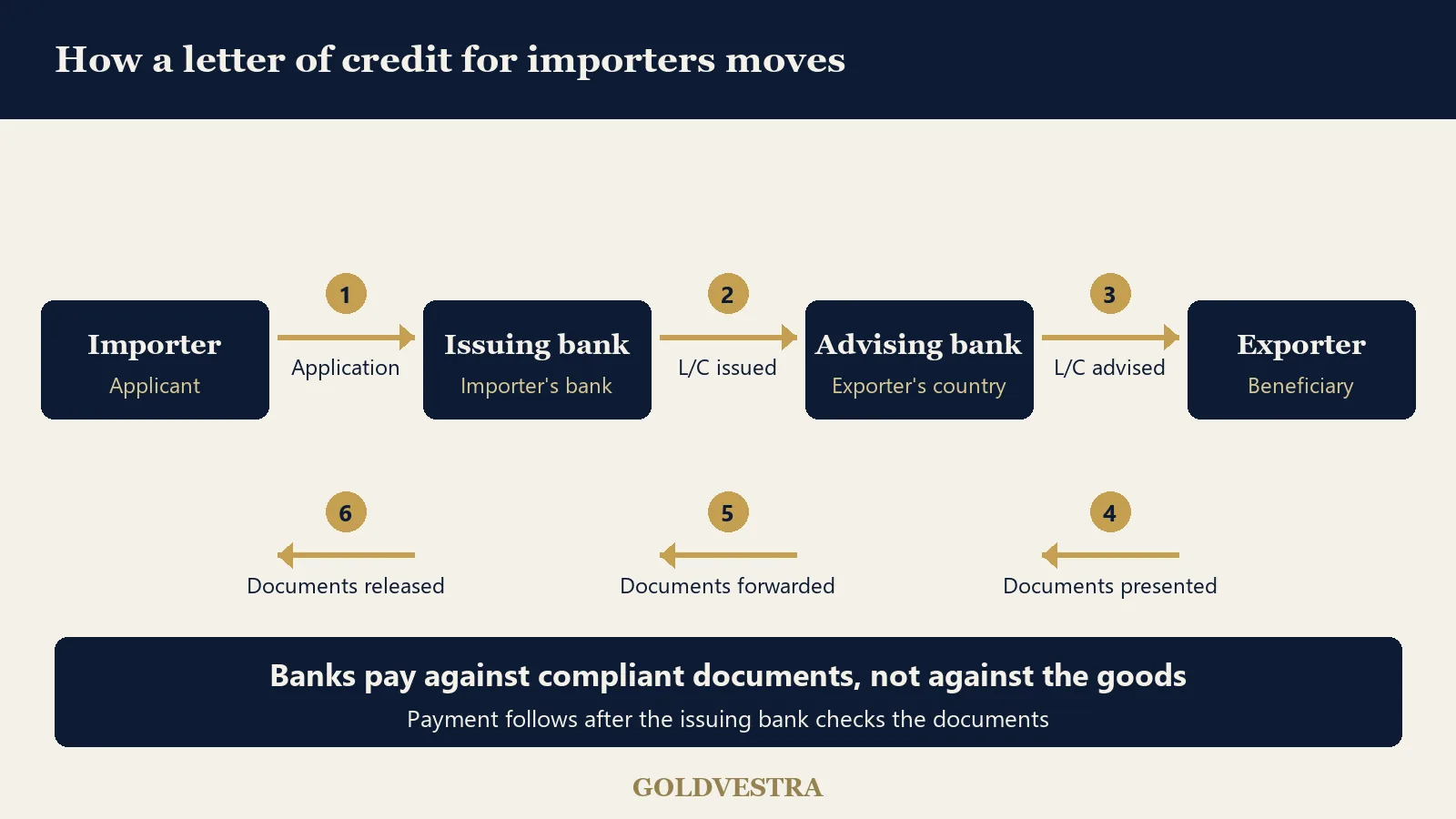
- Agree L/C payment in the contract. State the L/C type, currency, required documents, latest shipment date and expiry. See our guide to payment terms in international trade for how L/C compares with other terms.
- Apply to your bank. Submit the application with the contract or proforma invoice. The bank may review your credit line or ask for a margin deposit, so ask what it requires.
- Your bank issues the L/C. It sends the credit, usually by SWIFT, to the advising bank, which passes it to the supplier.
- The supplier checks the terms. If anything is wrong, the supplier requests an amendment before shipping. Each amendment needs the agreement of the parties.
- The supplier ships and presents documents. Under UCP 600 a presentation that includes transport documents must be made within 21 calendar days after shipment and before the credit expires, unless the credit says otherwise.
- The banks examine the documents. The issuing bank has a maximum of five banking days after presentation to decide whether they comply.
- Pay or refuse. If the documents comply, the bank pays at sight or at the agreed maturity. You then reimburse your bank and receive the documents needed to clear the goods. If they do not comply, the bank sends a refusal notice.
For each of these steps, the right paperwork matters. Our trade documentation service page explains what a clean document set looks like.
Documentary discrepancies that delay payment
On a letter of credit for importers, a discrepancy is a mismatch between the presented documents and the credit terms, the UCP 600 rules or other documents in the set. Banks examine documents on their face, so even a small typo can lead to refusal.
Common discrepancies on an import L/C include:
- Late shipment or late presentation: shipping after the latest shipment date, or presenting after the allowed period or expiry.
- Name or address mismatch: the invoice does not match the applicant or beneficiary details in the credit.
- Goods description: the commercial invoice description does not correspond with the credit.
- Amount or quantity: the invoice total, unit price or quantity differs from what the credit allows.
- Transport document problems: wrong port, missing on-board notation, unclear consignee or notify party.
- Missing or incomplete documents: a certificate of origin, packing list or insurance document that is absent, or fewer originals than required.
- Inconsistent data: weights, container numbers or dates that differ between documents.
What happens when documents are discrepant
The issuing bank must give a refusal notice that lists every discrepancy. The supplier can then correct the documents and present again before the credit expires. Alternatively, you can waive the discrepancies and accept the documents. Banks often charge a fee for discrepant presentations, so ask your bank.
Before you waive, check the goods and the shipping status. A waiver accepts the documents as they are. Our guide to 9 red flags of supplier payment fraud also shows why forged or altered documents deserve extra care.
Letter of credit for importers vs T/T: which is better?
| Factor | Letter of credit | Bank transfer (T/T) |
|---|---|---|
| Payment trigger | Compliant documents | Your payment instruction |
| Protection for you | Payment tied to documents and shipment terms | None built in once funds are sent |
| Assurance for supplier | Bank undertaking | Depends on trust and deposits |
| Effort | More paperwork and bank review | Simple and quick to arrange |
| Cost | Bank charges at several stages (ask your bank) | Transfer fee and FX margin |
| Best fit | New suppliers, large orders, higher-risk routes | Trusted suppliers and repeat or small orders |
A letter of credit for importers is worth the extra work for a first large order with a new supplier, or when the supplier will not ship without bank security. It lets you link payment to shipment documents instead of paying upfront.
T/T usually suits a trusted partner and smaller repeat orders, where the cost and effort of a letter of credit for importers are not justified. An L/C does not guarantee product quality, because banks check documents only. Pair it with inspection and, for Chinese suppliers, read our notes on paying Chinese suppliers from the UAE.
Checklist before you open a letter of credit
A little preparation avoids most problems with a letter of credit for importers.
- Get your bank’s terms in writing: application form, required documents, margin or credit-line rules and the fee schedule.
- Draft the document list with the supplier: ask only for documents the supplier can actually produce.
- Set realistic dates: latest shipment date, presentation period and expiry, including the place of expiry.
- Match documents to the Incoterm: for example, an insurance document is needed only when the chosen term makes the seller insure.
- Decide on confirmation: if the supplier asks for a confirmed L/C, ask your bank about the cost and who pays it.
- Review the draft and any amendment: each change costs time, so catch errors early.
- Use only bank channels: treat any L/C or document sent outside the banking system as a warning sign.
If you are still choosing suppliers or terms, our international procurement service page shows how we support importers, and you can request a quote to discuss your order. Always confirm rules and deadlines with your bank and the relevant authority.
Frequently asked questions
What is a letter of credit for importers?
It is a bank undertaking, issued at the importer’s request, to pay a supplier when the supplier presents documents that comply with the credit’s terms. It protects both sides: the supplier gets a bank promise, and the importer pays only against the required documents.
What is the difference between an issuing bank and an advising bank?
The issuing bank is the importer’s bank. It opens the L/C and undertakes to pay if documents comply. The advising bank is in the supplier’s country. It passes the L/C to the supplier and checks its authenticity, but it does not pay unless it also confirms the credit.
How long does the bank have to check L/C documents?
Under UCP 600, the issuing bank has a maximum of five banking days following the day of presentation to decide whether the documents comply. If it refuses them, it must send a notice stating each discrepancy. Confirm any local practice with your bank.
Who pays the letter of credit bank charges?
It depends on the sales contract and the credit’s terms. Commonly the importer pays the issuing bank’s charges and the supplier pays the other banks’ charges, but this varies. Agree it in the contract, and ask your bank for its full fee schedule in writing.
Is a standby L/C the same as a commercial L/C?
No. A commercial L/C is the main payment method, paid against shipping documents. A standby L/C is a backup guarantee, paid only if the applicant fails to pay or perform, usually against a written demand and statement. It follows ISP98 or UCP 600 if the credit says so.
Related reading
Payment Terms in International Trade
How advance payment, L/C and open account compare.
Supplier Payment Fraud: 9 Red Flags
Warning signs to check before you pay.
Paying Chinese Suppliers From the UAE
Wire, platform and escrow routes compared.
Trade Documentation
What a clean import document set looks like.
Planning an import with L/C payment terms?
Send us the product, quantity and supplier details. We will help you structure the sourcing and the document requirements before you commit to a payment method.