How to start import business in Dubai is a question with a short answer and a long checklist. The short answer: pick a product you can legally import, set up a licensed company, register with Dubai Customs, find a verified supplier and place a small first order.
Many first-time importers jump straight to suppliers. Then they discover that the licence activity, the product rules or the landed cost do not work. This plan puts the steps in a sensible order so you decide before you spend.
It is a general roadmap, not legal or tax advice. Fees and processing times change, so we point you to the official source instead of quoting numbers. For the registration step in detail, read our Dubai import export code guide.
In this article
- Dubai import business at a glance
- How to start an import business in Dubai: 7 steps
- Step 1: Choose a product you can import
- Step 2: Free zone or mainland
- Step 3: Trade licence and import code
- Step 4: Find and verify suppliers
- Step 5: Work out the import business cost
- Step 6: Plan your first import order
- Step 7: Ship, clear and deliver
- Common mistakes new importers make
- Frequently asked questions
Dubai import business at a glance
Dubai is a trading hub with ports, an airport, free zones and a large re-export market. That is why many people look at the import export business in Dubai as a first venture. The basics are the same everywhere, though: you buy goods abroad, bring them in legally and sell them for more than they cost.
What changes in Dubai is the paperwork and the choices. Before you start, understand the main moving parts:
| Part | What it means | Where to read more |
|---|---|---|
| Business set-up | A company with a trade licence that lists an import or trading activity | Dubai free zone vs mainland |
| Customs registration | A code that lets the company file import declarations | Dubai import export code guide |
| Product rules | Some goods are restricted or need a permit before import | UAE restricted imports |
| Landed cost | Everything you pay until the goods sit in your warehouse | import cost factors |
| Logistics | Freight, insurance, clearance and delivery | customs clearance in Dubai |
Treat these as five decisions, not one. The steps below take them in order.
How to start an import business in Dubai: 7 steps
This is the whole plan on one page. The rest of the article explains each step. Keep the diagram as a checklist.
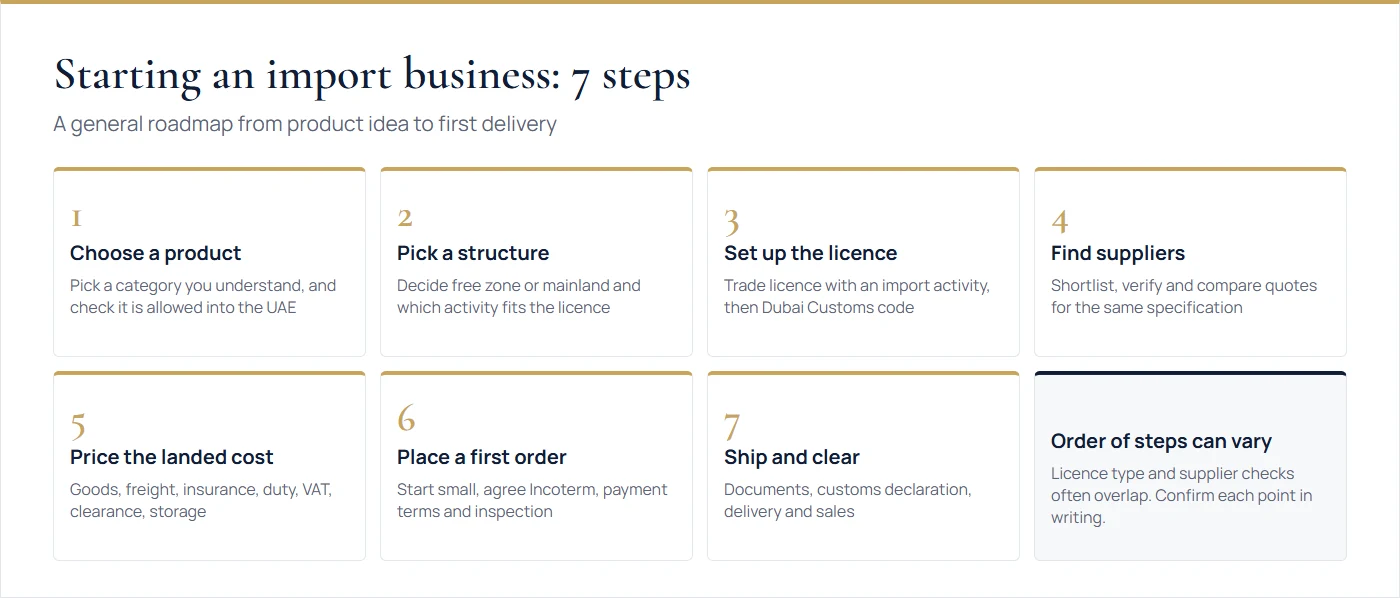
Some steps overlap. You can research suppliers while your licence is being processed. But do not pay a supplier before you know that your company can import the product.
Step 1: Choose a product you can import
Your product decides almost everything else: the licence activity, the permits, the shipping method and the margin. Start narrow. One product line is easier to price, source and sell than ten.
Check four things before you commit:
- Legality. Confirm the product is allowed into the UAE and whether it needs a permit. See our guide to UAE restricted imports.
- Demand. Identify who will buy it and through which channel: retail, wholesale or direct to businesses.
- Margin. Estimate a selling price, then work backwards to what you can afford to pay a supplier.
- Classification. Find the HS code for the product. It drives duty and permits.
Do not rely on guesses about demand. Talk to potential buyers, check what competitors sell and ask what they would pay. If you cannot name a buyer, you are not ready to order.
Step 2: Free zone or mainland
Your next decision is where the company is licensed. In Dubai, a company is licensed either by a free zone authority or by the mainland licensing department. For mainland companies, that is the Department of Economy and Tourism (DET).
Neither option is better for everyone. The right one depends on your product, your buyers and your storage needs. Our full comparison is in Dubai free zone vs mainland. Here is the short version:
| Question | Free zone | Mainland |
|---|---|---|
| Who issues the licence? | The free zone authority | Dubai Department of Economy and Tourism |
| Where are you based? | Inside the zone, in its offices and warehouses | Anywhere in Dubai that the licence allows |
| Selling to customers in the UAE | Rules differ by zone, so confirm how local sales work | Designed for trading with the local market |
| Good fit when | You store goods in the zone or mainly re-export | Most customers are in the UAE market |
Ask each authority in writing what your chosen activity allows, what it costs and what you need to submit. Do not assume that rules for one zone apply to another.
If you are unsure, a short trade consultation session can help you compare the options against your product plan.
Step 3: Trade licence and import code
A trade licence is the legal base of your import business. It lists the activities the company may carry out. Make sure the activity matches what you plan to import, because a mismatch can block registration or clearance later.
After the licence, you need a customs code to file declarations. This is a separate registration with Dubai Customs. Our Dubai import export code guide walks through it step by step, so we will not repeat it here.
In practice, the set-up phase looks like this:
- Choose the legal structure and the licence activity.
- Submit the application to the licensing authority and receive the licence.
- Open a business bank account, if your plan needs one for supplier payments.
- Register for the customs code with Dubai Customs.
- Check tax registration duties with the UAE Federal Tax Authority.
The order and the documents can vary with the structure and the activity. Always take requirements from the issuing authority, not from a third-party summary.
Step 4: Find and verify suppliers
A good supplier is the second half of an import business. Look for companies that can prove what they are. Our guide on how to vet international suppliers lists the checks in detail.
A simple supplier process looks like this:
- Write a specification so every supplier quotes the same product.
- Send a request for quotation to three or more suppliers.
- Compare quotes on the same Incoterm, so freight and risk are equal. See Incoterms.
- Ask about the minimum order quantity, lead time and packaging.
- Order product samples before you commit to a bulk order.
Be careful with offers that look too good, and with requests to pay in full before any proof of the goods. Match payment terms to documents and inspection, and keep everything in writing.
Step 5: Work out the import business cost
People often search for the import business Dubai cost as one figure. There is no single number. The cost depends on the structure, the product and the volume. The useful approach is to list every category and get a quote or an official fee for each.
There are two kinds of cost: the one-time cost of setting up, and the cost of each shipment.
| Cost group | What it covers | How to get a reliable figure |
|---|---|---|
| Company set-up | Licence, registration, office or flexi-desk, visas if needed | Written fee schedule from the licensing authority or free zone |
| Goods | Price paid to the supplier, per the agreed Incoterm | Supplier quote against your specification |
| Freight and insurance | Sea or air freight, cargo insurance | Quote from a freight forwarder |
| Duty and tax | Customs duty and VAT, depending on the product and code | Dubai Customs and the UAE Federal Tax Authority |
| Clearance and port charges | Broker fee, handling, terminal and storage charges | Quote from your clearing agent |
| Delivery and storage | Transport to your warehouse and storage until sale | Quote from a local carrier or warehouse |
Add the groups above for one shipment and you have the landed cost. Divide it by the number of units to get the cost per unit. Our guide to import cost factors explains each part. The U.S. International Trade Administration overview of UAE import tariffs gives background on how tariffs are applied.
Keep a buffer. First shipments often cost more than expected because of small items such as storage days or document fixes.
Step 6: Plan your first import order
Your first import order should teach you the process at a low risk. Do not start with the largest order you can afford.
- Start small. Order the smallest quantity that still gives a usable test of the market.
- Agree terms in writing. Specification, price, Incoterm, delivery date and payment schedule.
- Plan inspection. Have the goods checked before they ship. See our pre-shipment inspection guide.
- Prepare documents. Use the trade documentation checklist to make sure nothing is missing.
- Book freight early. Ask your forwarder about timing and the shipping method.
After delivery, compare the actual landed cost with your estimate. That gap tells you whether the margin works and what to fix in the second order.
Step 7: Ship, clear and deliver
When the goods are on their way, the importer of record has to file a customs declaration and pay any duty and tax. Most new importers use a licensed clearing agent for this. Read customs clearance in Dubai to see the stages, from arrival to release.
The core documents are normally:
- Commercial invoice and packing list.
- Bill of lading or air waybill.
- Certificate of origin, where it applies.
- Permits for regulated goods.
Dubai Customs publishes answers to common questions in its Dubai Customs FAQ. For a coordinated service across freight and clearance, see our import and export coordination page.
Common mistakes new importers make
- Choosing the product last. The product decides the licence activity and the permits.
- Paying a supplier before the set-up is clear. Check that you can import the goods first.
- Ignoring landed cost. The supplier price is only one part of what you pay.
- Skipping samples and inspection. Problems are cheaper to fix before shipping.
- Relying on summaries instead of official sources. Fees and rules change.
- Starting too big. A small first order limits the damage of a mistake.
Most of these come down to the same habit: decide on paper first, spend second.
Frequently asked questions
How do I start an import business in Dubai as a beginner?
Choose a product you can legally import, then decide between a free zone and mainland licence. Obtain a trade licence with an import activity, register for a customs code, verify suppliers and price the landed cost. Start with a small first order before you commit to bulk volumes.
Do I need a licence to import goods into Dubai?
Yes. To import commercially, you normally need a company with a trade licence that lists the right activity, plus a customs code to file declarations. The issuing authority depends on whether you choose a free zone or mainland. Confirm the exact requirements with that authority before you apply.
Is a free zone or mainland better for an import business?
Neither is better for everyone. Free zones suit businesses that store goods in the zone or mainly re-export. Mainland suits those who sell mainly to customers in the UAE market. Compare the licence activity, storage and customer needs, and ask each authority for the rules in writing.
How much does it cost to start an import business in Dubai?
There is no single figure. Cost depends on the structure, licence activity, product and shipment size. Break it into set-up fees, goods, freight, insurance, duty, tax, clearance and storage. Request written fee schedules from the licensing authority and quotes from forwarders and clearing agents.
What is the first step before placing my first import order?
Confirm that your company can legally import the product. Check the licence activity, the customs code and any permit the goods need. Then verify the supplier, agree the specification and terms in writing, and request samples. Only then place a small first order.
Can I run an import business in Dubai without a warehouse?
Often yes, at the start. Many importers use third-party storage or have goods delivered straight to the customer. Choose storage to fit your product and volume. Check whether your licence and the free zone or mainland location allow the storage and delivery model you plan to use.
Related reading
Dubai Import Export Code
How to register for the code that lets you file declarations.
Dubai Free Zone vs Mainland
Compare the two licence routes for your product.
Import Cost Factors
Every cost between supplier and warehouse.
Customs Clearance in Dubai
The stages from arrival to release.
Ready to plan your first import?
Tell us the product, the quantity and where you want it delivered. We will review the plan and follow with a proposal.